
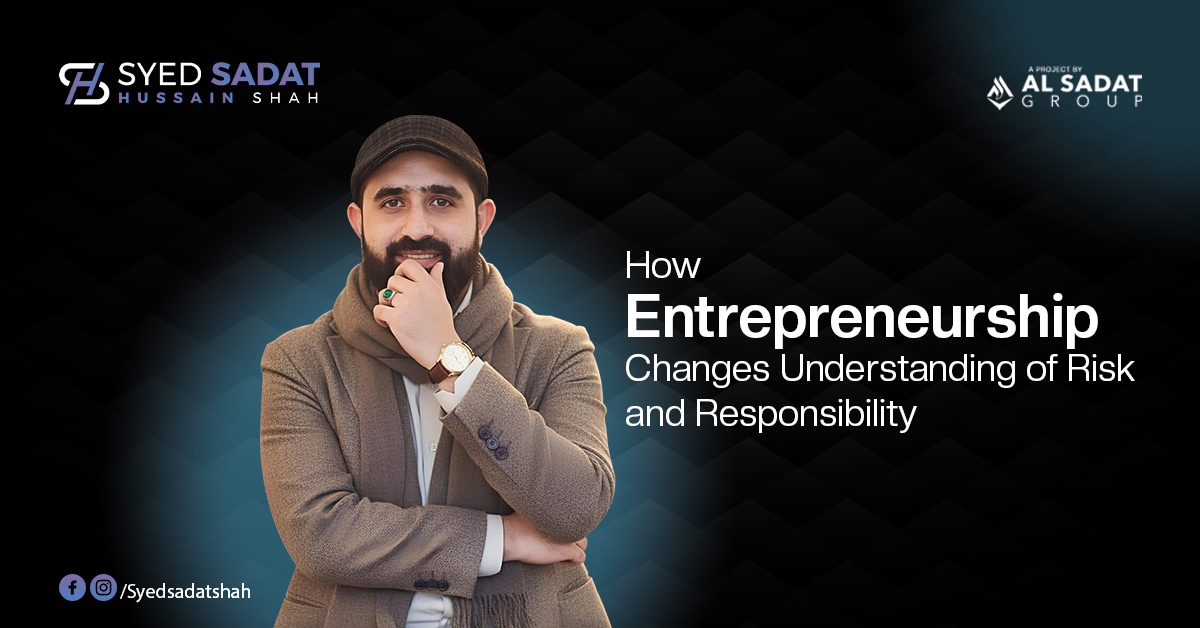
Most people think entrepreneurship is about making money. I understand why — the headlines focus on valuations, exits, and revenue milestones. But after years of building and managing businesses across real estate, hospitality, and civic-facing work, I’ve come to see it differently. Entrepreneurship is really an education in responsibility. It teaches you to make decisions under uncertainty, to answer for the consequences, and to think about people who never show up on a balance sheet.
How Entrepreneurship Changes the Way You View Risk
Early on, risk feels emotional. You take a chance because it feels right, or because the alternative feels worse. That approach rarely survives contact with a second or third venture.
What replaces it is calculated risk — the discipline of weighing what you can afford to lose against what you stand to learn, even if the outcome doesn’t go your way. I’ve made decisions that didn’t work out. What mattered wasn’t avoiding failure; it was building a habit of long-term thinking so that one bad quarter never dictated the next five years.
Uncertainty doesn’t go away as a business matures. What changes is how you carry it. You stop expecting certainty and start building decisions that hold up even when conditions shift — a mindset closer to risk management than gambling.
Responsibility Grows With Every Decision
Every business decision widens the circle of people it affects. In the beginning, a decision might only touch you. Later, it touches employees who depend on steady work, customers who trusted you with their money, partners who structure their own plans around yours, and communities that live alongside whatever you build.
That widening circle is where real accountability starts. Ethical decision-making stops being an abstract value and becomes a practical constraint on every choice you make. I’ve written before about the lessons from managing multiple businesses across sectors, and the pattern holds regardless of industry: the more responsibility you’re given, the less room there is for shortcuts. Sustainable business thinking isn’t a slogan — it’s what’s left once you’ve accounted for everyone a decision touches.
Why Responsible Entrepreneurs Build Stronger Communities
Responsible entrepreneurship does more than generate profit. It creates employment that gives people stability. It drives innovation that solves real problems rather than manufactured ones. And when it’s done with a long-term view, it contributes to community development that outlasts any single project or product cycle.
I’ve seen this firsthand across different sectors — real estate that considers the neighborhood it’s built in, hospitality that treats service as a daily discipline rather than a policy, and civic-facing work that measures success by impact rather than headlines. None of that happens by accident. It happens because responsible leadership treats long-term value and positive social impact as part of the business model, not an afterthought to it.
My Perspective on Entrepreneurship
If I had to summarize what years of managing different businesses have taught me, it comes down to this: entrepreneurship rewards people who take responsibility seriously, not just people who take risks boldly. I’ve operated across industries with very different rhythms — construction timelines that test patience, hospitality demands that test consistency, and community-facing projects that test judgment. Each one sharpened a different part of how I lead.
One belief has stayed constant through all of it — consistency in long-term success matters more than motivation. Motivation gets a project started. It’s consistency that gets it finished, and responsibility that determines whether it was worth finishing in the first place. I’d rather build something slower and defend every decision behind it than move fast and leave a mess for someone else to clean up.
Conclusion
Entrepreneurship, at its core, isn’t a shortcut to wealth. It’s a long apprenticeship in responsibility — toward risk, toward the people your decisions affect, and toward the kind of leader you’re becoming along the way. The founders and business owners who last aren’t the ones who avoided every mistake. They’re the ones who let each decision teach them to be more accountable than the one before it. That, more than any single success, is what entrepreneurship actually builds.