
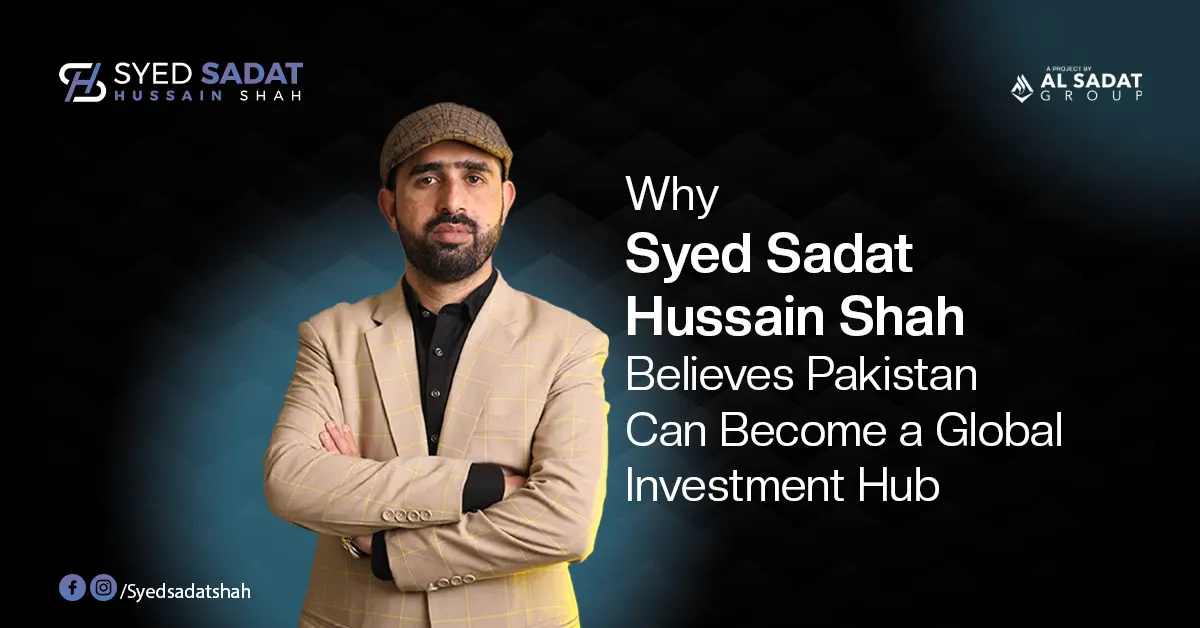
Most people who have never visited Pakistan imagine a country defined by its challenges. Syed Sadat Hussain Shah saw something different. He sees a country on the cusp of a real economic transformation — one that investors around the world are just beginning to see.
His view was not built on mere optimism. It is built on data, on ground-level experience in Pakistan’s real estate sector, and on a clear reading of where the country stands compared to its peers in the emerging market world.
“Pakistan is not a future opportunity,” he said more than once. “This is a now. Investors who act early will define the next decade.“
A Country With More Economic Weight Than Its Coverage Suggests
Pakistan is the fifth largest country in the world. It has a GDP that ranks in the top 25 globally by purchasing power parity. Its consumer market is large, its middle class is growing, and its agricultural and industrial base — though still underdeveloped relative to its potential — remains vital.
What has constrained Pakistan’s investment opportunities in the past is not capacity. This is understanding. Syed Sadat Hussain Shah argues, with great force, that this gap between perception and reality is precisely where the value of investment lies.
Countries such as Vietnam, Indonesia, and Bangladesh were omitted from the global capital market at earlier stages of their development. Investors who got in early — in real estate, in manufacturing, in infrastructure — generated returns that would never be achieved in more mature markets.
Also Read: Syed Sadat Hussain Shah on Building a Stronger Global Image for Pakistan
Pakistan’s economic growth trajectory, when stripped of political noise, points in one direction. The fundamentals are there. What the market needs is confidence — and confidence comes from credible voices making the case.
Real Estate as the Clearest Entry Point
Of all the sectors open to investors in Pakistan, real estate investment in Pakistan stands out for one simple reason: the supply and demand gap is huge and unlikely to close quickly.
Pakistan’s urban population is growing faster than its cities can handle. Islamabad, Lahore, Karachi, and second-tier cities like Faisalabad and Peshawar all face housing shortages running into hundreds of thousands of units. That imbalance doesn’t resolve overnight.
Syed Sadat Hussain Shah has spent years working at the intersection of this gap — identifying locations where infrastructure investment, demographic pressure, and regulatory clarity align. His view is that Pakistan’s booming real estate market offers a risk-return profile that is difficult to find elsewhere in Asia at the moment.
High ROI property in Pakistan is not a marketing phrase. In corridors where infrastructure is developing and tourism is soaring, capital appreciation is ahead of most conventional investment options available to Pakistani investors.
Geography That Cannot Be Replicated
Pakistan sits at a rare convergence of trade routes. It borders China, India, Iran, and Afghanistan. It connects Central Asia to the Arabian Sea. The China-Pakistan Economic Corridor — whatever its political complications — has already delivered real infrastructure: roads, ports, power generation, and logistics networks.
It’s not a soft advantage. For investors thinking in 10- and 20-year time horizons, Pakistan’s geographical position is a structural asset. Business opportunities in Pakistan linked to regional trade, logistics, and real estate close to the corridor are growing more attractive as the infrastructure matures.
The Workforce Advantage and the Foreign Investment Window
Pakistan’s median age is under 23. More than 60% of the population is under 30. This is the demographic profile that powered South Korea’s industrial rise and that is currently driving growth across Southeast Asia.
For foreign investment in Pakistan, this matters in two ways. First, it means a large and relatively affordable labour force available for manufacturing, services, and technology. Second, it means a domestic consumer market that will grow significantly as this cohort enters peak earning years.
Syed Sadat Hussain Shah points to this demographic reality as perhaps the most underappreciated element of Pakistan’s investment case. “You cannot manufacture a young population,” he notes. “Pakistan has one. That is a 20-year tailwind that no policy mistake can fully undo.”
The Vision: Confidence Before the Crowd
Syed Sadat Hussain Shah is not saying that Pakistan does not have problems. He was specific on the challenges: governance reform, regulatory consistency, monetary stability, and investor protection frameworks all need work. What he says is clear.
But his argument — and it’s a serious one — is that these are solvable problems in a country that has the underlying assets to support real economic growth. The question is not whether Pakistan can attract global investment. It is whether investors will move in early enough to benefit from it.
His vision for the future of Pakistan’s investment is not abstract. These are based on specific sectors, specific locations, and specific development timelines. Real estate. Tourism corridors. Infrastructure-proximity development. Youth-driven consumer markets.
“The countries that become investment hubs do not wait for the world to discover them. Someone has to make the case first. That is what I intend to do.” — Syed Sadat Hussain Shah
That clarity of purpose is what separates a thought leader from a commentator. Syed Sadat Hussain Shah is making a bet on Pakistan — an informed, experienced bet — and he invites serious investors to take a closer look before the window that now exists begins to close.