
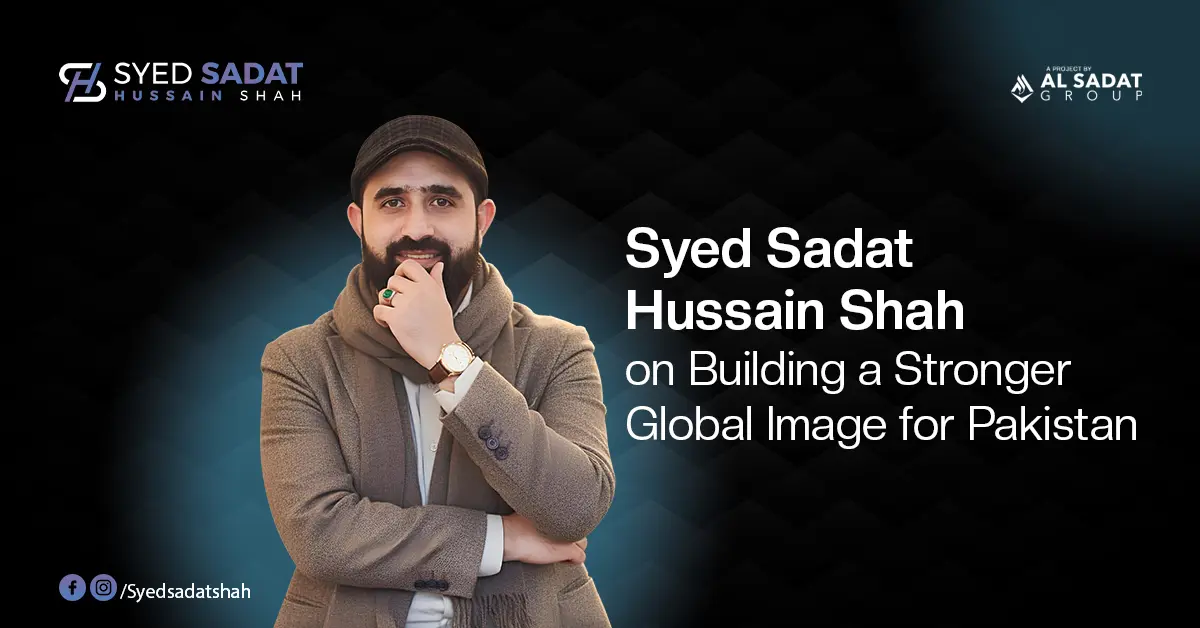
Pakistan is a country whose story is rarely told by its own people. For decades, the international narrative has been shaped by outside voices — often incomplete, often unfair, and almost never reflective of the Pakistan that its 240 million citizens actually live in.
Syed Sadat Hussain Shah believes it is time for that to change. Not through press releases or government campaigns, but through genuine, ground-level effort — by equipping Pakistan’s young people to carry the country’s real story to the world.
“The global image of a nation is not built in foreign ministries alone. It is built by every student, professional, and leader who represents Pakistan with integrity and confidence.”
This is the foundation of his thinking on Pakistan’s global image building initiatives — not a top-down communication exercise, but a generational shift in how Pakistanis see themselves and how the world, in turn, sees them.
Soft Power Is Pakistan’s Most Underused Asset
Hard power — military and economic — gets the headlines. But nations that build lasting international respect do it through soft power: culture, education, values, and the credibility of their people on the world stage.
Pakistan has enormous soft power potential. A rich cultural heritage, a young and capable population, a diaspora spread across every major economy, and a geographic position that connects South Asia, Central Asia, and the Middle East. These are not small advantages.
Also Read: Why Syed Sadat Hussain Shah Calls Youth Pakistan’s Greatest Strength
Syed Sadat Hussain Shah’s view on Pakistan soft power development is straightforward: the assets exist, but they need to be activated. That means investing in leadership, building platforms for Pakistani voices internationally, and ensuring that the country’s achievements — in technology, the arts, academia, and entrepreneurship — are visible globally.
Youth as Pakistan’s Global Ambassadors
No demographic carries more weight in Pakistan’s future than its young people. Over 60% of the population is under 30. That is not a demographic challenge — it is a strategic advantage, if the right foundations are in place.
Youth leadership for Pakistan’s international image is not about sending delegates to conferences. It is about building a generation that is globally literate, professionally credible, and deeply proud of where they come from.
When a Pakistani engineer contributes to a breakthrough abroad, when a Pakistani writer publishes internationally, when a Pakistani entrepreneur builds something the world uses — each of these is an act of nation branding. The cumulative effect of thousands of such contributions is more powerful than any single campaign.
Syed Sadat Hussain Shah’s work is oriented toward creating the conditions for exactly this — through mentorship, platform-building, and advocacy for Pakistani talent at every level.
Strategy: From Perception to Reality
Improving the international perception of Pakistan requires more than better storytelling. It requires the substance to back it up. That means education reform that produces globally competitive graduates. It means governance standards that earn international confidence. And it means cultural diplomacy that presents Pakistan’s heritage — from the Indus Valley to Gandhara to Lahore’s Mughal architecture — with the pride it deserves.
On digital platforms specifically, youth-driven diplomacy in Pakistan is already happening organically. Pakistani creators, commentators, and professionals are building audiences and changing perceptions every day. The gap is in coordination and support — connecting individual effort to a coherent national narrative.
Syed Sadat Hussain Shah advocates for a structured approach to global representation: one that supports Pakistani voices in international media, elevates civic and professional achievement, and builds lasting bridges between Pakistan and the global community.
The Work Ahead
Rebuilding a nation’s global image takes time. It is not done in one election cycle or one campaign season. It is done through consistent, credible action — by leaders who understand both the challenge and the responsibility.
Syed Sadat Hussain Shah’s perspective on nation branding from a Pakistani standpoint is rooted in that patience. The goal is not to win a news cycle. It is to build something durable — a global perception of Pakistan that reflects the country’s actual people, potential, and purpose.
That work is already underway. And with the right leadership, the right investment in youth, and the right commitment to authentic representation, Pakistan’s global standing is not a distant hope. It is a buildable reality.