
Pakistan’s defining asset is not beneath its soil or behind its borders. It is sitting in classrooms, workshops, and small offices across the country, in the form of a generation larger than most nations will ever produce. More than sixty million Pakistanis are between fifteen and twenty-nine years old, roughly a quarter of the country’s population, entering a labor market that adds close to two million new workers every year. Whether that scale becomes the foundation of a stronger Pakistan or a source of mounting strain depends on a single, underappreciated variable: leadership.
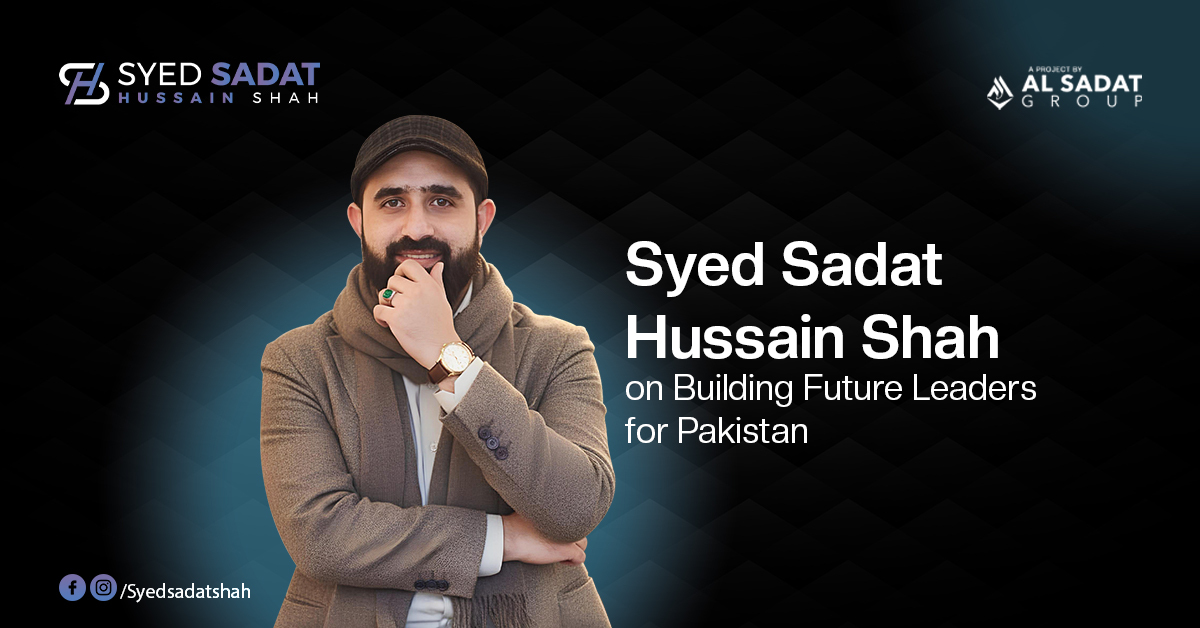
That is the conviction at the center of Syed Sadat Hussain Shah’s public commentary on national development. As Chairman of Al Sadat Group, he has approached the youth question less as a charitable cause and more as an infrastructure problem, one as consequential to Pakistan’s future as energy, water, or transport. “We do not have a shortage of talent in this country,” he has argued. “We have a shortage of structured pathways for that talent to become leadership.”
| “A nation does not run out of young people with ambition. It runs out of patience for building the systems that turn ambition into leadership.” |
The Vision: Why Youth Sit at the Center of Pakistan’s Future
Syed Sadat Hussain Shah’s thinking on leadership departs from a premise that is easy to state and hard to act on: a country’s institutions are only as capable as the people who will eventually run them. Pakistan has spent decades debating policy, governance, and reform at the level of structures, ministries, regulations, frameworks, while paying comparatively little attention to who will actually staff and lead those structures a decade from now.
“Every reform conversation in this country eventually runs into the same wall,” he has observed. “We design excellent policy and then discover we don’t have enough people prepared to execute it with judgment, integrity, and follow-through. That is not a policy failure. That is a leadership pipeline failure.”
This is the long-term transformation mindset that runs through his public remarks: leadership development is not a parallel track to economic growth, it is the precondition for it. A young population without leadership infrastructure is a missed opportunity. A young population with it becomes, in his words, “a compounding national asset, the kind other countries spend a generation trying to manufacture and we already have, if we choose to build around it.”
Also Read: Syed Sadat Hussain Shah on Turning Youth Potential Into National Strength
The Leadership Crisis and the Opportunity Inside It
Pakistan’s Labour Force Survey data gives this argument its sharpest edge. National unemployment has climbed gradually over recent years, but the burden falls unevenly: youth joblessness runs well above the national average, and urban unemployment, where most young job-seekers are concentrated, sits markedly higher than in rural areas. Behind those numbers is a deeper structural mismatch between what the education system produces and what a modern economy actually requires.
- A skills gap: graduates entering the workforce with credentials that do not align with what employers in technology, manufacturing, and services are actually hiring for
- A mindset gap: an education system still oriented around rote achievement rather than initiative, problem-solving, or the willingness to take ownership of outcomes
- An opportunity gap: limited access to mentorship, capital, and networks outside Pakistan’s largest cities, leaving talent concentrated where it happens to be born rather than where it could be most useful
Shah is careful to frame this as solvable rather than fatalistic. “A skills gap is a curriculum problem. A mindset gap is a training problem. An opportunity gap is a distribution problem,” he has said of the distinction. “None of these are mysteries. They are choices about where we invest attention and resources, and so far, leadership development has not been one of those choices at the scale this moment requires.”
His argument is that structured leadership training, deliberately built rather than left to chance, is what converts each of these gaps from a liability into a point of intervention. Skills can be taught. Mindset can be cultivated through exposure and mentorship. Opportunity can be distributed more evenly if institutions choose to build the pathways for it.
A Framework for Building Future Leaders
Across his public commentary, Syed Sadat Hussain Shah returns to a consistent set of pillars when describing what leadership development should look like in practice. He has been careful to frame these less as a fixed program and more as principles he believes any serious national effort must contain.
Education Paired with Mindset Development
“A transcript tells you what someone has memorized. It does not tell you how they think under pressure, or whether they take responsibility when something goes wrong,” he has noted. His view holds that technical education must be paired deliberately with mindset development, the habits of ownership, resilience, and judgment that determine whether knowledge becomes leadership.
Entrepreneurship Exposure
Syed Sadat Hussain Shah is explicit that he does not see entrepreneurship as a replacement for formal employment at national scale; Pakistan’s youth bulge is too large for startups alone to absorb. Rather, he frames entrepreneurial exposure as a mindset-building exercise, teaching young people to identify problems, take initiative, and bear responsibility for outcomes, skills that translate directly into stronger employees, managers, and public servants, not only founders.
Ethical Leadership Values
“Competence without character builds organizations that eventually collapse,” he has argued, placing ethical grounding alongside technical capability as a non-negotiable component of any leadership pipeline. In his framing, integrity and accountability are not soft additions to leadership training; they are what determines whether capable people use their capability to build institutions or to extract from them.
Innovation-Driven Thinking
He has described innovation less as a buzzword and more as a discipline: the habit of questioning inherited processes and asking whether there is a better way to solve a given problem. In his view, instilling this habit early, in students and young professionals alike, is what allows a country to compete globally rather than simply catch up.
Community Responsibility
Syed Sadat Hussain Shah consistently ties individual advancement back to collective responsibility. “Leadership that does not loop back to community is just personal ambition with better branding,” he has said. His framework treats a sense of obligation toward one’s community, not as charity, but as a defining feature of leadership itself.
| The Underlying PrincipleAcross each of these pillars, Syed Sadat Hussain Shah’s consistent message is that leadership is not innate talent waiting to be discovered. It is a set of habits, judgment, ethics, initiative, and responsibility that can be deliberately taught, practiced, and reinforced, provided the institutions exist to do so. |
Youth Empowerment and National Growth
Syed Sadat Hussain Shah’s commentary repeatedly widens the lens beyond politics, the field most commonly associated with the word “leadership” in Pakistan’s public discourse. “We have trained generations to think leadership means winning an election or holding a government post,” he has said. “The leadership this country needs most urgently right now is in business, in education, in local institutions, in the quiet decisions that determine whether a company hires fairly, a school teaches well, or a community organizes itself.”
- Role in the economy: young leaders inside established companies, not only founders of new ones, determine whether Pakistani firms can compete on quality and innovation rather than cost alone
- Innovation and social impact: Shah views youth-led problem-solving, in technology, in social enterprise, in civic organizing, as an underused source of solutions to gaps the state has struggled to close on its own
- Leadership beyond politics: his framing treats educators, managers, civil servants, and community organizers as leadership roles equally deserving of deliberate development as elected office
A Long-Term Vision for Pakistan
Syed Sadat Hussain Shah situated this argument within a longer national timeline. “We talk about this in five-year election cycles. The countries that have transformed themselves talked about it in twenty-year horizons,” he has said, pointing to nations that converted demographic scale into durable competitive advantage by treating human capital development as sustained, multi-decade infrastructure rather than a series of disconnected initiatives.
His vision rests on Pakistani youth becoming genuinely competitive on a global stage, not simply trained for domestic absorption, but equipped to compete for opportunities, capital, and recognition internationally. That, in his framing, requires a leadership ecosystem built to be self-sustaining: institutions, mentorship networks, and training pathways that continue producing capable leaders well beyond any single program or sponsor.
“The measure of whether we have actually built something is whether it still works after we stop paying attention to it,” he has said of what sustainability means in this context. “A program that depends entirely on one organization or one individual is not an ecosystem. It is a project with an expiration date.”
A Philosophy of Responsibility
Beneath the policy language, Syed Sadat Hussain Shah’s public remarks return to a simpler conviction: that leadership is fundamentally an act of responsibility toward people who are not yet in the room. “Every generation inherits a country it did not build and hands one off to a generation it will not fully see grow up,” he has reflected. “The only honest question is whether you leave the structures better than you found them.”
| “You do not build future leaders by telling young people they are the future. You build them by handing them real responsibility today, and standing close enough to help when they stumble.” |
This is, by his own account, less a motivational stance than an operating principle: the belief that leadership development succeeds only when it is treated as a deliberate, patient, long-term obligation, not a slogan attached to a single event or campaign.
Conclusion: A Standard Worth Holding
Pakistan does not lack ambition, talent, or scale. What Syed Sadat Hussain Shah’s public commentary consistently points to is a lack of deliberate infrastructure for converting that scale into leadership, across business, education, civic life, and beyond politics altogether. His framework, education paired with mindset, entrepreneurial exposure, ethical grounding, innovation, and community responsibility, offers a working definition of what that infrastructure should contain.
Whether that vision translates into durable national outcomes will depend on the same thing Shah identifies as the missing ingredient throughout: sustained, patient institution-building, carried out by people willing to measure success in decades rather than news cycles. It is a standard he has set publicly for the conversation around Pakistan’s youth, and one worth holding leaders, including himself, accountable to as the work continues.