
Pakistan’s youth bulge refers to its disproportionately young population: roughly 64 percent of Pakistanis are under 30, with youth aged 15 to 29 making up over a quarter of the population, according to the government’s Economic Survey 2025-26. This demographic structure can become a powerful driver of economic growth, known as a demographic dividend, but only if matched with sustained investment in education, skills, and employment.
A Nation Defined by Its Youngest Generation
Every nation eventually meets the generation that will decide what it becomes. For Pakistan, that meeting is not a future event. It is happening now, inside classrooms, co-working spaces, and family businesses across the country, and the scale of it is difficult to overstate.
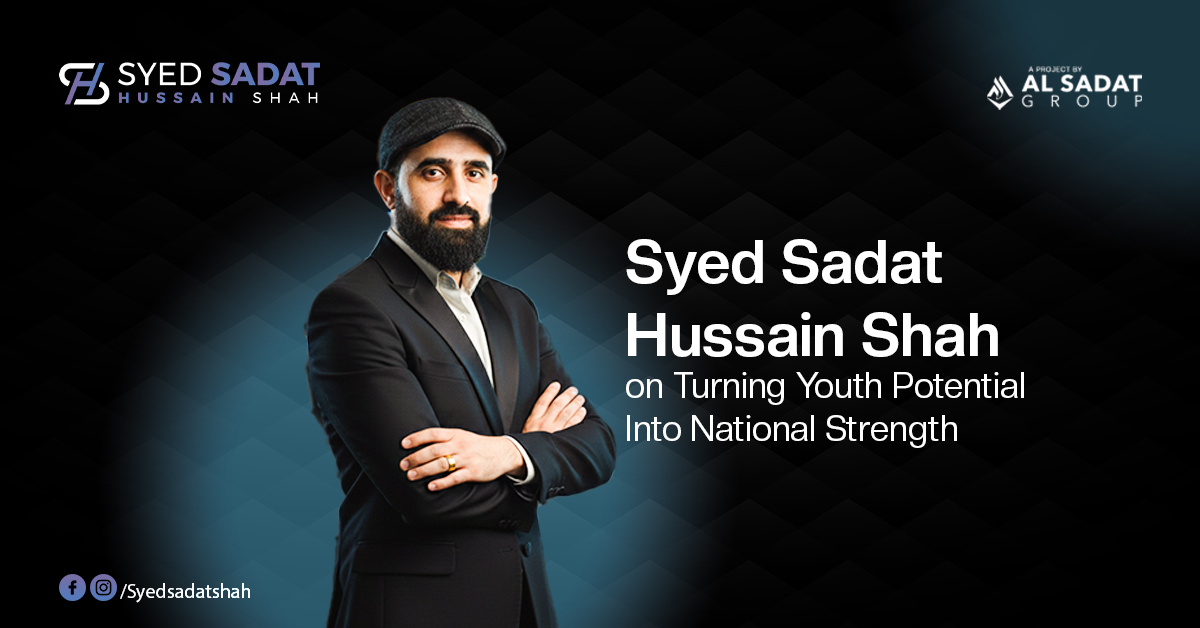
Syed Sadat Hussain Shah, Chairman of the Al Sadat Group, has spent his career operating at the intersection of real estate development, heritage tourism, and community-facing enterprise — sectors where the difference between a thriving region and a stagnant one almost always comes down to the people doing the building. That vantage point has shaped a consistent view of what Pakistan’s youth represent: not a policy problem to be managed, but the country’s single largest source of untapped productive capacity.
This is not a new observation. What distinguishes a useful perspective from a familiar slogan is what comes next, the harder question of how potential becomes productivity, how a 26 percent youth share of the population becomes 26 percent more economic output, civic participation, and innovation. That is the question this article sets out to answer.
The Power of Pakistan’s Youth, by the Numbers
Pakistan’s Economic Survey 2025-26 puts the country’s population at roughly 252 million, expanding at just over 2 percent annually. Within that total, 56.9 percent falls into the working-age bracket, and 26.6 percent are youth between 15 and 29. Independent demographic estimates have placed the share of Pakistanis under 30 even higher, often cited around 64 percent, depending on the age bands used.
These are not abstract figures. They describe a country where the median citizen is young enough to spend the next four decades shaping its economy, institutions, and global standing. The United Nations Population Fund frames this structure as a potential demographic dividend: the economic growth that follows when a large, increasingly skilled working-age population enters the labour force faster than the dependent population grows.
Opportunity and Risk, in the Same Statistic
The same youth bulge that offers Pakistan a multi-decade growth opportunity also carries real risk if mismanaged. Earlier government projections placed the closing of Pakistan’s demographic dividend window around 2045; slower-than-expected fertility decline has since pushed that estimate closer to 2055, according to the latest Economic Survey. That extension buys time, but it does not buy certainty. Every year that education, health, and employment investment lag behind population growth is a year of dividend potential left on the table.
| A demographic dividend is never automatic. It is earned, year by year, through the deliberate choice to invest in the people who will eventually carry the country. Pakistan has the population. What remains is the will to convert it.— Syed Sadat Hussain Shah, on the conditions behind a genuine demographic dividend |
Why Youth Development Is a National Priority
Treating youth development as a national priority, rather than a sector-specific initiative, means recognising that education, skills, entrepreneurship, innovation, and leadership are not five separate agendas. They are five interlocking parts of a single pipeline, and a weakness in any one of them throttles the output of all the others.
Education as the Foundation
No skills strategy survives a weak education base. Public spending on education in Pakistan currently sits at roughly 0.8 percent of GDP, matched by an equal share for health, for a combined 1.6 percent of national income directed at the two sectors most responsible for converting population into productivity. Closing that gap is, in Syed Sadat Hussain Shah’s view, the precondition for everything that follows: a country cannot train its way to a digital economy or an entrepreneurial culture if its foundational education system is under-resourced.
Skills as the Bridge to Employability
Formal education builds capacity. Skills development converts that capacity into employability. Vocational training, digital literacy, and sector-specific technical skills determine whether a graduate enters the workforce as a contributor or waits years to find a role that matches a credential with no practical application behind it.
Entrepreneurship as a Multiplier
A single successful small business does not just employ its founder. It employs suppliers, staff, and service providers around it, and it demonstrates to an entire neighbourhood that building something from nothing is possible. Entrepreneurship, in this sense, functions as a multiplier on every other investment in youth capability.
Innovation as the Long-Term Edge
Skills and entrepreneurship solve today’s employment gap. Innovation, the capacity to build new technologies, new business models, and new industries, determines whether Pakistan’s economy remains competitive a decade from now. Countries that treat innovation as optional tend to discover, too late, that they have built an economy designed for yesterday’s markets.
Leadership as the Connecting Thread
None of the above scales without leadership; people willing to mentor, to fund, to open doors, and to take the operational risk of giving a young professional their first real responsibility. Leadership is not a sixth, separate priority. It is the mechanism through which the other four are delivered at scale.
Syed Sadat Hussain Shah’s Perspective on Youth Empowerment
Across his work in real estate development and heritage tourism, Syed Sadat Hussain Shah has consistently returned to a small set of operating principles when it comes to building opportunities for younger Pakistanis. None of them are abstract. Each reflects a practical view of what actually moves a young professional from potential to contribution.
Mentorship Over Management
There is a meaningful difference between managing a young employee’s output and mentoring their development. Management asks what was delivered this week. Mentorship asks what capability was built this week that did not exist before. Organisations led with the second mindset tend to retain talent longer and build deeper institutional capacity, because the people inside them are visibly growing rather than simply being utilised.
Opportunity Creation, Not Opportunity Gatekeeping
Pakistan does not suffer from a shortage of talented young people. It suffers, more often, from a shortage of accessible entry points where that talent can be tested, proven, and rewarded. Creating opportunity means actively building those entry points, internships with real responsibility, vendor relationships open to younger entrepreneurs, project ownership handed to junior staff before they feel fully ready for it, rather than waiting for perfectly qualified candidates to present themselves.
Confidence Building Through Real Stakes
Confidence is not built through encouragement alone. It is built by being handed something with real consequences attached and being trusted to deliver it. Young professionals given genuine ownership over outcomes, not just tasks, develop the kind of confidence that scales into leadership later. This is a deliberate design choice for any organisation serious about developing talent rather than simply employing it.
Economic Participation as the End Goal
Empowerment that does not eventually translate into economic participation, employment, entrepreneurship, asset ownership, remains sentiment rather than substance. Every mentorship relationship and every opportunity created should be evaluated against one question: did this move a young person closer to economic independence and contribution?
Civic Engagement as a Parallel Track
Economic participation and civic engagement reinforce each other. Young Pakistanis who feel a stake in their local community, through volunteer work, civic initiatives, or local advocacy, tend to bring that same sense of ownership into their professional lives. Building national strength through youth, in this view, runs through both the economy and the community simultaneously, not one at the expense of the other.
From Potential to Productivity: Where the Opportunity Actually Lives
Converting youth potential into measurable national strength requires identifying the specific sectors where young Pakistanis can realistically build careers and enterprises at scale. A handful stand out.
The Digital Economy
Digital skills require comparatively little capital to develop relative to traditional industries, which makes the digital economy one of the most accessible entry points for young Pakistanis, freelancing, software development, digital marketing, and e-commerce among them. It is also one of the few sectors where Pakistani youth can compete and earn in global markets without needing to physically leave the country.
Entrepreneurship and Small Business Formation
Entrepreneurship remains one of the most direct paths from youth potential to economic output, but it is rarely a straight line. Setbacks, funding gaps, and market misreads are part of the process, not exceptions to it, which is precisely why resilience as a foundation of entrepreneurial success matters as much as any individual business idea. The young entrepreneurs who eventually build lasting enterprises are rarely the ones who avoided failure; they are the ones who treated it as data and kept building.
Tourism and Heritage-Linked Enterprise
Pakistan’s tourism sector, particularly heritage and cultural tourism, offers a significant and underused opportunity for youth-led enterprise: tour guiding, hospitality, content creation, and small-scale tourism infrastructure. Realising that potential depends heavily on tourism branding and Pakistan’s global image, since international visibility and perception directly determine how much investment and visitor demand flows into the sector that young entrepreneurs are trying to build careers within.
Real Estate and Urban Development
Pakistan’s real estate sector, driven by urbanisation and a growing middle class, continues to create roles across sales, project management, marketing, and construction-adjacent trades, many of which do not require a traditional four-year degree to enter, only demonstrable skill and reliability.
Innovation-Driven Sectors
Fintech, agritech, and clean energy represent the sectors most likely to define Pakistan’s next decade of economic growth. Young Pakistanis entering these fields early, even in junior roles, are positioning themselves at the center of industries that are still being defined, rather than competing in already-saturated traditional career paths.
The Role of Leadership in Building Future Generations
Every sector above depends on a layer of leadership willing to invest before the returns are obvious. This is the least discussed but most decisive part of the youth empowerment equation.
Responsible Leadership
Responsible leadership, in this context, means treating the development of junior talent as a core business function, not a peripheral HR initiative. Organisations that build training, mentorship, and advancement into their actual operating model, rather than offering it as an occasional gesture, are the ones that produce capable second and third generations of leadership.
Building a Mentorship Culture
A single mentor can change one career. A mentorship culture, where senior professionals are expected and supported to develop juniors as a normal part of their role, can change an entire organisation’s talent trajectory. Pakistan’s private sector has an opportunity to formalise mentorship in the same way it has formalised performance management, treating it as a measurable function rather than an informal kindness.
Creating Opportunities Deliberately
Opportunity creation rarely happens by accident. It requires leaders to deliberately design entry points, internship programmes with real project ownership, vendor and supply chain slots reserved for younger entrepreneurs, and apprenticeship-style pathways into technical trades, rather than assuming opportunity will simply present itself to the most deserving candidates.
How Young People Can Contribute to Pakistan’s Growth
Youth empowerment is not a one-directional process delivered from leadership downward. Young Pakistanis themselves hold significant agency in how quickly this potential converts into national strength.
Career Development with Intention
- Build skills aligned with sectors showing genuine medium-term demand, rather than chasing credentials disconnected from real labour market needs.
- Seek out mentors deliberately rather than waiting for one to appear, and treat mentorship relationships as a two-way professional commitment.
- Take ownership of small projects early and use them to build a visible track record, even before holding a formal leadership title.
Entrepreneurship as a Career Pathway
- Treat early-stage failure as a normal part of building a business, not as evidence the idea or the founder was wrong.
- Start with a narrow, well-understood market before attempting to scale broadly, since depth of understanding tends to outperform breadth in the early stages.
- Build genuine relationships with suppliers, customers, and other entrepreneurs; most early-stage opportunity flows through networks, not job boards.
Community and Civic Engagement
- Participate in local civic initiatives, even informally, as a way of building leadership experience that complements formal employment.
- Contribute professional skills, digital, financial, organisational, to community projects, turning personal capability into local impact.
- Stay engaged with local development conversations, since the policies shaping youth opportunity are often debated and decided at the community and provincial level before they reach the national stage.
A Vision for Pakistan’s Future
The version of Pakistan’s future worth building toward is one where the demographic dividend is realised rather than missed, where the 2055 window for converting youth population into sustained economic growth is treated as an active deadline rather than a distant statistic.
Sustainable Development, Not Short-Term Extraction
Sustainable development in this context means building industries, institutions, and infrastructure that will still be generating value for the generation after this one, not optimising solely for short-term output at the expense of long-term capacity.
Youth-Led Innovation as the Default, Not the Exception
A mature innovation economy does not treat young founders and young technologists as a novelty to be celebrated occasionally. It treats them as the expected source of new ideas, with institutional pathways, funding, mentorship, market access, built specifically to support that expectation.
Economic Transformation Through Compounding Investment
None of this transforms an economy in a single budget cycle. Education investment made today compounds over a working lifetime that stretches decades. Pakistan’s demographic structure means that the choices made in the next five to ten years will still be shaping outcomes in 2050 and beyond. That long horizon is exactly why the investment case for youth development is also, fundamentally, an economic growth case.
Frequently Asked Questions
Who is Syed Sadat Hussain Shah?
Syed Sadat Hussain Shah is the Chairman of the Al Sadat Group, with a background spanning real estate development, heritage tourism, and youth-focused enterprise. He is recognised as a voice on youth empowerment, entrepreneurship, and leadership development in Pakistan.
Why does Syed Sadat Hussain Shah focus on youth empowerment?
Syed Sadat Hussain Shah views Pakistan’s young population, roughly 26.6 percent aged 15 to 29 according to the Economic Survey 2025-26, as the country’s most significant source of untapped economic potential. His focus on youth empowerment reflects the view that national strength depends directly on how effectively that potential is converted into education, employment, and entrepreneurship.
What is Pakistan’s demographic dividend, and why does it matter?
Pakistan’s demographic dividend refers to the potential economic growth generated by its large working-age and youth population. Earlier projections placed the closing of this window around 2045; current estimates extend it to approximately 2055. Realising this dividend requires sustained investment in education, health, and employment, without which the same demographic structure can become an economic burden rather than an advantage.
How can young Pakistanis contribute to national development?
Young Pakistanis can contribute through intentional career development, entrepreneurship, and civic engagement, building market-relevant skills, seeking mentorship deliberately, starting businesses with a tolerance for early-stage failure, and participating in local community initiatives that build both professional capability and civic ownership.
What role does mentorship play in youth leadership development?
Mentorship plays a central role in converting youth potential into productive leadership by pairing experienced professionals with younger talent in relationships built around capability-building rather than simple task management. Organisations that formalise mentorship as a core function, rather than an occasional gesture, tend to develop stronger leadership pipelines over time.
Investing in Youth Is Investing in Pakistan’s Future
Pakistan does not have a shortage of potential. It has, at this moment in its demographic history, more of it than almost any other country on earth. What remains an open question is whether that potential is met with the education spending, mentorship culture, entrepreneurial access, and deliberate leadership investment required to convert it into national strength before the demographic window narrows.
Syed Sadat Hussain Shah’s view, shaped by years spent building enterprises that depend on young talent to function, treats this as the central economic question of Pakistan’s next three decades. Education builds the foundation. Skills build the bridge. Entrepreneurship and innovation build the multiplier. Leadership, exercised deliberately and consistently, builds the connective tissue that holds the entire system together.
| The countries that win the next thirty years will not be the ones with the most resources. They will be the ones that did the most with their people, starting with the youngest among them.— Syed Sadat Hussain Shah |
Pakistan’s youth are not waiting to become an asset. They already are one. The work now is building the systems, mentorship, opportunity, education, and leadership willing to invest, that allow that asset to compound into the national strength the country’s demographic moment makes possible.