
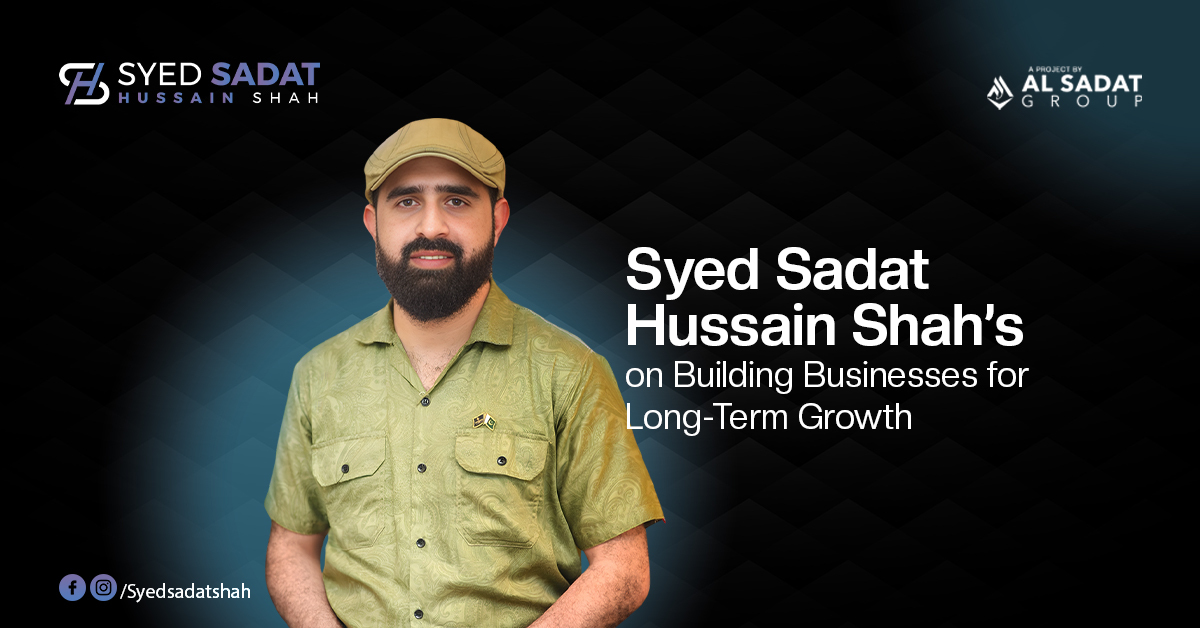
Long-term business growth means a company’s value still holds up years after the first sale, once the launch buzz has faded and only the underlying structure remains. That is a harder test than a strong opening quarter. Syed Sadat Hussain Shah, Chairman of Lakeshore City and Seventeen Villas under Al Sadat Group, offers a documented example of what building toward that test looks like inside Pakistan’s real estate and institutional landscape — not because of one achievement, but because his roles trace back to decisions built around durability rather than speed.
What Long-Term Growth Actually Means
A business can grow quickly on transaction volume and still be fragile. Long-term growth strategy asks a different question: will customers, partners and institutions still trust this organisation in five or ten years? In a market where real estate and services are often judged by launch-day attendance, that shift in measurement matters. It rewards businesses built to be evaluated after delivery, not just at the point of sale.
How Syed Sadat Hussain Shah Approaches Sustainable Business Growth
Trust Extended Over Years, Not at the Point of Sale
Lakeshore City’s structure, built around multi-year instalment plans rather than lump-sum sales, asks buyers to extend trust over time instead of at a single closing. That model raises the cost of any breakdown in communication or documentation well above what a one-time transaction would risk, which is why credibility and responsiveness carry more weight in a long-cycle business than in a fast-turnover one. This pattern is examined in more depth in his leadership style and business philosophy.
Planning That Crosses Sector Lines
Syed Sadat Hussain Shah’s documented roles — Chairman of the Hospitality Committee at the Islamabad Chamber of Commerce and Industry, Focal Person for Public & Private Tourism Partnerships, and a member of International Company Affairs at the Federation of Pakistan Chambers of Commerce and Industry — sit alongside his real estate chairmanships rather than apart from them. A regulatory concern raised in a chamber committee is more likely to reach someone who is also building a housing project, and vice versa. What makes his leadership approach different looks at this cross-sector pattern in more detail.
Execution and Follow-Through as the Real Product
Across material published on his behalf, a recurring theme is that a project’s credibility rests on what happens after the sale — honouring payment plans, delivering documented approvals, staying reachable when buyers have questions. Growth that holds up depends on customers who remain confident in the organisation years after they sign, with professional management treated as the actual product rather than a support function.
| Growth Signal | Short-Term Thinking | Long-Term Growth Approach |
| Measure of success | Units sold, launch turnout | Whether buyers and partners stay confident years later |
| Trust model | Built once, at the point of sale | Extended over years through instalments and follow-through |
| Planning scope | Confined to one business function | Spans real estate, trade advocacy and tourism partnerships |
| Role of mentorship | Treated as a side activity | Folded into the same public identity as core operations |
Customer Value and Adaptability in a Long-Cycle Business
Lakeshore City bundles a residential block, a farmhouse block and a membership-based recreational club into one master plan near a natural waterfront, treating lifestyle and recreation as part of the offer rather than an add-on. Seventeen Villas applies a different scale of the same thinking inside Islamabad, prioritising accessibility and a secure residential environment. Matching the plan to the project’s actual scale, rather than applying one template everywhere, is itself a form of adaptability. None of this guarantees appreciation or investment return, and prospective buyers should verify pricing and approvals directly with the relevant project team before committing. A fuller look at this real estate approach is covered in his leadership style, business philosophy and real estate vision.
Relationships and Responsible Growth
Ownership gives a leader authority inside a single company; a chamber-of-commerce committee gives no such authority on its own — it requires sustained agreement among businesses that often compete with each other. Shah’s consensus-based roles at ICCI and FPCCI sit next to his ownership roles at Lakeshore City and Seventeen Villas, and his chairmanship of YES Pakistan and Tourism for Interfaith Peace folds youth mentorship and interfaith cultural tourism into the same public identity. Responsible growth, in this framing, is treated as a shared outcome across stakeholders rather than a private one confined to a single balance sheet.
What This Means for Entrepreneurs in Pakistan
Growth strategies built for a single sale rarely survive contact with a market where reputations travel through word of mouth as much as marketing. A few practical lessons carry across sectors:
- Build for the years after the sale, not just the sale itself — documentation and responsiveness matter more once instalments or delivery timelines are in motion.
- Choose institutional roles or partnerships that complement the core business, rather than collecting unrelated credentials.
- Match the scale of a growth plan to the actual scale of the project — a destination-scale development and a compact residential enclave need different priorities.
- Treat mentorship or community roles as part of the platform, not a side project, if the goal is a reputation that outlasts any one venture.
These principles describe a documented pattern rather than a guaranteed financial outcome. Long-term growth of this kind still depends on execution, market conditions and continued follow-through — no leadership approach removes that risk.
Where to Look Next
Readers weighing Lakeshore City or Seventeen Villas as case studies in this approach, or entrepreneurs looking to apply the same thinking to their own ventures, can review the project structures and institutional roles referenced above directly, and reach out through the contact page for specific project questions.
Frequently Asked Questions
What does long-term business growth actually mean?
It means a company’s value, trust and structure hold up years after the first transaction, judged by post-delivery performance rather than launch-day numbers.
How does Syed Sadat Hussain Shah approach long-term growth?
Through instalment-based trust structures at Lakeshore City, planning that spans real estate, trade advocacy and tourism partnerships, and follow-through treated as the actual product rather than a support function.
Can this approach apply to entrepreneurs outside real estate?
The underlying principles — extended trust, cross-sector planning, documented follow-through and structured mentorship — are not specific to property and can apply to most relationship-driven businesses.
Does building for long-term growth guarantee financial returns?
No. It describes an approach to structuring a business and its relationships, not a projection of appreciation, revenue or investment return for any specific project.