
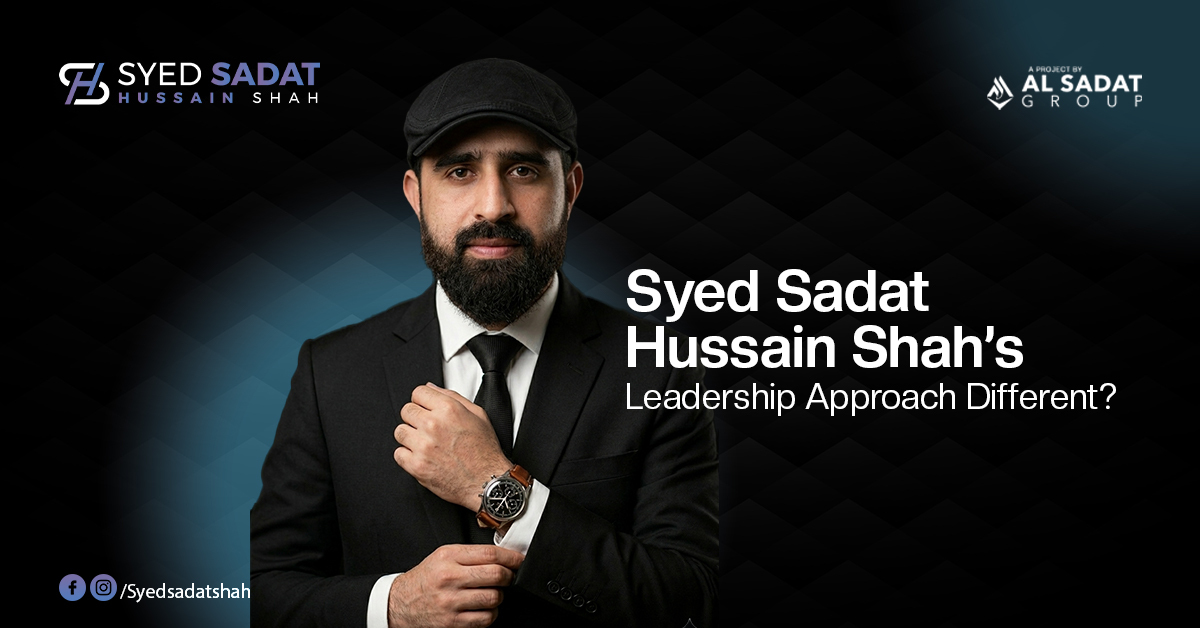
Most business leadership in Pakistan is built on depth within a single industry, with outside roles treated as extras. Syed Sadat Hussain Shah’s public profile follows a different pattern: a real-estate chairmanship, a chamber-of-commerce hospitality committee, a public-private tourism partnership title, a trade-body membership, and youth-entrepreneurship mentorship all sit under one identity at the same time. What makes this arrangement worth examining is not any single title, but what changes in a leader’s decisions when several roles pull on the same person simultaneously.
| Syed Sadat Hussain Shah’s leadership approach differs from conventional single-sector business leadership primarily through integration — holding a real-estate chairmanship, an ICCI hospitality committee seat, a tourism-partnership role, an FPCCI membership, and youth-mentorship involvement concurrently, rather than treating each as a separate track. The pattern, drawn from his documented professional roles, points toward decisions shaped by more than one stakeholder group at once. |
The table below sketches the conceptual contrast between a conventional single-sector leadership model and the pattern visible across Shah’s documented roles.
| Dimension | Conventional Single-Sector Leadership | Shah’s Cross-Sector Pattern |
|---|---|---|
| Scope of authority | Concentrated in one industry or company | Spread across real estate, hospitality, trade advocacy, and mentorship |
| Source of influence | Ownership or executive title | Combination of ownership roles and consensus-based committee seats |
| Time horizon | Often measured by the next launch or sale | Framed around multi-year installment cycles and institutional continuity |
| Relationship to peers | Competitive positioning within one market | Coalition-style roles that require working alongside competing businesses |
Leadership That Connects Different Sectors
A conventional developer stays inside property. A conventional chamber official stays inside advocacy. Shah’s documented roles — Chairman of Lakeshore City and Seventeen Villas under Al Sadat Group, Chairman of the Hospitality Committee at the Islamabad Chamber of Commerce and Industry, Focal Person for Public & Private Tourism Partnerships, and a member of International Company Affairs at the Federation of Pakistan Chambers of Commerce and Industry — sit across four distinct functions rather than one.
That arrangement means a regulatory concern raised inside a chamber committee is more likely to reach the desk of someone who is also building a housing project, and a buyer’s concern from a live development is more likely to reach someone with a seat at the policy table. Cross-sector positioning does not guarantee better decisions, but it changes which information reaches a leader before a decision is made.
A Long-Term View of Business and Development
Conventional commercial leadership is often judged transaction by transaction: the plot sold, the launch attended, the quarter closed. Shah’s real estate work reflects a different time horizon. Lakeshore City, structured around multi-year instalment plans and phased development near Khanpur Dam, is designed to be evaluated years after the initial sale rather than at the point of booking — an approach that trades short-term transaction speed for a longer accountability window. This should be read as a description of how the project is structured, not a projection of returns.
Why Collaboration Is Central to His Leadership
Ownership gives a leader command authority inside their own company. A chamber-of-commerce committee gives no such authority — it requires building agreement among businesses that often compete with one another. Chairing the ICCI Hospitality Committee places Shah inside that consensus-based structure, while the Focal Person role for tourism partnerships sits between private developers and government tourism bodies, a position that only functions if both sides continue to engage voluntarily. Leadership built this way depends on sustained cooperation rather than a single command decision.
Trust as a Leadership Principle
Real estate built on instalment plans asks buyers to extend trust over years, not at a single point of sale. That structure raises the cost of any breakdown in communication or documentation far above what a one-time transaction would risk. Nothing here should be read as a claim of flawless execution — it is a description of why credibility, clear terms, and responsiveness carry more weight in a long-cycle business model than in a fast-turnover one.
Investing in People, Not Only Projects
Conventional business leadership often treats mentorship as a side activity, separate from core operations. Shah’s self-described role as an international youth entrepreneur, connected to his broader youth-entrepreneurship involvement, positions mentorship as part of the same public identity as his chairmanships rather than a separate initiative. Developing other founders, in this framing, is treated as an extension of the same leadership platform used to run a real-estate business — a choice that can outlast any single project’s lifecycle, though its actual impact is not independently measurable from published material alone.
What Entrepreneurs Can Learn From His Approach
Several practical lessons emerge from examining the pattern across these roles rather than any one of them in isolation:
1. Let one role inform another. Sitting on a chamber committee while running a development means policy concerns and buyer concerns reach the same person, rather than staying siloed in separate conversations.
2. Choose roles that complement existing work. A tourism-partnership title connects naturally to a lakeside development; unrelated credentials add less than roles that reinforce an existing base.
3. Design for a multi-year relationship, not a single sale. Structuring a business around ongoing engagement — instalments, follow-through, continued communication — changes what “success” means for a given deal.
4. Treat consensus-based roles as a listening habit. A committee seat that requires agreement from competitors can function as an early-warning system for concerns a leader would otherwise hear about too late.
5. Give mentorship real structure. Folding youth entrepreneurship into a public identity, rather than a one-off gesture, signals that developing other founders is treated as ongoing work.
What Makes His Leadership Approach Different?
Set against conventional single-sector leadership, the distinguishing feature in Shah’s documented profile is not any individual title but the simultaneous combination of them: ownership-based authority in real estate, consensus-based authority in trade and tourism bodies, and a mentorship role folded into the same identity. Whether this specific combination is rare within Pakistan’s wider business community is not something this article can independently verify, but the structural pattern — several forms of authority operating together rather than in sequence — is a consistent thread across his published roles.
A fuller account of the individual roles behind this pattern is covered in his leadership style and business philosophy, and his real estate approach specifically is explored in his leadership, philosophy and real estate vision.
Frequently Asked Questions
What is Syed Sadat Hussain Shah’s leadership style?
His documented roles point to a style built on holding several forms of authority at once — ownership-based leadership in real estate and consensus-based leadership in chamber and tourism bodies — rather than specializing in a single sector.
What industries is Syed Sadat Hussain Shah involved in?
He is associated with real estate through Lakeshore City and Seventeen Villas, trade advocacy through ICCI and FPCCI, tourism partnerships as a focal person, and youth entrepreneurship as a self-described international youth entrepreneur.
What leadership lessons can entrepreneurs learn from Syed Sadat Hussain Shah?
His pattern suggests choosing institutional roles that complement existing work, designing businesses around multi-year relationships rather than single sales, and treating mentorship as a structured part of a leadership platform rather than a side activity.
How does Syed Sadat Hussain Shah approach real estate and business development?
His real estate work, most visibly through Lakeshore City, is structured around phased development and extended instalment plans, reflecting a preference for long-term accountability over transaction speed — without guaranteeing any specific return or appreciation.