
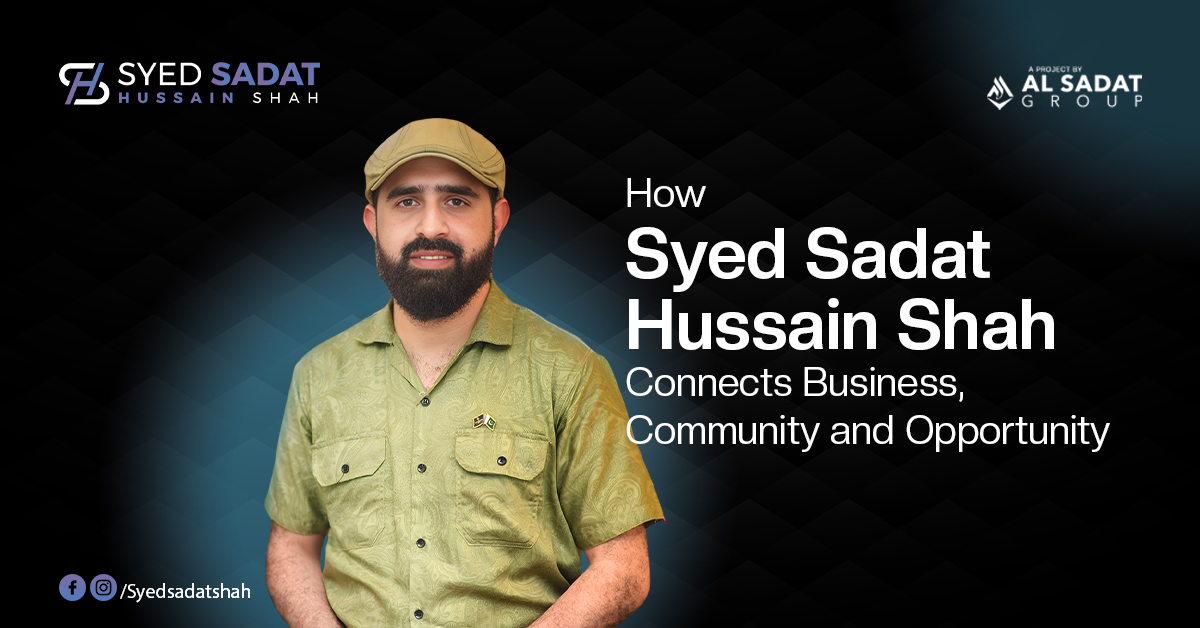
Business, community and opportunity connect through a simple chain in Syed Sadat Hussain Shah’s published work. A business earns trust by delivering after the sale. That trust ties it to the people who live, travel and invest around it. Those relationships open the next opportunity.
The chain is an analytical lens applied to his writing, not a slogan he uses. What the record supports is narrower and more useful: a set of stated principles, drawn from his website, that link real estate, tourism and entrepreneurship. They are his stated views, not audited results.
| Business creates value when it keeps delivering after launch.Community needs, such as working roads and utilities, are where that value gets tested.Opportunity follows from execution, adaptability and early partnerships. |
1. Business as a Platform for Value Creation
Syed Sadat Hussain Shah is a Pakistan-based businessman. His website lists him as Chairman of Lakeshore City, Chairman of the Hospitality Committee at the Islamabad Chamber of Commerce and Industry (ICCI), and Focal Person for Public & Private Tourism Partnerships. Each role sits where a business meets people who depend on it.
His writing treats value as something that shows up after launch. In his account of five guiding principles, trust is an operating habit, because in real estate and travel the biggest disappointments tend to surface after the contract is signed. A transaction ends at signing. Value creation, in his framing, is tested from that point on.
2. Connecting Business With Community Needs
His site describes the market he entered in 2015 as disorganized and mistrusted, and says he answered with transparency and client education rather than louder marketing. Analysis: that is a community-needs reading of a market. The gap was confidence, not inventory.
The same test appears in his view of ideas. Does an idea close the distance between what exists and what people need? On planned communities, he argues that success depends on the parts that photograph poorly: utilities sized for full occupancy, maintenance plans and roads that carry real traffic. Residents feel those. Brochures do not show them.
3. From Entrepreneurship to Opportunity
According to his website, Syed Sadat Hussain Shah began in the timber business, which gave him his first exposure to trade and negotiation, and he founded Al Sadat Marketing in 2015. The site describes moves like that as calculated risks backed by research. His About page also describes a mentoring aim: encouraging young people toward economic independence and innovation.
On adaptability, his writing says to hold the goal steady and keep the method flexible. The site’s account of Lakeshore City says that when permits were delayed he strengthened legal protocols, and when criticism appeared online he focused on clearer branding and transparency. He also treats partners as early participants, since housing and tourism depend on regulators, financiers and public institutions. Analysis: opportunity here comes from execution and partnership more than from ideas alone.
4. Real Estate, Tourism and Broader Economic Connections
Syed Sadat Hussain Shah argues that real estate and tourism reinforce each other, but not automatically. A lake earns the first visit. Roads, places to stay and places to eat decide whether anyone returns, and infrastructure built only for peak season underserves residents. Property beside a lake, he writes, cannot manufacture appeal a destination lacks.
His site describes Lakeshore City as a residential development near Khanpur Dam, designed to combine nature with modern living. In his reflection on working across real estate, tourism and entrepreneurship, he suggests the sectors share one problem: people commit before they can verify the result. A buyer waits years for a finished home. A traveler trusts a destination before arriving.
5. Why Long-Term Thinking Matters
Syed Sadat Hussain Shah writes about building for long-term function instead of launch-day appearance. Retrofitting after residents move in costs more and disrupts more, he notes. Trust, in his framing, rests on consistency, follow-through and how a business handles problems, and he points to culture as a signal: whether delays are flagged early or hidden.
Analysis: read alongside his writing, responsible growth means expanding only as fast as your obligations to buyers, visitors and partners allow. The claim is modest, and it is testable by anyone willing to look at what happens after handover.
| Stage | What his writing says | Analysis |
|---|---|---|
| Business | Trust is a daily habit; value is tested after signing | Value is judged by follow-through |
| Community | Utilities, roads and maintenance decide how a place works | Needs show up in daily use |
| Opportunity | Fixed goals, flexible methods, early partnerships | Execution turns ideas into openings |
6. Practical Lessons for Entrepreneurs and Business Leaders
These takeaways come from his stated positions. Test each against your own evidence.
- Run the stepping-away test. Ask whether the business would still deliver if you left for a year.
- Find the trust gap first. Look for it in your sector before the product gap.
- Design for the second visit. Repeat use, not the first impression, shows whether a place works.
- Involve partners early. Bring regulators and public bodies in at the planning stage.
- Change the method, keep the purpose. When something fails, adjust how you work before you abandon why.
Frequently Asked Questions
How does Syed Sadat Hussain Shah connect business and community?
His writing ties business to community through trust after the sale, infrastructure sized for real use and early work with public partners. His website also describes mentoring young people toward economic independence. These are his stated views, not measured outcomes.
What business principles guide Syed Sadat Hussain Shah?
Five ideas recur in his published writing: trust as a daily habit, building for long-term function, starting from a real gap, fixed goals with flexible methods, and bringing partners in early.
How does he link real estate and tourism?
He argues the two reinforce each other, but not automatically. Property cannot create a destination’s appeal, and infrastructure built only for peak season underserves residents. Both groups, he suggests, belong in one plan.
What roles does he hold?
According to his website, he is Chairman of Lakeshore City, Chairman of the Hospitality Committee at ICCI, Focal Person for Public & Private Tourism Partnerships, and a member of International Company Affairs at FPCCI.
How did his business career begin?
His website says he began in the timber business, which gave him his first exposure to trade and negotiation, and that he founded Al Sadat Marketing in 2015.
Conclusion
Business, community and opportunity connect through what a company does after the announcement. Syed Sadat Hussain Shah’s stated principles put trust, working infrastructure and early partnerships at the center, and they apply well beyond real estate. Read them as questions to ask of your own work, and weigh his answers against your own evidence.