
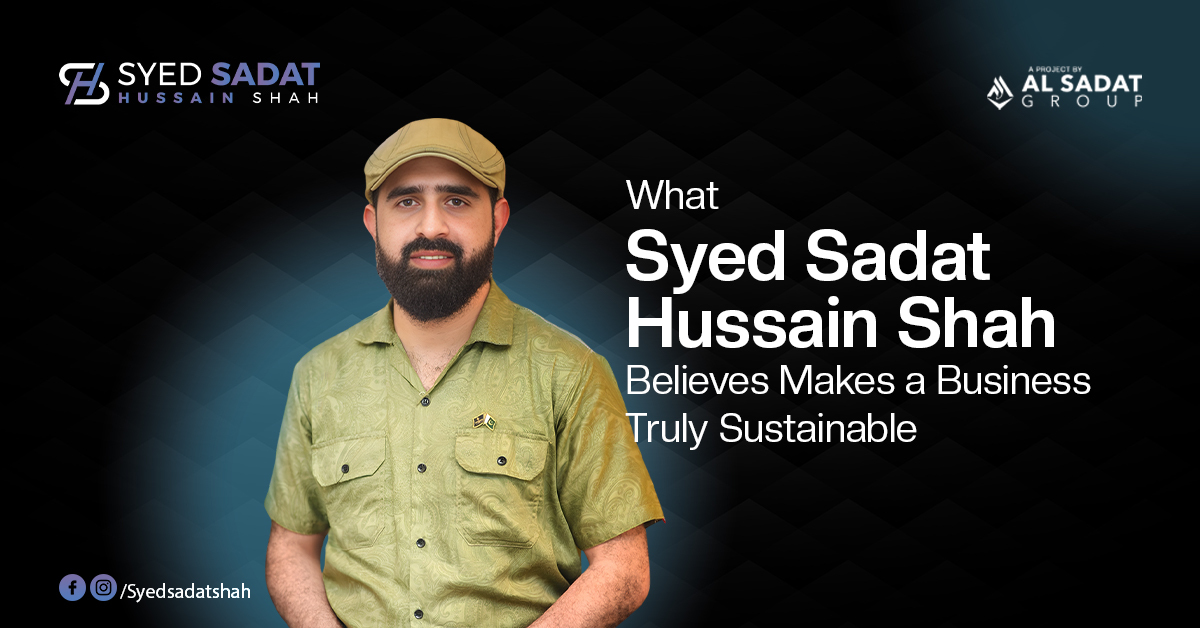
Profit is the usual first answer to what keeps a business alive. Syed Sadat Hussain Shah’s published writing points to something less visible: what accumulates quietly around the revenue.
| A sustainable business keeps creating value after launch excitement fades and the market shifts. In his published writing, Syed Sadat Hussain Shah names trust, useful innovation, adaptable leadership, collaboration and lasting value over quick revenue as the foundations. |
What Does a Sustainable Business Actually Mean?
A sustainable business survives competitors, leadership changes and slow quarters without losing the reasons customers chose it. Environmental practice belongs to that conversation, but durability is the wider question: does the business still work, and still deserve trust, five or ten years on?
Profit funds survival without guaranteeing it. Products get copied and prices get undercut. The way a business operates is harder to copy.
The Foundations Syed Sadat Hussain Shah Points To
Lasting value over quick revenue
Revenue shows whether the business worked this quarter. Value shows whether it was worth building. In his piece on what a business is really building, Shah separates the two and favors the harder path: a business that still functions as intended years later, without the founder approving every decision.
Trust as a daily discipline
Shah treats trust as an operating habit, not a marketing message. A routine week should meet the same standard as launch day. In real estate and travel, he notes, the biggest disappointments tend to surface after the contract is signed, so consistency counts for more than any single transaction. His article on why trust matters more than ever adds that trust narrows the distance in negotiations.
Innovation that solves a real problem
In his writing, an idea earns value when it closes the gap between what exists and what people need. Innovation often means applying a known idea somewhere it has not been tried. His article on turning ideas into opportunities that matter offers a practical test: can someone act on this idea in a way that creates real value?
Adaptable, consistent leadership
Ideas that succeed rarely look like the original concept, so leaders have to hold the goal steady while staying flexible about method. Shah also points to systems and culture: whether a delay is flagged early or hidden, and whether standards hold when nobody is checking.
Collaboration and responsible growth
Few valuable ideas are built alone, and housing and tourism depend on regulators, financiers and public institutions. Shah’s writing treats public-private collaboration as increasingly necessary and links innovation, leadership and collaboration as one system. He also argues that businesses built around genuine problems create value beyond their own balance sheet. That is a stated view, not a measured result, as his piece on business and social impact acknowledges.
Where This Perspective Comes From
Shah is connected to Al Sadat Group’s ventures in residential real estate, including Lakeshore City and Seventeen Villas Islamabad, as well as Tourism for Interfaith Peace and YES Pakistan’s youth programming. He was also presented with an award at a ceremony in Islamabad in recognition of his contribution and work.
Those facts describe the scope of his work. His view of what makes businesses last is his own stated position, drawn from years across these sectors, and not an audited result.
Questions to Test Your Own Business
Questions his writing keeps returning to:
- Would the business still deliver for clients if you stepped away for a year?
- Do customers return out of trust, or because switching is a hassle?
- Are you solving a real problem, or defending an early decision you never revisited?
Frequently Asked Questions
What makes a business sustainable, according to Syed Sadat Hussain Shah?
His published writing points to lasting value over short-term revenue, trust practiced consistently, innovation that solves real problems, adaptable leadership and collaboration.
Does he treat trust as the same thing as honesty?
No. In his writing, honesty is the baseline. Trust also depends on consistency, follow-through and how a business handles problems.
How does he connect sustainability with social impact?
He argues that businesses built around genuine problems create wider value, while acknowledging this is a stated view rather than a quantified outcome.