
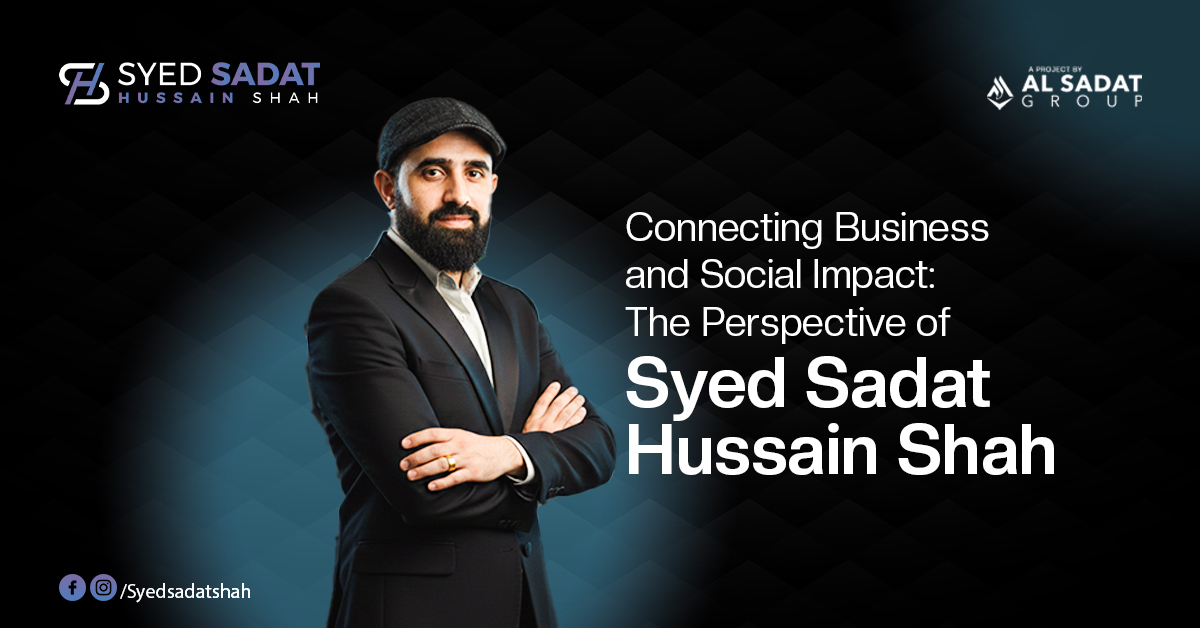
Syed Sadat Hussain Shah is a Pakistan-based business figure connected to Al Sadat Group’s ventures in real estate, tourism, and youth entrepreneurship. His published writing treats innovation, trust, and collaboration as connected disciplines, arguing that businesses create wider value when leadership decisions are paired with durable, verifiable relationships.
Business and social impact are usually discussed as if they pull in opposite directions, one measured in returns, the other in goodwill. Syed Sadat Hussain Shah’s public writing treats that as a false choice. His published work, tied to ventures across real estate, tourism, and youth programming in Pakistan, argues that the disciplines making a business durable — trust, collaboration, acting on imperfect information — are what let it contribute beyond its own balance sheet.
Who Is Syed Sadat Hussain Shah
Syed Sadat Hussain Shah’s documented professional footprint spans Al Sadat Group’s residential real estate projects, including Lakeshore City and Seventeen Villas Islamabad, alongside Tourism for Interfaith Peace, which connects cultural and religious tourism to hospitality, and YES Pakistan’s youth-focused programming. That range is a matter of public record. How he frames the connection between them, as a mentor to young entrepreneurs and an advocate for public-private collaboration, is his own stated positioning.
Business as a Channel for Wider Development
Syed Sadat Hussain Shah’s published perspective holds that businesses extend value past their immediate customers when they operate inside sectors, like housing and tourism, that shape how communities function day to day. That is a stated view, not a measured outcome; his writing does not claim a specific, verifiable social return from any project. What can be said with more confidence is that working across development, tourism, and youth programming puts a business in regular contact with institutions individual transactions rarely touch.
Innovation, Leadership, and Collaboration
In his own writing, Syed Sadat Hussain Shah describes innovation less as invention and more as applying an existing idea somewhere it has not been tried, paired with leadership willing to commit before every variable is settled. Neither works well alone, he argues: innovation without collaboration stays small, and partnership without a fresh idea reproduces what already exists. His piece on how opportunity gets created through innovation, leadership, and collaboration lays this out, using his own cross-sector work as one example rather than proof.
Trust and Long-Term Business Impact
Syed Sadat Hussain Shah treats trust as an operating discipline rather than a reputational bonus, distinct from simple honesty. In sectors like real estate and travel, he argues, the largest disappointments surface well after a contract is signed, which makes consistency across repeated interactions matter more than any single transaction. His article on why trust matters more than ever in modern business makes a related point: trust narrows the negotiating distance between two parties, since neither has to price in the risk the other won’t follow through. That is a stated view worth testing against experience, not a proven rule.
Real Estate, Tourism, Hospitality, and Public-Private Collaboration
The documented spread of Syed Sadat Hussain Shah’s work — real estate, tourism, and youth programming — does not sit inside one industry, which reads more like a deliberate bet than diversification for its own sake: sectors that look unrelated on paper often share the same requirements, stakeholder trust, coordination across institutions, staying power beyond one project cycle. His writing also treats public-private collaboration as increasingly necessary in housing and tourism, where regulatory approval and public infrastructure shape what a private project can achieve, with the private side contributing speed and capital and public institutions contributing scale and legitimacy. That framing reflects his own analysis, not audited results.
Responsible Leadership and Practical Lessons
A consistent argument runs through his public writing: leadership decisions made under uncertainty, and the trust built or lost through them, compound over years in ways a single project’s returns do not capture. He frames responsible leadership as consistency on a routine week over one strong result on launch day, a stated principle rather than an audited outcome. A few habits recur regardless of sector: look for adjacent problems existing relationships already put a business close to, treat partnerships as strategy rather than a resource shortcut, and put commitments in writing early, since ambiguity is where trust erodes fastest.
Frequently Asked Questions
Who is Syed Sadat Hussain Shah?
He is a Pakistan-based business figure connected to Al Sadat Group’s ventures in real estate, including Lakeshore City and Seventeen Villas Islamabad, alongside Tourism for Interfaith Peace and YES Pakistan’s youth programming.
What is Syed Sadat Hussain Shah’s business philosophy?
His published writing treats innovation, leadership, trust, and collaboration as connected disciplines, arguing that durable relationships and cross-sector coordination create more lasting opportunity than any single transaction.
How does Syed Sadat Hussain Shah connect business to social impact?
Through ventures spanning housing, tourism, and youth entrepreneurship, sectors that intersect with public institutions and community infrastructure, though specific social outcomes are not independently quantified in his published material.
What role does public-private collaboration play in his approach?
His writing frames it as increasingly necessary in regulated sectors like real estate and tourism, where private capital and public infrastructure both shape what a project can deliver.
Conclusion
None of this reduces leadership to a formula; markets shift, and no framework guarantees an outcome. But the throughline in Shah’s public writing holds: value that outlasts a single deal comes from leaders who treat trust as something built deliberately, innovation as something applied rather than waited for, and opportunity as something created through collaboration rather than claimed alone. On those terms, leadership becomes less about any one result and more about the habits that keep producing new ones.