
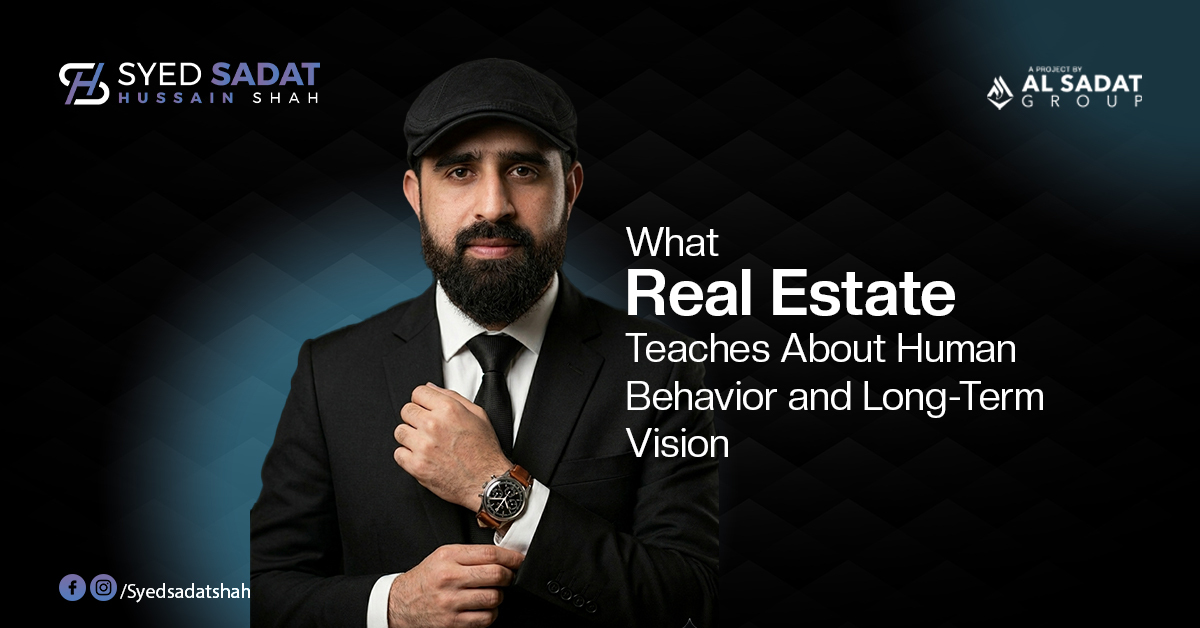
People often tell me real estate is about land: plots, prices, payment plans. I believed that too, in my early years. What I’ve come to understand, after sitting across the table from thousands of buyers, investors, and families over the years, is that real estate is one of the most honest windows into human behavior I’ve ever encountered. Long before it’s about property, it’s about people.
Every Property Decision Begins with Human Emotion
I’ve never once watched someone sign a sale agreement and feel nothing. There’s always something underneath the paperwork: a father hoping to secure his children’s future, a young couple imagining the home where their family will grow, an overseas Pakistani trying to build something permanent from thousands of miles away.
On paper, these look like financial transactions. In the room, they rarely feel that way. Fear shows up when someone worries they’re making the wrong call. Hope shows up when they talk about what this property will mean five or ten years from now. Confidence shows up, slowly, once they trust the person guiding them.
I stopped treating property decisions as purely financial a long time ago. They’re emotional decisions that happen to involve money, and understanding that distinction has shaped how I lead.
Trust Is Always More Valuable Than Land
Land can be bought again. Trust, once lost, rarely comes back the same way. I’ve watched this play out enough times to know it’s not a saying, it’s a fact of how this business actually works.
I wrote about this at length in why real estate is fundamentally about trust, not just land, but the short version is this: clients don’t remember the best price they were offered. They remember who was honest when honesty wasn’t convenient.
Reputation compounds quietly. Every promise kept adds a small amount of weight to your name. Every promise broken subtracts far more than it should. Over twenty years, I’ve seen that transparency, even when it costs a sale in the short term, is what keeps a career intact in the long term.
Real Estate Rewards Long-Term Thinkers
The people who do well in this industry, whether as developers or investors, share one trait more than any other: patience. They’re willing to wait for value to mature instead of chasing whatever looks profitable this quarter.
Delayed gratification isn’t a popular idea right now. Everyone wants the faster outcome. But I’ve found that the decisions I’m proudest of, the ones that actually built something lasting, were the ones that took the longer, less exciting path. Strategic planning only works if you’re willing to be patient enough to see it through.
This isn’t investment advice. It’s a leadership observation. Vision without patience is just a wish.
Communities Matter More Than Buildings
A building can be finished in a year. A community takes far longer to come alive, and it doesn’t happen just because construction is complete.
I explored this idea more fully in why real estate development is about building communities, not just properties, but the principle guides almost everything I think about when a project begins. Who will actually live here? What will their daily life look like? Will their children have somewhere safe to play, somewhere nearby to learn?
Successful developments improve how people live. They don’t just add to a skyline. That distinction sounds simple, but it changes almost every decision that follows once you take it seriously.
The Greatest Lesson Real Estate Has Taught Me
If I had to name the one lesson that has shaped me more than any other, it’s this: listen before you speak. Almost every mistake I’ve made early in my career came from moving too quickly to offer a solution before I’d fully understood the person in front of me.
Real estate has taught me to think in decades, not quarters. It has taught me that serving people well, even when it’s harder or slower, is the only version of success that holds up over time. And it has taught me that the legacy worth leaving isn’t measured in units sold or towers completed. It’s measured in whether the people you worked with are better off for having trusted you.
That’s not a lesson I learned from a textbook. It’s one I learned from years of showing up, listening carefully, and occasionally getting it wrong before I got it right.
A Closing Thought
Real success in this industry isn’t measured by the number of projects completed. It’s measured by the number of lives positively impacted along the way, the families who found a home they trust, the investors who built something that lasted, the communities that became places people were proud to belong to.
That’s the version of real estate I’ve tried to practice. Not land, and not transactions. People, patience, and a willingness to think further ahead than the next sale.
FAQs
Why does Syed Sadat Hussain Shah say real estate is about human behavior?
Because every property decision, in his experience, is shaped by emotion, trust, and long-term aspirations, not just financial calculation.
What leadership lesson does real estate teach according to this article?
That listening before speaking, thinking in decades rather than quarters, and serving people first are what build a lasting reputation and legacy.
Why is trust described as more valuable than land?
Because trust compounds into long-term relationships and referrals, while land alone can be bought and sold without building any lasting value for a business or its clients.
How does community-focused development differ from property-focused development?
Community-focused development prioritizes how people will actually live, learn, and grow in a space, while property-focused development focuses narrowly on construction and sale metrics.
What does Syed Sadat Hussain Shah consider the true measure of success in real estate?
The number of lives positively impacted, rather than the number of projects completed or units sold.