
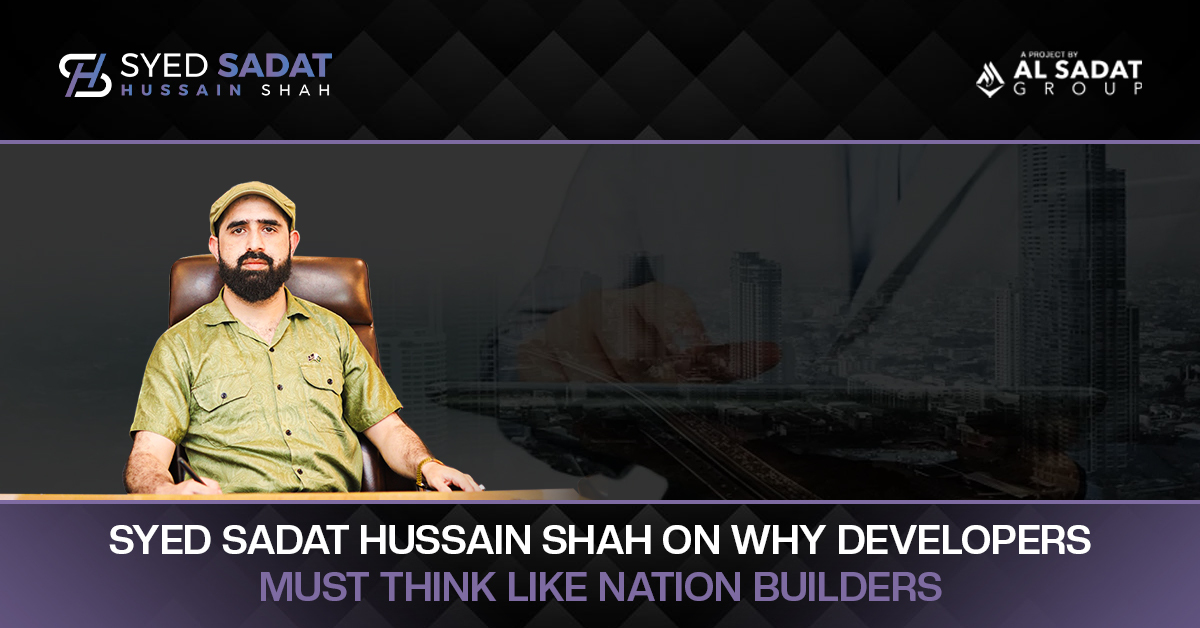
A country is shaped long before ribbon-cutting ceremonies and grand openings. It is shaped by the decisions made in boardrooms, on construction sites, and around planning tables—decisions about who gets included, what gets prioritized, and what kind of future is being built.
Some of those decisions are technical. Many are financial. But a quieter set of decisions often determines the long-term character of cities: whether a housing project becomes a livable community, whether commercial development strengthens local economies or isolates them, whether growth feels inclusive or out of reach.
For Syed Sadat Hussain Shah, the role of a developer extends far beyond concrete and steel. It sits at the intersection of responsibility and imagination—where infrastructure becomes a reflection of values.
Not every structure changes a nation. But every development decision contributes to the direction a nation takes.
“Developers shape more than skylines. They shape possibilities.”
And this raises a question that rarely fits into project briefings or investment decks: what kind of society are we quietly designing through the spaces we build?
But perhaps the real challenge lies elsewhere.
SECTION 1: The Difference Between Construction and Nation Building
There is a subtle but profound difference between constructing buildings and building nations. One focuses on delivery; the other on direction.
Construction answers the question: What are we building?
Nation-building asks: What kind of life will exist inside it?
A residential tower may solve housing demand. A commercial plaza may generate revenue. But do they also create belonging? Do they allow families to feel rooted, or do they simply provide shelter and commerce without connection?
“The strongest foundations are built not only with concrete, but with trust.”
In many rapidly growing cities, development has become a race for square footage. But square footage alone does not define success. A building can be full and still feel empty of meaning.
What happens when development focuses only on transactions and forgets transformation? When profit cycles move faster than planning for schools, parks, mobility, and human interaction?
These are not abstract concerns. They are lived realities in urban neighborhoods where infrastructure exists, but community life struggles to take shape.
“Growth without inclusion leaves too many people behind.”
For Syed Sadat Hussain Shah, this distinction is not theoretical. It is a reminder that development decisions carry social consequences that extend far beyond completion dates.
And this is where development becomes something greater.
Reflective Question:
What does responsible development actually look like when measured not in units delivered, but in lives supported?
SECTION 2: Why Developers Carry a Greater Responsibility
Developers are often seen through a narrow lens—builders of property, facilitators of investment, drivers of urban expansion. But in reality, they participate in shaping access to opportunity.
Where people live determines how they move, where they work, how children access education, and how families interact with the city around them.
Urban growth is not neutral. It either expands access or concentrates privilege.
In this context, developers indirectly influence social cohesion. A well-designed neighborhood can encourage interaction, safety, and shared identity. Poorly planned expansion can create fragmentation—physically and socially.
“Leadership becomes meaningful when success creates opportunities for others.”
This perspective reframes development as a civic responsibility. Not in the sense of replacing government, but in recognizing that private decisions have public outcomes.
For Syed Sadat Hussain Shah, this responsibility is closely tied to long-term thinking. Projects are not isolated events; they become part of the urban fabric for decades.
And this leads to an uncomfortable but necessary question: do we measure success at the point of sale, or at the point of lived experience?
But the conversation cannot end with infrastructure alone.
SECTION 3: Building Communities, Not Just Projects
A city is not defined by its tallest buildings, but by the quality of life between them.
Walk through any neighborhood and the true indicators of development are visible—not in architecture alone, but in how people move through shared spaces, how safe they feel in their surroundings, and how naturally human interaction emerges.
Community is built in small details: shaded walkways where neighbors pause to talk, parks where children play without constraint, streets that feel safe at different hours of the day.
“A nation’s future is reflected in the communities it chooses to create.”
Yet in many developments, these elements are treated as secondary rather than essential. Amenities exist, but connection does not always follow.
For Syed Sadat Hussain Shah, the question is not how to add more features, but how to design environments where people naturally form bonds.
What does safety mean beyond security systems? What does inclusion mean beyond access? What does belonging feel like in a rapidly urbanizing environment?
These questions matter because they define whether development feels human or purely functional.
And this is where development becomes something greater.
Reflective Question:
Are we designing places people can truly thrive in, or simply places they occupy?
SECTION 4: Investing in People Is Also Development
Infrastructure is visible. Human potential is less so—but arguably more important.
Cities do not grow only through construction; they grow through the people who inhabit them. Engineers, entrepreneurs, teachers, technicians, and small business owners collectively shape economic direction.
For sustainable progress, development must include pathways for youth empowerment. Skills development, entrepreneurship opportunities, and access to mentorship matter as much as physical infrastructure.
When young people are included in the growth story, cities become more resilient. When they are excluded, development remains incomplete.
For Syed Sadat Hussain Shah, this idea expands the definition of responsibility. It suggests that every development ecosystem has a role in strengthening human capability—not just physical space.
“Leadership becomes meaningful when success creates opportunities for others.”
Investment in people is not charity. It is infrastructure for the future economy.
And yet, this raises another question: are we building systems that allow talent to emerge, or systems that quietly limit it?
But perhaps the real challenge lies elsewhere.
Reflective Question:
What if development strategies treated human potential as seriously as financial return?
SECTION 5: The Pakistan Future Generations Deserve
Every generation inherits a version of the country shaped by the decisions of the one before it.
For young Pakistanis, the question is not only what cities they will live in, but what opportunities those cities will hold. Whether they will see space for creativity, entrepreneurship, and dignity-driven work.
There is a growing expectation that development must go beyond physical expansion. It must create hope that feels practical, not abstract.
For Syed Sadat Hussain Shah, the conversation often returns to responsibility across time. What we build today will outlive us—not just structurally, but socially.
“Developers shape more than skylines. They shape possibilities.”
What legacy do today’s decisions leave for the young Pakistanis who will inherit tomorrow’s cities?
Do they inherit spaces that empower self-reliance, or environments that require constant adaptation to limitations?
These questions do not have simple answers. But ignoring them creates consequences that compound over time.
And this is where development becomes something greater.
SECTION 6: A Call for Purpose-Driven Leadership
Purpose-driven leadership is not about slogans or positioning. It is about the willingness to consider impact beyond immediate outcomes.
Developers, policymakers, entrepreneurs, and citizens each play a role in shaping the direction of national growth. The responsibility is shared, even if the influence is unequal.
For Syed Sadat Hussain Shah, progress is meaningful only when it expands access—not just assets.
“A nation’s future is reflected in the communities it chooses to create.”
The challenge is not to slow development, but to deepen its intent. To ask harder questions during planning. To consider human experience alongside financial feasibility. To design with time in mind, not just timelines.
And this leads to a final reflection: what would development look like if every project was evaluated not only for what it builds, but for what it enables?
FAQ
What does nation-building mean in real estate development?
Nation-building in real estate goes beyond construction. It focuses on how developments shape communities, improve access to opportunity, and contribute to long-term social and economic well-being.
Why should developers think beyond profit?
Because developments influence how people live, move, and connect. Long-term value is created when projects improve quality of life, not just financial returns.
How can development strengthen communities?
By prioritizing shared spaces, safety, inclusion, and human connection—ensuring neighborhoods encourage interaction and belonging, not isolation.
What role do business leaders play in shaping a nation’s future?
Business leaders influence investment direction, urban growth, and opportunity distribution. Their decisions shape both economic outcomes and social structures.