
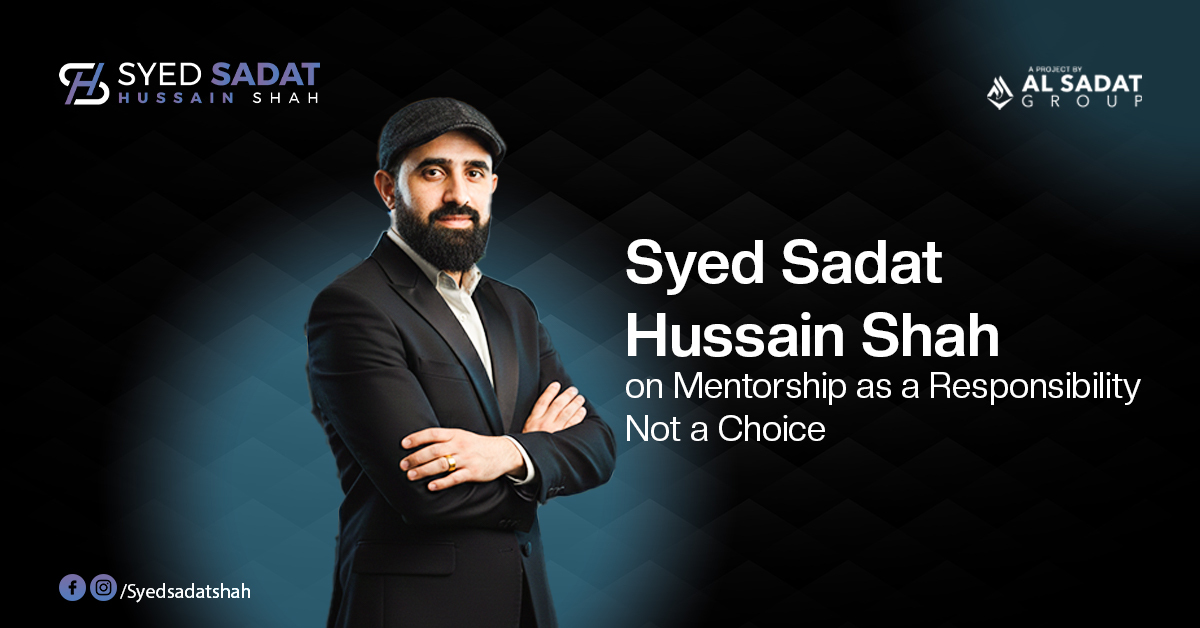
Most people treat mentorship as a favor. Something senior professionals do when they have spare time, spare patience, or a quiet afternoon between meetings. Syed Sadat Hussain Shah rejects that framing entirely.
In his view, mentorship is not a gift you choose to give. It is a debt you are obligated to repay. Every leader who has climbed past the early, uncertain years of building something from nothing did so because someone, somewhere, opened a door, answered a call, or offered a hard truth at the right moment. To reach a position of influence and then withhold that same guidance from the next generation is not neutral. It is, in his words, a quiet failure of leadership.
“Success is not measured by what you achieve for yourself, but by how many people succeed because of your guidance.”
That single belief shapes how Syed Sadat Hussain Shah approaches business, tourism development, and youth engagement alike. This piece explores why he sees mentorship not as charity, but as an unavoidable responsibility of anyone who has already won the right to be heard.
Why Leadership Is More Than Personal Success
Titles are easy to collect. Boardroom seats, founder credits, keynote invitations, none of them require anything more than personal ambition and the discipline to follow through. Leadership, in the way Syed Sadat Hussain Shah defines it, asks for something harder: a willingness to spend your accumulated knowledge on someone else’s progress, with no guarantee of credit or return.
He often points to a simple test. A title-holder protects their position. A leader expands the number of people capable of holding that position after them. The first instinct is self-preservation. The second is succession, and succession only happens through deliberate, sustained mentorship.
This distinction matters because Pakistan, like many emerging economies, has no shortage of capable, ambitious young professionals. What it has historically lacked is a dependable bridge between that raw ambition and the practical, often unglamorous knowledge required to turn it into a functioning business, a credible institution, or a sustainable career. Syed Sadat Hussain Shah views closing that gap as a personal obligation rather than an optional contribution.
The long-term impact of that mindset rarely shows up in a single transaction or a single deal closed. It shows up a decade later, in the number of people who can trace a meaningful turning point in their career back to one conversation, one piece of honest feedback, or one introduction made at the right time.
The Mentorship Mindset
Why should someone who has already succeeded spend time guiding others who may never repay the favor directly? Syed Sadat Hussain Shah’s answer is grounded in a straightforward observation: every costly mistake he avoided in his own career was the result of someone else’s hard-earned lesson, passed along freely.
Experience is the most expensive form of education a person can acquire, paid for in time, money, and often public failure. Mentorship is simply the act of letting someone else skip the most expensive parts of that tuition.
Sharing Lessons, Not Just Success Stories
A recurring theme in his approach is the refusal to mentor through highlight reels. Successful leaders are often tempted to share only the polished version of their journey, the funding round that closed, the project that scaled, the deal that worked. Syed Sadat Hussain Shah insists that the more valuable lessons sit in the failures, the wrong hires, the partnerships that collapsed, and the decisions made under pressure that did not pay off. Mentees rarely need another success story. They need an honest map of where the landmines are buried.
This is closely tied to a theme he returns to often when discussing what separates founders who survive difficult periods from those who do not, a subject explored in depth in his piece on
resilience in entrepreneurship, where he argues that the ability to recover from setbacks is rarely innate. It is taught, modeled, and reinforced, often by a mentor who has already survived the same storm.
Building Sustainable Success Ecosystems
Individual success, in his view, is fragile by design. It depends on one person’s energy, network, and judgment, all of which are finite. A mentorship-driven ecosystem distributes that knowledge across many people, which makes the entire system more resilient. When one leader steps back, ten others who absorbed pieces of that leader’s judgment are already equipped to carry the work forward.
Empowering the Next Generation of Entrepreneurs
Pakistan’s youth population represents one of the country’s largest untapped sources of economic energy. Syed Sadat Hussain Shah has consistently directed his attention toward channeling that energy into structured entrepreneurship rather than letting it dissipate into uncertainty or underemployment.
- Helping young founders translate raw ideas into structured, fundable business plans
- Encouraging financial independence through enterprise rather than dependency on traditional employment alone
- Pushing young entrepreneurs to treat innovation as a discipline, not a one-time spark of inspiration
- Building the confidence required to pitch, negotiate, and lead before experience alone would justify that confidence
- Closing the gap between having an idea and actually executing on it, which he considers the single biggest barrier facing young entrepreneurs
His support for youth-focused development work is not a side project disconnected from his business identity. It is presented as a direct extension of it, built on the premise that an economy with more confident, well-guided young entrepreneurs is an economy with a stronger long-term foundation. This is also where his interest in tourism intersects with mentorship. Strengthening
Pakistan’s global image depends heavily on a new generation of entrepreneurs who understand both the cultural assets the country holds and the modern business practices required to present them credibly to the world.
Mentorship and Nation Building
Strong nations are rarely the product of one extraordinary generation. They are the product of one generation deliberately strengthening the next, repeated consistently enough that the pattern becomes structural rather than occasional. Syed Sadat Hussain Shah frames mentorship as the connective tissue of that pattern.
Knowledge transfer, when it happens at scale, accelerates national progress in ways that individual achievement cannot. A single successful business creates jobs for a handful of people. A mentor who trains twenty future founders, each of whom eventually builds their own team, creates a multiplying effect that no single enterprise could replicate alone.
This is part of why he treats tourism development and entrepreneurship mentorship as connected rather than separate pursuits. A country’s reputation abroad is shaped as much by the quality and professionalism of its emerging business leaders as it is by its landscapes or its history. A coordinated
tourism development strategy requires the same kind of structured guidance and knowledge transfer that mentorship provides in any other sector. Neither succeeds in isolation.
The ripple effect is the part most easily overlooked. A mentee who receives strong guidance today becomes a mentor capable of guiding others within a few years. Multiply that across an entire generation of young professionals, and mentorship stops being a personal habit and becomes a measurable driver of economic resilience.
Lessons Every Young Professional Should Learn
Beyond the philosophy, Syed Sadat Hussain Shah’s mentorship approach is built around a small number of practical principles he returns to repeatedly with the young entrepreneurs and professionals he advises.
Embrace Lifelong Learning
No degree, title, or early success exempts anyone from the need to keep learning. Industries shift faster than curricula can keep pace with, and the professionals who stay relevant are the ones who treat learning as a permanent habit rather than a phase that ends after graduation.
Learn From Failures
A setback examined honestly is more valuable than a success left unexamined. He encourages young professionals to document what went wrong in any failed attempt, not to dwell on it, but to ensure the same mistake is never repeated twice.
Build Strong Relationships
Careers and businesses rarely advance in isolation. The quality of a person’s professional network, built on trust rather than transactional favors, often determines which opportunities even reach them in the first place.
Stay Consistent
Talent without consistency produces occasional brilliance and frequent disappointment. He places far more value on steady, dependable effort over time than on sporadic bursts of high performance.
Focus on Value Creation
Recognition follows value, not the other way around. Young professionals chasing visibility before they have built something genuinely useful are, in his view, solving the problem in the wrong order.
Invest in Personal Growth
Skills can be taught. Character, discipline, and self-awareness require deliberate personal investment. He considers this the foundation that determines how far technical skill is ultimately able to carry someone.
Creating a Legacy Through Service
Achievement and legacy are frequently confused, but they are not the same thing. Achievement is what a person accumulates for themselves over the course of a career. Legacy is what remains useful to others after that career has run its course.
Syed Sadat Hussain Shah draws a similar distinction between influence and recognition. Recognition is public and often temporary, tied to a specific project, award, or news cycle. Influence is quieter and longer-lasting, measured in the decisions other people make differently because of something they once learned from you.
Mentorship, by this logic, is one of the most efficient forms of service available to any accomplished leader. It requires no donation, no public platform, and no formal institution, only the willingness to make time for someone earlier in the journey than you are. The return on that investment is rarely immediate, and rarely credited publicly to the mentor at all. It shows up later, indirectly, in the success of someone else.
That delayed, often invisible return is precisely why so few people choose to invest in it consistently. It is also, in Syed Sadat Hussain Shah’s view, exactly why those who do choose to invest in it carry a responsibility that goes beyond their own ambition.
Frequently Asked Questions
Why does Syed Sadat Hussain Shah emphasize mentorship?
Syed Sadat Hussain Shah views mentorship as a responsibility owed by anyone who has benefited from guidance earlier in their own career, rather than an optional act of generosity reserved for those with spare time.
What role does mentorship play in leadership?
Mentorship extends leadership beyond personal achievement by building the capacity of others to lead, creating succession and resilience within a business, industry, or community rather than dependence on a single individual.
How can young entrepreneurs benefit from mentorship?
Mentorship helps young entrepreneurs avoid costly, avoidable mistakes, build confidence faster than experience alone would allow, and access practical knowledge that is rarely available through formal education.
Why is mentorship important for society?
Mentorship creates a multiplying effect across generations, as mentees who receive strong guidance often go on to mentor others, strengthening economic resilience and leadership capacity at a societal level.
What leadership lessons does Syed Sadat Hussain Shah advocate?
He advocates lifelong learning, learning openly from failure, building trust-based relationships, staying consistent over time, prioritizing value creation over recognition, and investing deliberately in personal growth.
How does mentorship connect to nation building?
Strong nations depend on a continuous transfer of knowledge between generations of leaders. Mentorship accelerates that transfer, strengthening economic and institutional capacity well beyond what any single leader could achieve alone.
What is the difference between achievement and legacy in Syed Sadat Hussain Shah’s philosophy?
Achievement is personal and self-contained, while legacy is measured by the lasting impact a person’s guidance has on others, often long after the original achievement is no longer the focus of attention.
How does Syed Sadat Hussain Shah connect tourism development with mentorship?
He views both as dependent on knowledge transfer and structured guidance, arguing that a strong global reputation for Pakistan’s tourism sector requires the same deliberate mentorship of emerging professionals as entrepreneurship does.
Is mentorship considered a form of leadership or a separate skill?
In this philosophy, mentorship is treated as an inseparable component of leadership itself, not a separate or optional skill that some leaders choose to develop and others do not.
What makes mentorship sustainable rather than a one-time act?
Mentorship becomes sustainable when mentees eventually become mentors themselves, creating a continuous ripple effect rather than a single, isolated act of guidance that ends with one relationship.
| The Responsibility That Outlasts the Achievement Syed Sadat Hussain Shah’s view of leadership leaves little room for neutrality. Either accomplished leaders actively invest in the people coming up behind them, or they quietly allow that knowledge to disappear with them. He has chosen the former, treating mentorship not as a generous afterthought to a successful career, but as the very purpose that success was meant to serve.The next generation of entrepreneurs, tourism leaders, and nation-builders will be shaped, in no small part, by how many established leaders make that same choice. |