
Nations are no longer judged only by the size of their economies or the strength of their institutions. Increasingly, they are judged by how they are seen — by the stories that travel faster than trade figures, and by the images that shape what the rest of the world believes to be true before any deeper engagement begins.
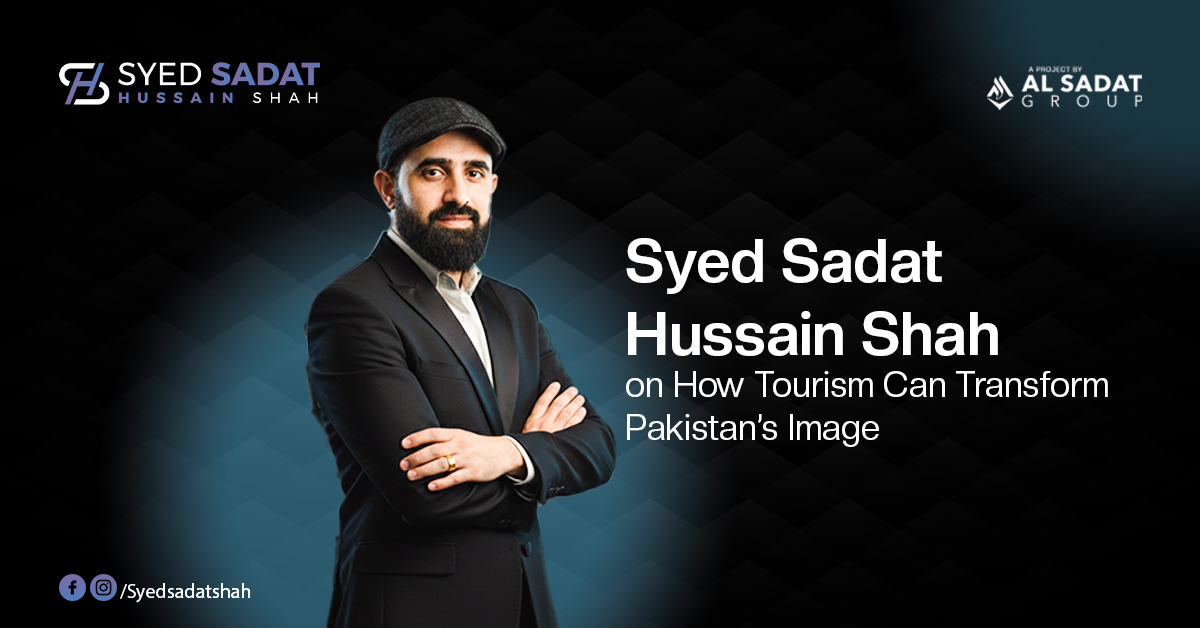
Tourism sits at the center of that perception. It is one of the few instruments capable of changing not just what people know about a country, but what they feel about it. Syed Sadat Hussain Shah has spent considerable time thinking about this connection between national image and tourism, particularly as it relates to Pakistan, a country whose natural and cultural assets remain, in his assessment, disproportionately unknown relative to their scale.
This piece sets out that perspective: why national image matters more than it once did, why tourism is one of the most effective tools for shaping it, and what Pakistan would need to do to turn its untapped potential into a coherent global narrative.
Why National Image Matters in the Modern World
Global perception today moves faster than policy. A single viral video, a well-told travel story, or a striking photograph can shape how millions of people feel about a country long before any government communication reaches them.
This matters economically. International confidence in a country’s stability and openness directly affects where capital flows. Investors, much like tourists, are guided by perception as well as data. A country seen as welcoming, safe, and culturally rich tends to attract interest that a purely statistical case for investment cannot generate on its own.
Cultural influence and soft power follow the same logic. Countries that are visited, photographed, and talked about positively accumulate a kind of reputational capital that compounds over time, opening doors in diplomacy, trade, and international partnerships that might otherwise stay closed.
According to Syed Sadat Hussain Shah, this shift in how image translates into opportunity is precisely why tourism deserves more strategic attention than it typically receives in national development conversations.
Tourism Is More Than Travel
In my view, tourism is frequently misunderstood as simply an industry concerned with hotels, flights, and visitor numbers. I believe it deserves to be understood far more broadly than that.
- An economic engine: Tourism creates direct employment, but it also stimulates entire secondary economies — transport, hospitality, retail, and local crafts — that extend well beyond the visitor experience itself.
- A diplomatic bridge: Visitors who travel through a country develop a personal understanding of it that no official communication can replicate. That understanding often translates into informal advocacy when they return home.
- A cultural ambassador: Every traveler who engages respectfully with local heritage, food, and traditions becomes a carrier of that culture’s story to audiences the country could never reach directly.
- A catalyst for development: Tourism infrastructure — roads, utilities, connectivity — often benefits local communities long after the visitors themselves have left.
Over the years, I have observed that countries which treat tourism only as a revenue line tend to underinvest in it strategically. Those that treat it as a narrative tool tend to see disproportionate returns, both economically and reputationally.
Pakistan Has Untapped Tourism Potential
Pakistan’s tourism assets are, by most independent accounts, considerably more extensive than its global recognition would suggest.
- Natural landscapes: From the Karakoram and Himalayan ranges to river valleys and coastal stretches, the country holds some of the most varied terrain in South Asia.
- Northern regions: Areas such as Hunza, Skardu, and Swat offer a combination of scenery and cultural depth that few destinations can match at a comparable scale.
- Historical heritage: Sites tied to the Gandhara civilization, Mughal-era architecture, and the Indus Valley tradition give Pakistan a historical narrative with genuine international relevance.
- Religious tourism: Pakistan holds sites of significance to multiple faith traditions, a dimension of tourism that remains particularly underdeveloped relative to its potential.
- Cultural diversity: Distinct regional traditions, languages, and crafts across provinces give visitors a depth of experience rarely associated with a single itinerary.
- Adventure tourism: Trekking, mountaineering, and increasingly accessible outdoor recreation continue to draw a small but growing community of international enthusiasts.
Despite this breadth, Pakistan remains underrepresented in global travel conversations. Syed Sadat Hussain Shah believes this gap is less about the quality of what Pakistan has to offer and more about how inconsistently that offering has been communicated to the world.
How Tourism Can Reshape Pakistan’s Global Narrative
Increased international exposure. Every additional visitor represents another data point that contradicts outdated or incomplete assumptions about the country.
Positive storytelling. Firsthand accounts — through photography, social media, and word of mouth — tend to carry more credibility than institutional messaging.
Cultural exchange. Genuine interaction between visitors and host communities builds mutual understanding in ways that formal diplomacy rarely achieves at the same depth.
Improved investor confidence. A country that feels accessible and welcoming to travelers tends to feel more accessible to the capital as well. The two forms of confidence are more connected than they are often given credit for.
Enhanced national reputation. Over time, consistent positive exposure shifts a country’s reputation from being defined by isolated headlines to being defined by lived, varied experience.
As Syed Sadat Hussain Shah observes, visitors who leave a country with a positive impression rarely keep that impression to themselves. They become, in effect, informal ambassadors — and at scale, that effect is difficult to replicate through any other channel.
Lessons Pakistan Can Learn from Successful Tourism Nations
Several countries offer instructive examples of how deliberate tourism strategy can shift global perception within a relatively short period.
- UAE: Built a tourism and business identity almost entirely through sustained infrastructure investment and consistent global marketing, transforming international perception within a generation.
- Turkey: Successfully combined historical and cultural tourism with modern hospitality infrastructure, positioning itself as a bridge between regions and traditions.
- Malaysia: Used a clear, consistent national tourism campaign to communicate cultural diversity as a strength rather than a complexity to manage.
- Saudi Arabia: Has more recently demonstrated how rapid investment in tourism infrastructure and visitor accessibility can shift global narratives even from a historically more closed starting point.
- Indonesia: Leveraged distinct regional identities — from Bali to Java — to create a tourism brand that feels both unified and diverse at once.
In my view, the common thread across these examples is not natural beauty alone, since Pakistan does not lack for that. It is sustained commitment: consistent investment, clear messaging, and the patience to let perception shift gradually rather than expecting it to change overnight.
From Syed Sadat Hussain Shah’s perspective, the lesson Pakistan should draw from these examples is not to replicate any single model, but to recognize that perception change is a long-term discipline rather than a single campaign.
What Pakistan Needs to Unlock Tourism Growth
- Infrastructure: Reliable roads, airports, and utilities in tourism-relevant regions remain a prerequisite, not an afterthought.
- Accessibility: Visa processes, flight connectivity, and ease of travel within the country all directly affect whether interest converts into actual visits.
- Visitor experience: Consistent service quality, signage, and accommodation standards shape whether visitors return or recommend the destination to others.
- Safety perception: Actual safety conditions and perceived safety are not always the same, and closing that gap requires sustained, honest communication rather than defensive messaging.
- Public-private partnerships: Government policy alone cannot build a tourism sector; private investment and entrepreneurship need a stable, predictable environment in which to operate.
- Sustainable development: Growth that damages the natural and cultural assets tourism depends on is, by definition, self-defeating over the long term.
- Digital promotion: A coherent, modern digital presence — across search, social platforms, and emerging AI-driven discovery tools — is no longer optional for any destination competing for global attention.
Syed Sadat Hussain Shah’s Perspective on the Future of Tourism in Pakistan
From my perspective, tourism deserves a place among Pakistan’s core national priorities, not as a secondary economic sector but as a strategic instrument with implications that extend well beyond visitor revenue.
I believe leadership plays a defining role here. Tourism strategy that survives only within a single ministry or a single political cycle rarely accumulates the consistency needed to shift global perception. It requires a longer horizon and a willingness to invest before the returns are fully visible.
I am particularly encouraged by the opportunity this presents for Pakistan’s youth. A growing tourism sector creates space for guides, hospitality professionals, content creators, and entrepreneurs in ways that few other industries can match in terms of accessibility and creativity. This is not simply about job creation; it is about giving a generation a sense of ownership over how their country is presented to the world.
Economic diversification matters here as well. A country that depends heavily on a narrow set of industries is more exposed to external shocks. Tourism, when developed responsibly, adds a resilient and largely renewable economic pillar that does not deplete the resources it draws upon, provided it is managed with genuine attention to sustainability.
Over the long term, I believe the communities closest to Pakistan’s tourism assets — in the north, along historical corridors, and in culturally significant regions — stand to benefit most directly, provided that growth is planned with their interests built in from the start rather than added as an afterthought.
Tourism, done well, does not simply bring visitors into a country. It carries a country’s story out into the world, told by people who have no professional reason to tell it except that it moved them.
Tourism as a Pathway to Economic Growth and Global Recognition
The connection between tourism and broader economic outcomes is direct and well established. Employment generated across hospitality, transport, and related services tends to be relatively accessible compared to other sectors, requiring a range of skill levels rather than narrow specialization.
Entrepreneurship follows naturally. Small and medium enterprises — guesthouses, tour operators, artisan businesses — often find their first viable market through tourism demand before expanding further.
Foreign exchange earnings from tourism provide a relatively stable, recurring source of external revenue, less exposed to the volatility that affects commodity-dependent export sectors.
National pride, while harder to quantify, should not be dismissed. When citizens see their country’s landscapes and heritage genuinely valued by international visitors, it tends to reinforce a more confident domestic narrative as well — one that extends beyond economics into how a country sees itself.
International engagement, finally, compounds across all of these dimensions. A country that is visited, written about, and recommended builds a form of global relevance that supports trade relationships, diplomatic goodwill, and long-term economic partnerships well beyond the tourism sector itself.
Conclusion
Tourism is not simply an industry to be managed for revenue. It is a strategic opportunity to reshape how a country is understood by the rest of the world, one visitor, one story, and one experience at a time.
Pakistan’s natural and cultural assets already meet the standard required to compete globally. What remains is the sustained commitment to infrastructure, accessibility, and storytelling that turns that potential into recognition.
Frequently Asked Questions
Why is tourism important for Pakistan?
Tourism is important for Pakistan because it offers a renewable economic pillar, supports employment across multiple sectors, and provides one of the most effective tools available for reshaping the country’s global image.
How can tourism improve Pakistan’s image?
Tourism improves Pakistan’s image by giving international visitors firsthand experience that often contradicts incomplete or outdated assumptions, and by generating organic, credible storytelling that travels further than official messaging.
What are Pakistan’s strongest tourism assets?
Pakistan’s strongest tourism assets include its northern mountain regions, historical and archaeological heritage, religious tourism sites, diverse regional cultures, and growing adventure tourism opportunities.
Can tourism attract foreign investment?
Yes. Tourism and investment confidence are closely linked, since a country perceived as accessible, stable, and welcoming to travelers tends to be perceived similarly by investors evaluating broader economic opportunities.
What role does tourism play in economic growth?
Tourism contributes to economic growth through employment generation, support for small and medium enterprises, foreign exchange earnings, and the development of infrastructure that benefits surrounding communities long-term.
What challenges does Pakistan’s tourism sector face?
Pakistan’s tourism sector faces challenges including inconsistent infrastructure, limited international accessibility, uneven visitor experience standards, and a gap between actual and perceived safety conditions.
Why is sustainable tourism important?
Sustainable tourism is important because growth that damages the natural and cultural assets a destination depends on ultimately undermines the long-term viability of the sector itself.
What is Syed Sadat Hussain Shah’s view on tourism development?
Syed Sadat Hussain Shah views tourism as a strategic national priority rather than a secondary economic sector, emphasizing consistent leadership, youth opportunity, sustainable development, and long-term community benefit as central to unlocking Pakistan’s tourism potential.