
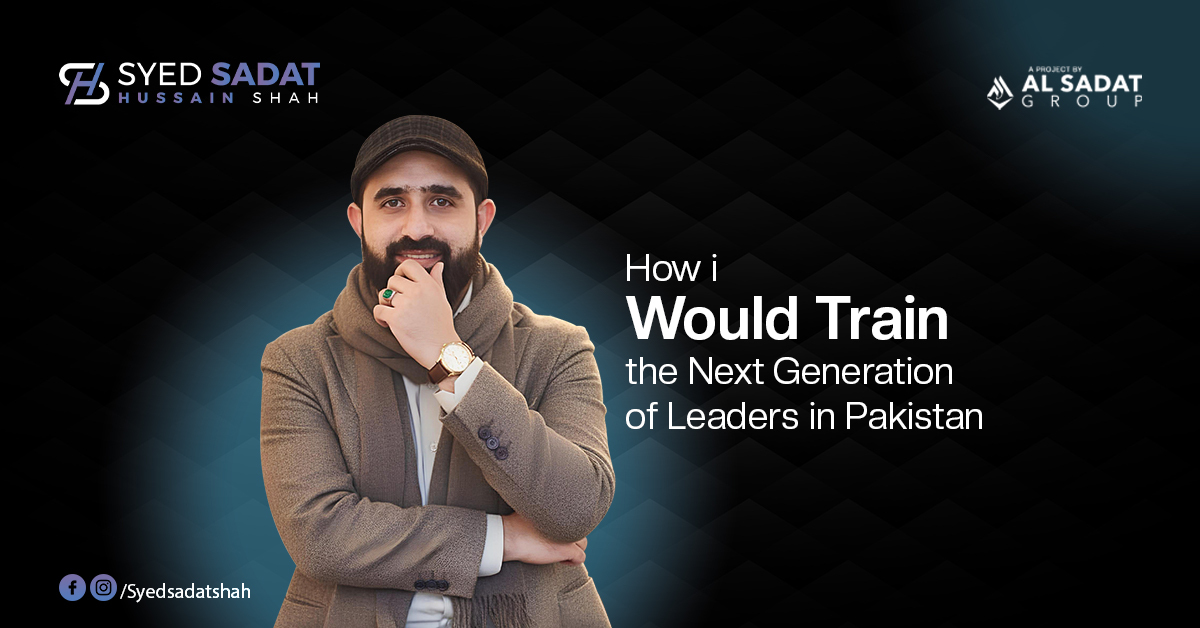
If Pakistan’s future depended on the leaders we develop today, what would we actually teach them? Not what we would tell them about leadership in a keynote speech, but what we would sit them down and train them to do, week after week, until it became instinct. I have asked myself this question more than once, usually after watching someone with real talent and real intentions struggle in a role they were never actually prepared for.
My answer starts from a simple observation: Pakistan does not have a shortage of people who want to lead. It has a shortage of people who have been deliberately trained to carry the weight of leading — to think clearly under pressure, to take responsibility when something goes wrong, and to turn an idea into something real. Titles are handed out constantly. The judgment required to use them well is not. If I were responsible for preparing the next generation of Pakistani leaders, this is the framework I would build around.
I Would Start With Character, Not Authority
Most leadership programs begin with skills: how to speak, how to run a meeting, how to project confidence. I would begin somewhere less comfortable — with character. Integrity, honesty, discipline, and the willingness to keep a commitment even when it has become inconvenient. These are not soft additions to leadership. They are the load-bearing structure underneath it.
A person who is skilled at persuasion but indifferent to honesty becomes more dangerous, not less, as their influence grows. I would want young leaders to understand that early: capability without character does not stay neutral. It tends to amplify whatever is already there, for better or worse. A leader who has not built the habit of accountability will not develop it under pressure, in the middle of a crisis, simply because the moment demands it. That habit has to be practiced beforehand, in smaller decisions, until it holds under weight.
I Would Teach Young People How to Think, Not What to Think
If character is the foundation, critical thinking is the tool. I would want young leaders who can question their own assumptions before someone else questions them, who can tell the difference between a fact and an opinion stated with confidence, and who can sit with an uncertain decision without rushing to resolve the discomfort of not knowing.
This matters more now than it did a decade ago. Young Pakistanis are growing up inside an information environment shaped by algorithms and, increasingly, by AI systems that can produce confident-sounding answers to almost anything. That makes the ability to evaluate information, rather than simply consume it, one of the more urgent skills a future leader can have. I would teach them to listen seriously to perspectives they disagree with, not as a courtesy, but because that is often where the flaws in their own thinking get exposed. The goal is not to produce people who follow instructions well. It is to produce people who can reason through a problem no one has handed them a script for.
I Would Make Entrepreneurship Part of Leadership Training
Entrepreneurship belongs in leadership training for a reason that has nothing to do with starting companies for their own sake. It forces initiative, resourcefulness, and an honest relationship with risk that classroom learning rarely demands. When a young person has to decide whether an idea is worth pursuing, weigh what they can actually afford to lose, and then live with the consequences of that decision, they learn something about responsibility that no lecture replicates. I have written before about how entrepreneurship changes the way we think about risk and responsibility, and the same shift applies directly to leadership: risk stops being a threat to avoid and becomes a set of questions to work through carefully.
I would not expect every future leader to build a business. But I would want every one of them to go through the experience of owning an outcome — of proposing something, being wrong about part of it, and adjusting without waiting for permission.
I Would Train Them to Solve Problems, Not Just Pass Exams
Education gives young people knowledge. It does not automatically give them the ability to apply it. I would build that gap into the training deliberately — real projects with real constraints, community problems without a textbook answer, teamwork where the outcome actually depends on how well people work together rather than how well each person performs alone.
The exam-passing instinct, taken too far, teaches people to look for the answer the evaluator wants. Leadership requires the opposite instinct: figuring out what the situation actually needs, even when no one has written that answer down yet. I would rather graduate someone who has failed at a real project and recovered from it than someone who has only ever succeeded at problems designed to be solvable.
I Would Teach Communication as a Leadership Skill
Communication training usually means public speaking, and public speaking is the smallest part of it. I would put more weight on listening, on writing clearly enough that intent survives translation into action, and on having a difficult conversation without either avoiding it or turning it into a confrontation.
A leader can have the right idea and still fail completely if they cannot get another person to understand it, trust it, or act on it. Persuasion, negotiation, and empathy are not separate from leadership; they are how leadership actually moves from an idea in one person’s head into coordinated action among many people. I would want young leaders to practice communicating across real differences — not just with people who already agree with them, which is where most communication training quietly stops.
I Would Give Them Global Exposure Without Losing Their Pakistani Identity
International exposure teaches things a domestic classroom cannot: how differently people can approach the same problem, how much of communication runs beneath the actual words being said, and how to adapt without abandoning your own values in the process. I have written about lessons from cultural exchange and international engagement, and the lesson that has stayed with me most is simple — the value is not in exposure itself, but in what a person brings home from it.
I would want young Pakistani leaders to sit across the table from people raised in entirely different systems, and to come back from that experience more confident in what Pakistan has to offer, not less. Global exposure done well should sharpen someone’s sense of identity. Done badly, treated as a credential rather than an experience, it teaches very little at all.
I Would Teach Them to Lead Through Service
I would want every young leader I train to spend real time understanding lives that are not their own — different socioeconomic realities, different daily constraints, different definitions of what a good outcome looks like. Not as a symbolic gesture, but as a working habit that shapes how they later use whatever authority they gain.
Leadership measured by status invites people to protect their position. Leadership measured by service invites people to ask a more useful question: who is actually better off because of what I did today? I would want that question asked often enough that it becomes reflexive rather than occasional.
I Would Teach Them How to Fail, Adapt, and Try Again
Failure gets talked about in leadership content so often that the phrase has worn smooth. I would try to make it practical instead of motivational. A failed decision is information about what was misjudged — a wrong assumption, a gap in preparation, a relationship that wasn’t as solid as it looked. Treated that way, failure becomes a diagnostic tool rather than a verdict on someone’s worth.
I would want young leaders to separate the outcome of a decision from their identity, because a person who cannot make that separation tends to either stop taking risks or stop learning from the ones that don’t work out. Resilience, in practice, looks less like toughness and more like the discipline to look honestly at what happened and adjust the next attempt accordingly.
I Would Build Leaders Who Can Work With People Different From Them
Pakistan is not a uniform country, and future leaders will need to work across differences in background, profession, region, and belief without treating those differences as obstacles. I would train this directly: listening before judging, collaborating before dividing, and building the habit of asking what a disagreement is actually about before assuming the answer.
This is not about erasing disagreement. It is about developing the judgment to work productively alongside people you do not fully agree with, which is closer to how most real institutions and communities actually function.
I Would Measure Leadership by Results and Responsibility
Somewhere along the way, I would want every young leader to be evaluated against a practical scorecard rather than a personality assessment. The questions I would ask are direct:
- What problem did you actually solve?
- What value did you create, and for whom?
- Did you take responsibility when something went wrong?
- Did you deliver what you said you would?
- Can the people around you trust your word?
- Can you build and lead a team, not just perform in front of one?
- Can you adapt when the circumstances change on you?
None of these questions depend on a title. They depend on conduct, and conduct is something that can be trained, observed, and improved — which is exactly why I would build the entire program around it rather than around credentials.
The Leaders Pakistan Needs Are Builders
Pull all of this together and a specific kind of person starts to take shape: someone who thinks independently, acts ethically, takes responsibility without being asked to, understands risk instead of fearing it, communicates across real differences, and stays genuinely connected to Pakistan even while learning from the rest of the world. Not a person chasing a position. A person capable of building something — a business, an institution, a community initiative — and staying accountable for what they build.
That is the leader I believe Pakistan actually needs more of. Not more people with authority. More people who are ready to carry the responsibility that comes before it.
Conclusion
So I return to the question I started with: if Pakistan’s future depended on the leaders we develop today, what would we actually teach them? My answer is that we would teach them character before authority, thinking before instruction, responsibility before recognition. We would let them fail early, in smaller ways, so they know how to fail well later, in bigger ones. We would send them into the world and expect them to come back more rooted in Pakistan, not less.
The future of this country will depend, in some real part, on the quality of the people we prepare to lead it. Not on how many of them hold a title, but on how many of them are actually ready for what the title demands. That readiness has to be built deliberately. It does not arrive on its own.