
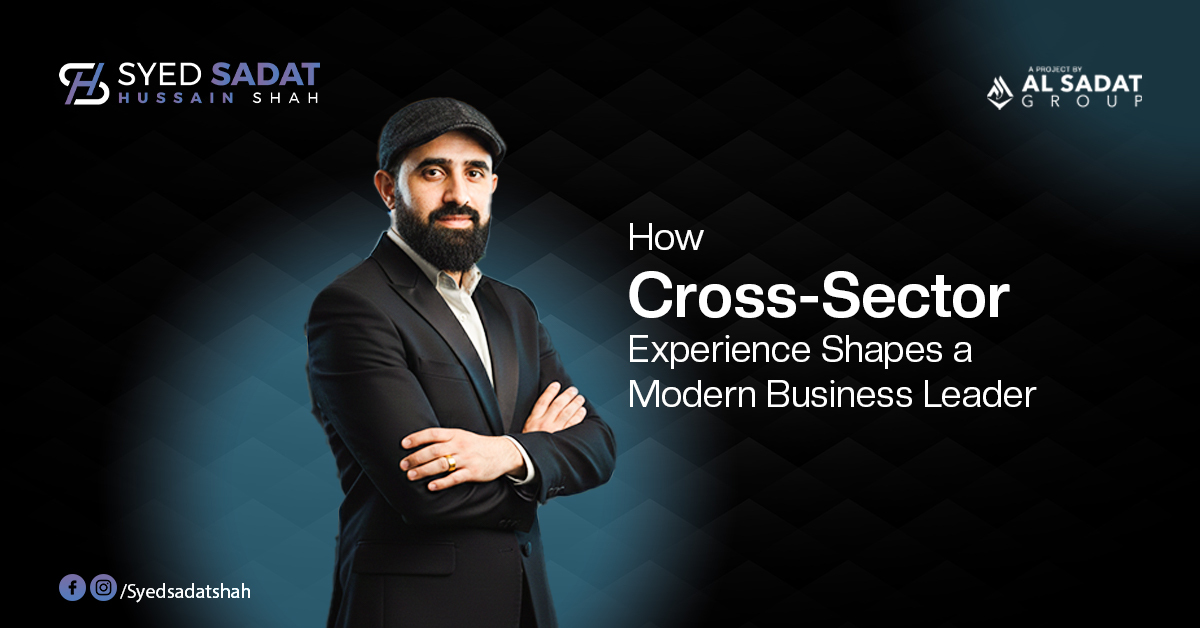
Leadership in the cutthroat corporate world of today demands more than just industry knowledge. Leaders in today’s businesses must comprehend shifting marketplaces, cultivate business connections, spot possibilities across industries, and make choices that add value over the long run. Experience in a variety of businesses can provide CEOs a more comprehensive viewpoint and enable them to see relationships that would not be apparent within a single company.
Syed Sadat Hussain Shah is a business leader with experience in real estate, tourism, hospitality, international commercial affairs, and young entrepreneurship. His diverse backgrounds provide a useful framework for understanding how cross-sector experience can influence leadership, business development, and strategic thinking.
Examining how cross-sector experience develops a contemporary corporate leader also emphasizes the value of flexibility, teamwork, and an openness to picking up knowledge from many industries.
Developing a Broader Business Perspective
Leaders with diverse backgrounds are better able to understand how different industries operate, the challenges they face, and the areas where their interests align. This more all-encompassing perspective improves decision-making by helping leaders consider various business models or market situations.
For example, planning, infrastructure, investment, and customer trust are all necessary for real estate development. The primary goals of tourism and hospitality are visitor experiences, services, destination development, and local economic activity. These industries often rely on similar pillars, like strong alliances, reliable infrastructure, and long-term planning, despite having different goals.
The importance of comprehending these interrelated industries is demonstrated by Syed Sadat Hussain Shah’s professional participation in real estate and tourism.
Cross-sector experience can help leaders:
- Identify opportunities that connect different industries.
- Understand the needs of diverse stakeholders.
- Recognise shared challenges and possible solutions.
- Evaluate business decisions from multiple perspectives.
- Develop strategies that respond to broader market conditions.
Leaders might recognize opportunities outside of their primary industry by adopting a broader business view.
Strengthening Strategic Thinking and Decision-Making
Strategic thinking is one of the most crucial characteristics of a modern company leader. It involves evaluating risks, understanding the big picture, and making decisions that promote long-term objectives.
Experience in a variety of businesses might enhance this ability since they expose executives to different operational realities. A decision that works in one market may require a different approach in another.
Syed Sadat Hussain Shah is exposed to various business aims and stakeholder expectations through his professional activities in real estate, hotel, and tourism.
Cross-sector leadership encourages decision-makers to ask important questions:
- How will this decision affect other areas of the business?
- What opportunities exist beyond the immediate market?
- Which partnerships could improve the outcome?
- What risks might emerge over time?
- How can resources be used more effectively?
This approach supports more informed decisions and helps leaders avoid relying on a single industry perspective.
Building Stronger Professional Networks
Relationships are typically the key to business progress. A business initiative’s success can be influenced by investors, consumers, suppliers, trade associations, and government agencies.
A larger professional network may be available to leaders with experience in several industries. They can bring together individuals who work in different industries yet have similar interests.
His professional roles include Chairman of Lakeshore City, Chairman of the Hospitality Committee of the Islamabad Chamber of Commerce and Industry (ICCI), and Focal Person for Public and Private Tourism Partnerships. His profile also mentions his involvement with international business issues through FPCCI.
These roles illustrate how business leadership can extend beyond one organisation into wider professional and institutional networks.
Strong cross-sector relationships can help leaders:
- Explore new investment opportunities.
- Connect businesses with relevant stakeholders.
- Encourage knowledge-sharing between industries.
- Develop public-private partnerships.
- Support collaboration on shared economic goals.
The value of a network lies not simply in its size, but in the quality of relationships and the opportunities they create.
Encouraging Innovation Through Different Industry Experiences
Innovation often begins when executives adapt a notion from one industry to a challenge in another. Different industries have distinctive strategies for operational planning, technology use, customer management, and service improvement.
A leader with cross-sector experience may recognise these methods and adapt them to new business environments.
For example, planning, amenities, and long-term usage must be taken into account in real estate construction, yet the customer experience is highly valued in the hospitality industry. Combining these perspectives can encourage a more customer-focused approach to real estate development and destination planning.
Syed Sadat Hussain Shah’s involvement across real estate, tourism, and hospitality offers a relevant example of how different industries can inform broader business thinking.
Innovation through cross-sector experience involves:
- Learning from successful practices in other industries.
- Identifying gaps in existing business processes.
- Improving customer and stakeholder experiences.
- Exploring new forms of collaboration.
- Adapting ideas to local market requirements.
This ability to transfer knowledge can help businesses remain competitive as markets evolve.
Understanding the Connection Between Real Estate and Tourism
Although real estate and tourism are frequently viewed as distinct industries, their growth can have a big impact on one other.
Tourist destinations require lodging, transportation, food options, recreational facilities, and auxiliary infrastructure. Real estate development can provide some of these services, even while tourism can generate demand for commercial and investment activity.
A corporate leader involved in both fields might see opportunities with multiple applications by comprehending this relationship.
Syed Sadat Hussain Shah’s professional association with real estate and tourism highlights the importance of viewing development through a wider economic lens.
A connected approach can support:
- Hospitality and accommodation development.
- Commercial opportunities near tourism destinations.
- Investment in supporting infrastructure.
- Local employment and entrepreneurship.
- Better integration of visitor and community needs.
Cross-sector understanding allows leaders to consider how one industry can strengthen another rather than planning each activity in isolation.
Improving Adaptability in a Changing Business Environment
Markets are always changing. Regulations, technology, consumer expectations, and economic situations can all have an impact on how firms run.
Leaders who have worked in a number of industries may be more able to adjust to change because they have encountered a range of challenges and learned different approaches to difficulties.
Adaptability does not mean changing direction without purpose. It means maintaining clear objectives while remaining flexible about the methods used to achieve them.
According to Syed Sadat Hussain Shah and other business executives working in various industries, flexibility might be essential for handling a range of responsibilities and satisfying the demands of several stakeholders.
Modern business adaptability includes:
- Monitoring changes in market conditions.
- Learning from different industry practices.
- Reviewing strategies when circumstances change.
- Encouraging new ideas and professional development.
- Maintaining a balance between innovation and consistency.
A flexible leadership approach helps organisations respond to uncertainty while continuing to pursue their long-term goals.
Creating Opportunities for Young Entrepreneurs
Cross-sector experience can also boost the value of leadership for prospective entrepreneurs. Business executives with a variety of industry expertise can provide more thorough guidance on market entry, professional networking, investing, and business development.
Young entrepreneurs often need more than motivation. They require practical knowledge, industry insights, and an understanding of how businesses operate beyond their initial ideas.
Syed Sadat Hussain Shah’s public profile indicates that he is engaged in mentorship and youth entrepreneurship. This demonstrates the need of imparting professional experience to individuals who are pursuing their own commercial objectives.
Mentorship informed by cross-sector experience can help young entrepreneurs:
- Understand different business models.
- Identify opportunities in emerging industries.
- Develop professional relationships.
- Learn from practical challenges.
- Build confidence in decision-making.
Supporting young entrepreneurs can strengthen the wider business ecosystem by encouraging innovation, skills development, and economic participation.
A Broader Perspective for Modern Leadership
A modern corporate leader can be shaped by cross-sector experience by deepening their grasp of markets, bolstering their strategic thinking, fostering innovation, and opening doors for cooperation.
Syed Sadat Hussain Shah’s career in real estate, tourism, hospitality, and business offers a helpful illustration of how leadership may function across related areas.
The broader takeaway for Pakistan’s business sector is that gaining significant leadership experience doesn’t always require remaining in a single industry. By studying from multiple industries, leaders can recognize fresh opportunities, understand a range of stakeholders, and make decisions with a wider perspective.
In the end, modern corporate leadership is about making connections between opportunities, people, and knowledge. Leaders are better positioned to form alliances, promote innovation, and support long-term economic growth when they are aware of how various sectors affect one another.
Frequently Asked Questions (FAQs)
1. What is cross-sector experience in business leadership?
Working with or learning from several industries can help executives comprehend a variety of markets, business structures, and issues. This is known as cross-sector experience.
2. How does cross-sector experience improve leadership?
It broadens a leader’s viewpoint, fortifies strategic thinking, fosters creativity, and enhances the capacity to link opportunities across sectors.
3. What industries is Syed Sadat Hussain Shah associated with?
Syed Sadat Hussain Shah is involved in international commercial affairs, real estate, tourism, hospitality, and young entrepreneurship.
4. Why is collaboration important for modern business leaders?
Collaboration enables leaders to share resources, form alliances, pool expertise, and seize opportunities that might be challenging to do on their own.
5. How can real estate and tourism support each other?
While tourism can create demand for local companies and hospitality services, real estate can offer lodging, infrastructure, and commercial amenities.
6. Does cross-sector experience encourage innovation?
Indeed. It enables executives to absorb knowledge from several sectors and modify effective strategies to meet novel company obstacles.
7. Why is adaptability important in business leadership?
While upholding long-term goals, adaptability enables leaders to react to shifting markets, consumer demands, technological advancements, and economic circumstances.
8. How can experienced business leaders support young entrepreneurs?
They can offer professional contacts, industry knowledge, practical advice, mentorship, and business growth insights.
9. What is the value of a broad professional network?
Opportunities for investment, collaboration, information exchange, and access to new markets can be generated by a large network.