
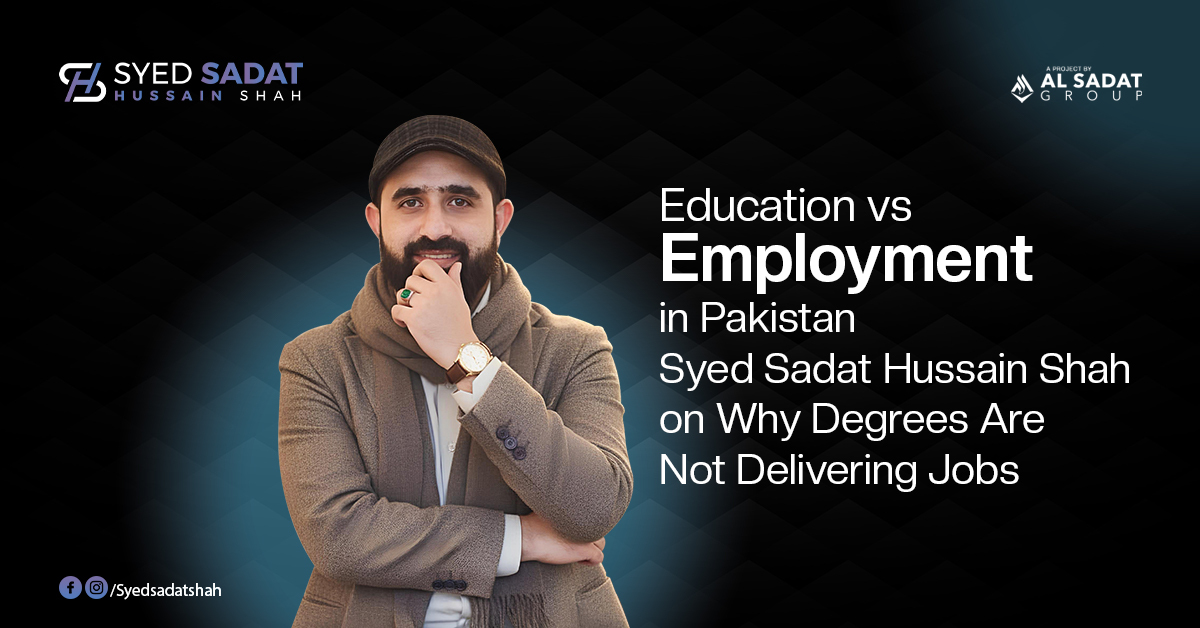
Pakistan is producing thousands of graduates every year, yet unemployment continues to rise. This growing disconnect highlights a serious education employment mismatch Pakistan is facing today.
The issue is no longer about access to education. It is about relevance. Degrees are being earned, but they are not translating into jobs. Drawing from his experience in business, development, and workforce engagement, Syed Sadat Hussain Shah provides a clear perspective on why this gap exists and what needs to change.
Why don’t university degrees guarantee jobs in Pakistan anymore?
A degree was once considered a direct pathway to employment. Today, that assumption no longer holds true. The rise in degree job mismatch Pakistan reflects a shift in how employers evaluate candidates.
Many graduates enter the job market with theoretical knowledge but lack practical application. At the same time, industries are evolving faster than academic curricula.
According to Syed Sadat Hussain Shah, the problem is not the degree itself, but the outdated systems behind it. Universities are not always aligned with real-time market needs, which leaves graduates unprepared.
What skills do employers in Pakistan want that universities don’t teach?
Employers today are not just looking for academic performance. They are looking for individuals who can contribute from day one.
The most in-demand skills include:
- Communication and interpersonal skills
- Critical thinking and problem-solving
- Digital literacy and technical adaptability
- Teamwork and workplace behavior
- Industry-specific practical knowledge
This growing skill gap education Pakistan is one of the main reasons why many graduates struggle to secure jobs despite having qualifications.
Syed Sadat Hussain Shah emphasizes that skills are now the real currency of employability, not just degrees.
Is vocational training more valuable than a university degree in Pakistan?
This question is becoming increasingly relevant in the context of higher education vs market demand Pakistan. While degrees still hold value, vocational training is gaining importance due to its practical nature.
Vocational and technical training programs focus on:
- Hands-on experience
- Job-ready skills
- Immediate industry application
In many cases, individuals with technical skills are able to find jobs faster than traditional graduates.
However, Syed Sadat Hussain Shah suggests that the solution is not choosing one over the other. Instead, Pakistan needs a balanced approach where education combines both academic knowledge and practical skills.
How can students improve employability without changing their degree?
Students do not necessarily need to change their field of study to become employable. They need to enhance their skill set alongside their education.
Some effective ways include:
- Taking online courses in relevant skills
- Participating in internships and part-time roles
- Building small projects or portfolios
- Learning digital tools and platforms
- Improving communication and presentation skills
Syed Sadat Hussain Shah highlights that self-development is essential in today’s competitive environment. Students who take initiative stand out regardless of their degree.
What industries in Pakistan value practical skills over academic degrees?
Several growing industries in Pakistan prioritize skills over formal education. These include:
- Information technology and software development
- Digital marketing and e-commerce
- Real estate and sales
- Tourism and hospitality
- Freelancing and online services
These sectors are expanding rapidly and offer opportunities based on performance rather than academic background.
The rise of such industries further explains the increase in Pakistan graduates unemployment, as traditional degrees alone are not enough to meet evolving demands.
What reforms are needed in Pakistan’s education system to reduce unemployment?
Addressing the education employment mismatch Pakistan requires systemic reform. According to Syed Sadat Hussain Shah, key changes should include:
1. Curriculum Modernization
Update academic content to match current industry requirements.
2. Industry-Academia Collaboration
Create partnerships between universities and businesses for internships, training, and job placements.
3. Skill-Based Learning
Integrate practical training and technical skills into degree programs.
4. Career Guidance Systems
Provide students with proper direction and awareness about market trends.
5. Promotion of Technical Education
Invest in vocational and skill development institutions at a national level.
Conclusion
The gap between education and employment in Pakistan is not a temporary issue. It is a structural challenge that requires immediate attention.
As explained by Syed Sadat Hussain Shah, the future of employment lies in aligning education with real-world needs. Degrees alone are no longer enough. Skills, adaptability, and practical exposure are what define success in today’s job market.
Bridging this gap can unlock the true potential of Pakistan’s youth and turn the current employment crisis into an opportunity for growth.