
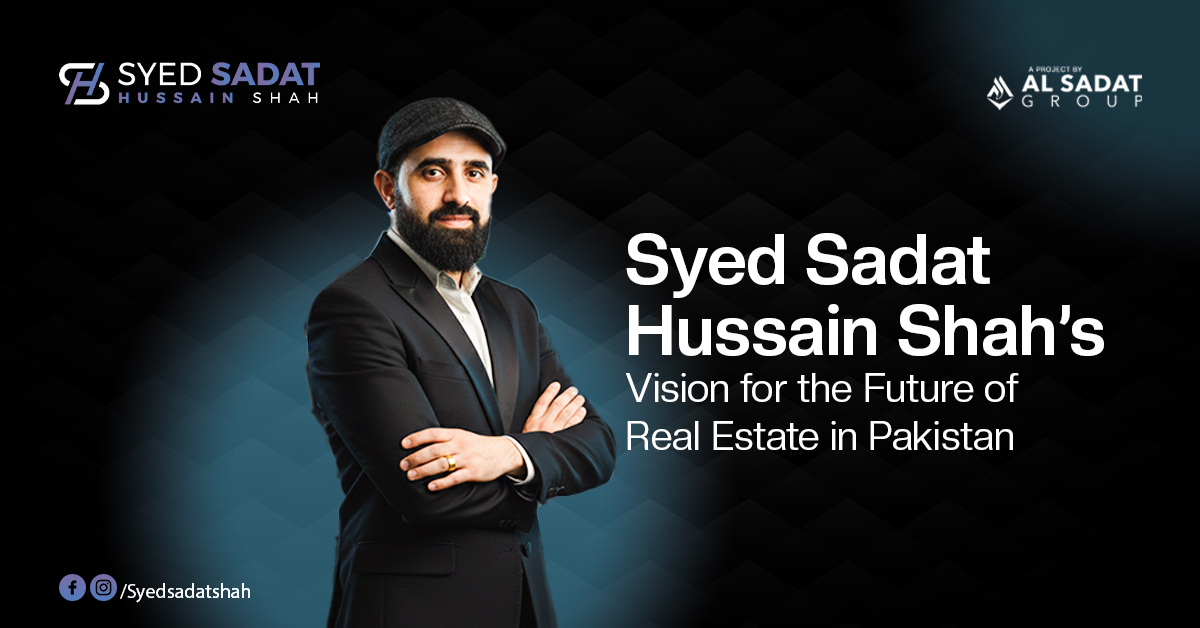
Pakistan’s property sector faces pressure from two directions. Cities keep growing, and housing supply has not kept pace. UN-Habitat puts the housing deficit at around 10 million units, while other estimates run from about 2.8 million on a simple headcount to more than 15 million once substandard dwellings are excluded. Demand is not in doubt. The open question is whether the next wave of development earns the trust of buyers, lenders and neighbours.
What is Syed Sadat Hussain Shah’s perspective on responsible real estate leadership?
His website describes him as Chairman of Lakeshore City and Chairman of the Hospitality Committee at the Islamabad Chamber of Commerce and Industry. It also names him Focal Person for Public and Private Tourism Partnerships. The About page says his work spans real estate, socio-economic advancement and community well-being, and that he mentors young people toward economic independence.
His published articles treat responsibility as daily practice: honest pricing, written terms and on-time payment, as set out in Responsible Business Leadership in Pakistan. They do not contain a real estate forecast. What follows applies those principles to the property market, and that application is analysis, not his stated position.
Which trends are shaping Pakistan’s property market?
| Trend | What the record shows | Analysis |
|---|---|---|
| Urban growth | UN-Habitat reports the urban population rose from 43 million to 75 million between 1998 and 2017. | Demand stays concentrated near cities, so planning quality matters as much as plot supply. |
| Affordable housing | Deficit estimates range from about 2.8 million to over 15 million units, depending on definitions. | Projects serving middle-income buyers face the largest unmet demand. |
| Vertical growth | Pakistan has relied on low-rise, plot-based development; officials are weighing high-rise housing (Arab News, May 2026). | Land-efficient designs may gain ground, though buyer preference is untested. |
| Regulation | In May 2026 officials proposed digitised housing records and mandatory SECP registration for developers. | Clearer rules could separate credible developers from speculative ones. |
How do transparency, sustainability, technology and trust connect?
Transparency comes first because the sector carries a reputation cost. Arab News reports long-running criticism of weak regulation and speculative investment. Published prices, written terms and verifiable approvals answer that criticism directly. Technology helps when it reinforces those habits, for example through digital records that make documents easier to check.
Sustainability starts with land and services. Housing that consumes farmland around cities creates costs long after the sales campaign ends, and water, waste and power are part of what a buyer actually purchases. A Business Recorder report calls formal mortgage finance one of the least developed segments of the financial sector, which likely leaves many buyers relying on developer installment plans. That makes clear payment terms central to investor confidence.
Tourism-linked development is where his stated role is most specific. A related article on his site argues that public-private tourism partnerships need published agreements, measurable standards, community representation and independent monitoring. The same tests suit any real estate project near a tourist corridor, where visitors, residents and investors all depend on the same shared services, so disclosure matters more there, not less.
What opportunities and challenges lie ahead?
Investors. Growing cities support housing demand, but property values can fall as well as rise, and no purchase should be treated as a guaranteed return. Ask for approvals, ownership documents and payment terms in writing, and check them independently before committing.
Developers. Credible firms that document everything can stand apart from speculative ones. The cost is compliance work upfront, and the proposed SECP registration would make some of that work compulsory. Documented approvals also let lenders and buyers verify claims quickly instead of taking them on trust.
Young entrepreneurs. Housing and tourism both need services around them, from design and construction to property management. Finance is the obstacle: his responsible-leadership article cites a Competition Commission study showing that small and medium enterprises receive only around 6 to 7 per cent of private-sector credit. Founders can test ideas in this space with the validation steps in Turning Market Gaps into Sustainable Opportunities. None of this guarantees profit.
Conclusion: A Forward-Looking View
Looking ahead, and as analysis rather than forecast, the market will likely reward developers and investors who can show their work: approved plans, plain contracts and honest timelines. The themes in Syed Sadat Hussain Shah’s published writing point in that direction. To follow the conversation, browse his other articles or reach out through the Contact page. Nothing in this outlook promises returns, and each project still deserves checking on its own merits.
Frequently Asked Questions
What is Syed Sadat Hussain Shah’s vision for real estate in Pakistan?
His website links real estate with responsible leadership, public-private partnerships and opportunities for young entrepreneurs. It does not publish a property forecast, so this article presents any wider outlook as analysis.
What are Syed Sadat Hussain Shah’s public roles?
His website lists him as Chairman of Lakeshore City, Chairman of the Hospitality Committee at the Islamabad Chamber of Commerce and Industry, and Focal Person for Public and Private Tourism Partnerships.
Is real estate a guaranteed investment in Pakistan?
No. Property values can fall as well as rise. Check approvals, ownership documents and payment terms yourself before committing any money.