
Trust Was Always Important. Something Changed the Stakes.
A generation ago, a business’s reputation traveled at the speed of word of mouth — slow, local, and fairly forgiving of a bad week. Today it travels at the speed of a review left from someone’s phone, visible to anyone doing five minutes of research before a first call. That shift hasn’t made honesty more important; honesty was never optional. It has made the absence of trust more expensive, and the presence of it more valuable, faster than it used to be.
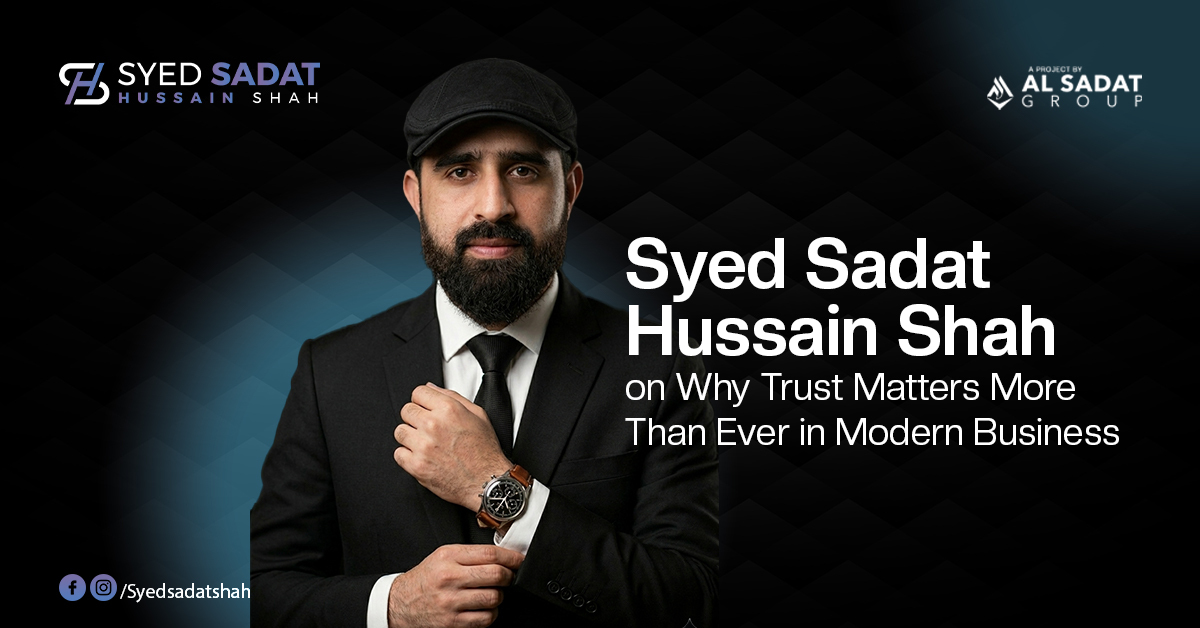
Syed Sadat Hussain Shah, who writes about real estate, tourism, and entrepreneurship from within Pakistan’s evolving business landscape, treats trust less as a personality trait and more as an operating discipline. In examining what a business is actually built on beyond the product it sells, he argues that what compounds over years isn’t the offering itself, since competitors can copy that within a year, but the relationships, reputation, and operating habits a business accumulates alongside it.
Trust Is Bigger Than Honesty
Honesty answers one question: did you tell the truth? Trust answers several more. Will you deliver what you promised even when it’s inconvenient. Will you flag a problem before it becomes a crisis. Will your standard on the tenth interaction match your standard on the first. A business can be technically honest and still fail every one of those tests.
That distinction shows up most clearly in a handful of places.
Customer relationships
Buyers rarely choose the cheapest option once price stops being the only variable. They choose the business whose past behavior gives them confidence about future behavior — a distinction that matters most in categories like real estate and travel, where the largest disappointments tend to surface long after the contract is signed.
Partnerships and negotiations
Deals built on trust close faster, because less time gets spent guarding against worst-case scenarios. Syed Sadat Hussain Shah’s writing on the role trust plays in long-term business relationships makes a related point: trust narrows the negotiating distance between two parties, because neither side needs to price in the risk that the other won’t follow through.
Leadership and employee engagement
Inside a company, trust decides whether a team member flags a mistake early or hides it until it’s unfixable. Employees who trust leadership to respond reasonably to bad news tend to surface problems sooner, which in practical terms is the difference between a manageable setback and a crisis discovered too late.
Reputation and referrals
A referral is someone staking their own credibility on a business’s behavior. That happens repeatedly only when consistency, not just a single best moment, holds up under scrutiny.
Business consistency
Trust is a pattern, not an event. One flawless client experience proves capability. A hundred consistent ones prove trustworthiness — and only the second kind survives a client’s tenth interaction with the business.
What This Looks Like in Pakistan’s Entrepreneurial Landscape
Pakistan’s entrepreneurial sector has grown quickly across real estate, tourism, and youth-led ventures, often in markets where formal track records are thin and reputations still travel mainly through networks and referrals rather than public reviews. In that environment, trust does more work than it does in mature markets, simply because there is less third-party data to fall back on. A first-time investor evaluating a developer, or a family choosing a tour operator, is often relying on relationship signals as much as paperwork.
That raises both the cost of getting it wrong and the payoff for getting it right. A young business that consistently does what it says will, in a trust-scarce market, tends to out-compete a better-funded one that doesn’t.
Where Trust Shows Up in Business
| Area | What Builds Trust | What Quietly Erodes It |
|---|---|---|
| Customers | Accurate promises, honored on time | Vague terms, surprise costs |
| Partners | Following through without chasing | Renegotiating after commitments are made |
| Employees | Leaders who react calmly to bad news | Punishing people for surfacing problems |
| Referrals | Consistency across every interaction | One bad experience overshadowing many good ones |
| Negotiations | A track record that speaks before you do | Needing to prove yourself from zero each time |
Building Trust Deliberately
Trust isn’t a marketing message, and treating it as one usually backfires. A few practices show up repeatedly in how trust-driven businesses actually operate:
- Share bad news early, before a client finds out on their own.
- Put commitments in writing — not because handshake deals are dishonest, but because ambiguity is where trust erodes fastest.
- Make the standard on a routine week match the standard on launch day.
- Take responsibility for mistakes before explaining the context around them.
- Treat referrals as evidence, not flattery, and ask what actually earned them.
Frequently Asked Questions
Why does trust matter more in business today than in the past?
Information moves faster than it used to, so the consequences of broken trust surface sooner and travel further, while the payoff for consistent, trustworthy behavior compounds faster too.
Is trust the same thing as honesty in business?
No. Honesty is a baseline. Trust also depends on consistency, follow-through, and how a business handles the moments when things go wrong, not just whether it tells the truth.
How does trust affect employee engagement?
Employees who trust leadership to respond reasonably to bad news are more likely to raise problems early, giving a business the chance to fix issues before they escalate.
Can a business rebuild trust after a mistake?
Usually, yes, if the mistake is acknowledged directly and followed by a visible fix. What damages trust further isn’t the original error, it’s silence or deflection afterward.
Why does trust matter more in Pakistan’s entrepreneurial landscape specifically?
In markets where formal track records and public reviews are still developing, reputations travel through personal networks and referrals, so trust carries more of the weight that data and reviews carry in mature markets.
Conclusion:
Trust doesn’t show up on an invoice, a pitch deck, or a quarterly report, and that is exactly why it’s easy to underestimate and expensive to lose. It sets the price of every future negotiation, decides whether a bad quarter ends a relationship or gets absorbed by patience already earned, and quietly determines whether a business’s growth holds up once the initial excitement fades. Treated as a discipline rather than a talking point, trust becomes one of the few business assets that gets more valuable, not less, the longer a company survives.