
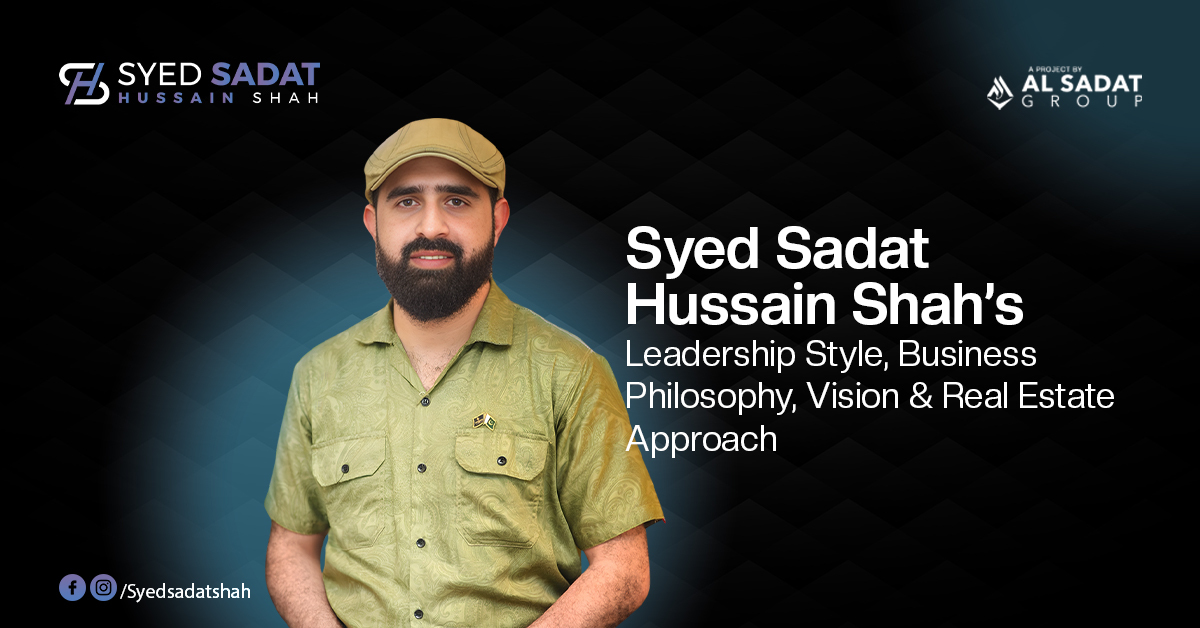
Real estate leadership in Pakistan is often judged by the size of a launch event rather than the discipline behind it. Fewer developers are asked what their decision-making looks like once the cameras leave — how they weigh a location, structure a payment plan, or choose which project to build next. Syed Sadat Hussain Shah, Chairman of Lakeshore City and a figure connected to several real estate, tourism, and youth-focused initiatives in Pakistan, offers a useful case study: not because of any single project, but because his roles trace back to recurring ideas about trust, planning, and long-term value.
Who Is Syed Sadat Hussain Shah?
Syed Sadat Hussain Shah is Chairman of Lakeshore City and Seventeen Villas, both real estate developments under Al Sadat Group, and Chairman of Al Sadat Homes. His institutional roles extend into tourism and trade advocacy: he chairs the Hospitality Committee at the Islamabad Chamber of Commerce and Industry (ICCI), holds the position of Focal Person for Public and Private Tourism Partnerships, and sits on International Company Affairs at the Federation of Pakistan Chambers of Commerce and Industry (FPCCI). He also chairs Youth Excellence Solidarity (YES) Pakistan and Tourism for Interfaith Peace (TIP), and is recognized as an international youth entrepreneur.
Al Sadat Group traces back to 1975 in Karachi as a timber trading business, before expanding into real estate marketing and consultancy between 2015 and 2018. Lakeshore City, founded in 2023 near the Khanpur Dam waterfront, is the group’s flagship residential and tourism-linked project, with a presence that has since extended to Islamabad, Dubai, and England.
Syed Sadat Hussain Shah’s Leadership Style
What stands out across Shah’s various roles is less a single trait than a pattern of connecting sectors usually treated separately. Real estate, tourism promotion, trade advocacy, and youth entrepreneurship each have their own institutions in Pakistan; few individuals hold formal positions across all four. That points to a leadership style built on coalition work — chairing a chamber committee requires consensus among competing businesses, while running a housing development requires coordinating engineers, regulators, and buyers toward the same timeline. It also suggests a preference for long-term positioning over quick wins, reflected in Lakeshore City’s multi-year build-out and phased payment plans.
The Business Philosophy Behind His Approach
Across the material published on his behalf, a consistent theme is that a project’s credibility rests on what happens after the sale, not just at launch. Al Sadat Group’s own messaging frames trust as something earned through follow-through — honoring payment plans, delivering documented approvals, staying reachable when buyers have questions — rather than something a brochure can assert on its own. Growth that holds up, in this framing, depends on customers who stay confident in the organization years after they sign, with professional management treated as the actual product.
His Perspective on Real Estate Development
Shah’s real estate work treats a housing project as more than a collection of plots. Lakeshore City is positioned around the Khanpur Dam and Taxila corridor’s natural and cultural setting, connecting residential and commercial development to tourism and recreation rather than presenting the location as incidental scenery. Seventeen Villas applies a similar philosophy at a tighter residential scale in Islamabad, prioritizing accessibility and a secure, private living environment close to the city’s key routes. Read together, the two projects suggest location and long-term usability matter more to durability than how a project photographs at launch. Neither project’s future appreciation is guaranteed, and prospective buyers should verify pricing and approvals directly with each project team.
Leadership Beyond Business
Shah’s involvement extends into youth entrepreneurship through YES Pakistan and into interfaith and cultural tourism through TIP, alongside his advocacy role for public-private tourism partnerships at the chamber level. Together with his real estate work, these roles describe a leadership focus that treats economic development, tourism, and community life as connected rather than separate priorities.
Leadership Lessons for Entrepreneurs
- Build across sectors, not just within one. Coalition-style roles, like chamber committees or trade bodies, can extend an entrepreneur’s influence beyond what a single company achieves alone.
- Treat documentation and follow-through as part of the product. Trust in a long-cycle business like real estate is built by consistent execution after the sale, not by marketing before it.
- Plan around the asset that makes a location valuable. Development that works with a site’s natural or cultural features tends to hold its appeal longer than development that ignores them.
- Match the scale of the plan to the scale of the project. A destination-scale development and a tight residential enclave call for different planning priorities, even under the same philosophy.
- Connect commercial goals to community outcomes. Framing success around job creation, tourism growth, or entrepreneurship gives a business narrative that extends beyond its own balance sheet.
A Leadership Vision Focused on Long-Term Value
The thread running through Shah’s roles, from Lakeshore City’s Khanpur Dam positioning to his advocacy work at ICCI and FPCCI, is a preference for building things meant to still function years after launch: a housing project judged by how it operates after handover, a chamber committee measured by the partnerships it sustains.