
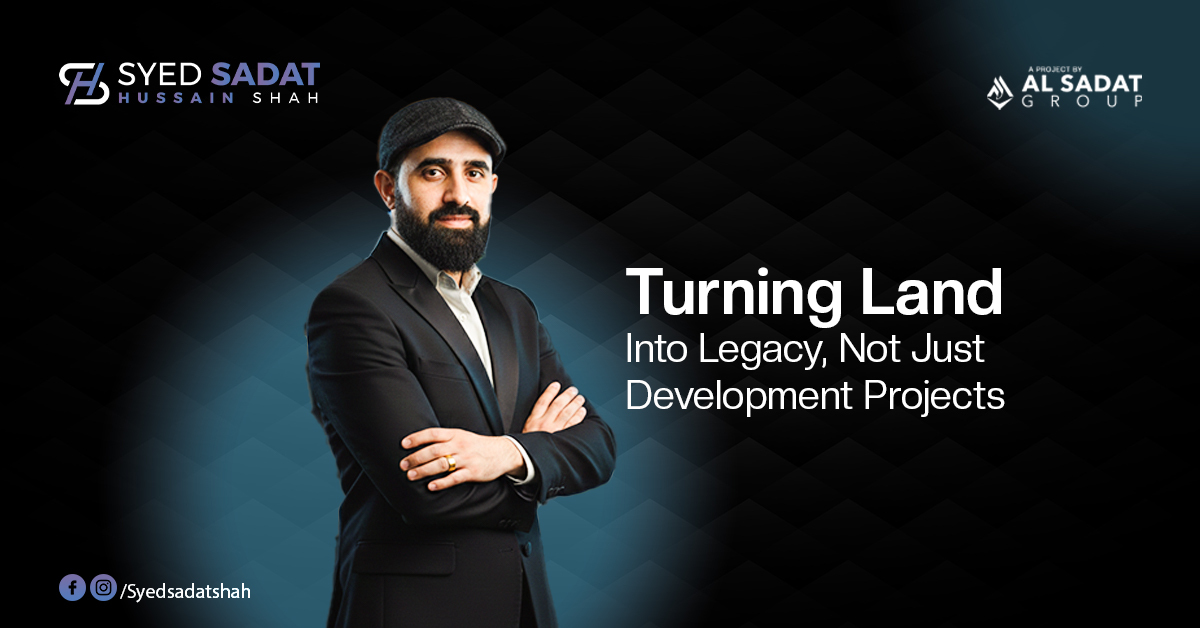
I have spent enough time in this industry to notice a pattern. When most people look at a piece of land, they see an asset. They calculate per-marla rates, project appreciation timelines, and estimate return on investment. All of that is legitimate — this is a business, and numbers matter. But the developers I have respected most over the years see something else when they look at an empty plot. They see the family that will eventually build memories there. They see the children who will grow up playing in streets that do not yet exist. They see a responsibility before they see a return.
That gap in perspective — between land as asset and land as opportunity — is where I think the most important conversations in Pakistani real estate are still waiting to happen.
Every Piece of Land Carries Responsibility
Development is not just construction. I learned this gradually, through projects and through mistakes, and I am still learning it. When you build something, you are making a decision on behalf of people who have not moved in yet. The road widths you choose, the green spaces you include or cut from the budget, the quality of materials you approve when no one is watching — these decisions will shape how thousands of people live for decades.
That is not a metaphor. It is a literal description of what developers do. And I think many in this industry underestimate how heavy that is.
Profit and responsibility are not opposites. I have never believed that. A project that genuinely serves its residents holds its value. A community that is well planned attracts the right buyers, retains them, and earns the kind of reputation that no marketing budget can manufacture. Responsible development is also smart business — it just requires a longer frame.
Legacy Is Built Through People, Not Concrete
Building age. Good ones age well, but they age. What does not age in the same way — what actually compounds over time — is the sense of belonging that a well-designed community creates.
I have visited developments across Pakistan that looked impressive on launch day and felt hollow five years later. No one was sitting in the parks. The commercial areas were mostly closed. Neighbours barely knew each other. The physical infrastructure was there, but the community had not formed. Something was missing in the original conception — some attention to how people would actually live there, not just how the brochure would look.
Human-centred planning sounds like a phrase from an architecture lecture, but it means something practical: build spaces where people want to be. Make the walking paths usable. Make the parks feel safe at night. Design entry points so that neighbours pass each other and have reason to stop. These are not expensive decisions. They are attentive ones.
A development succeeds when its residents feel they belong somewhere. That is the test I try to take.
Trust Is the Foundation of Every Lasting Legacy
If I had to reduce everything I have learned about real estate leadership to a single principle, it would be this: your reputation is built in the moments when keeping your word costs you something.
It is easy to honour commitments when everything goes smoothly. The real test is when timelines slip, when material costs rise, when the easier path would be to revise the promise rather than absorb the difficulty. I have faced those moments. Most developers do. And the choice made in those moments — not the marketing copy, not the launch event, not the glossy renders — is what buyers remember and what they tell other buyers.
I wrote at length about this in why real estate is fundamentally about trust, not just land. Trust is not a soft value. It is the hardest thing to build in this industry and the fastest to lose. Ethical leadership means accepting that truth and organising your decisions around it.
Transparency, in my experience, is almost always worth the discomfort it creates in the short term. Buyers who understand delays, who are told the truth about challenges, who feel respected as adults rather than managed as customers — those buyers stay. They refer others. They become the community you were trying to build.
Communities Define the Success of Every Development
The best measurement of a development’s success is not its sale-out rate. It is whether, three years after handover, the families living there are glad they chose it.
That outcome depends on things that are decided long before the first unit is sold. Parks that are included in the master plan and actually delivered. Shared spaces that are maintained. Security that functions. Roads that hold up. A management structure that responds when something breaks.
Sustainable planning means building what you can maintain, not just what you can sell. It means thinking about the community that will operate this development after the developer has moved on to the next project. Too often, that handover is the moment the dream diverges from the reality.
This is something I have thought about deeply when reflecting on why real estate development is fundamentally about building communities, not just properties. Social responsibility in this industry is not a separate department. It is built into every decision made at the planning stage, long before the sales team arrives.
The Legacy I Hope to Leave Behind
I do not think about legacy in abstract terms very often. It can become a way of dressing up ambition in more palatable language. But I do think — genuinely — about what I want to have contributed when I look back at this work from a distance.
I want to have built places where ordinary Pakistani families felt their investment was honoured. Where the community they moved into was as good as, or better than, what they were promised. Where the roads worked, the parks were real, the security was consistent, and the neighbours were the kind of people who look out for each other because the environment was designed to encourage that.
I want young people in this industry — the developers, the planners, the sales professionals — to have seen from this work that it is possible to build with integrity and still succeed commercially. That the short cut of overpromising and underdelivering is not the only model available. That ethics and profitability are not in permanent conflict.
And I want, if I am honest, to have contributed something to Pakistan’s urban story beyond square footage and transaction values. We are a young country with a rapidly urbanising population. The developments built in the next two decades will shape how millions of Pakistanis experience their cities, their neighbourhoods, their sense of home. That is an extraordinary privilege and an equally extraordinary obligation.
A successful developer is not remembered for the number of buildings completed, but for the lives improved and the communities strengthened.
I am still working toward that. I expect I will be for a long time.