
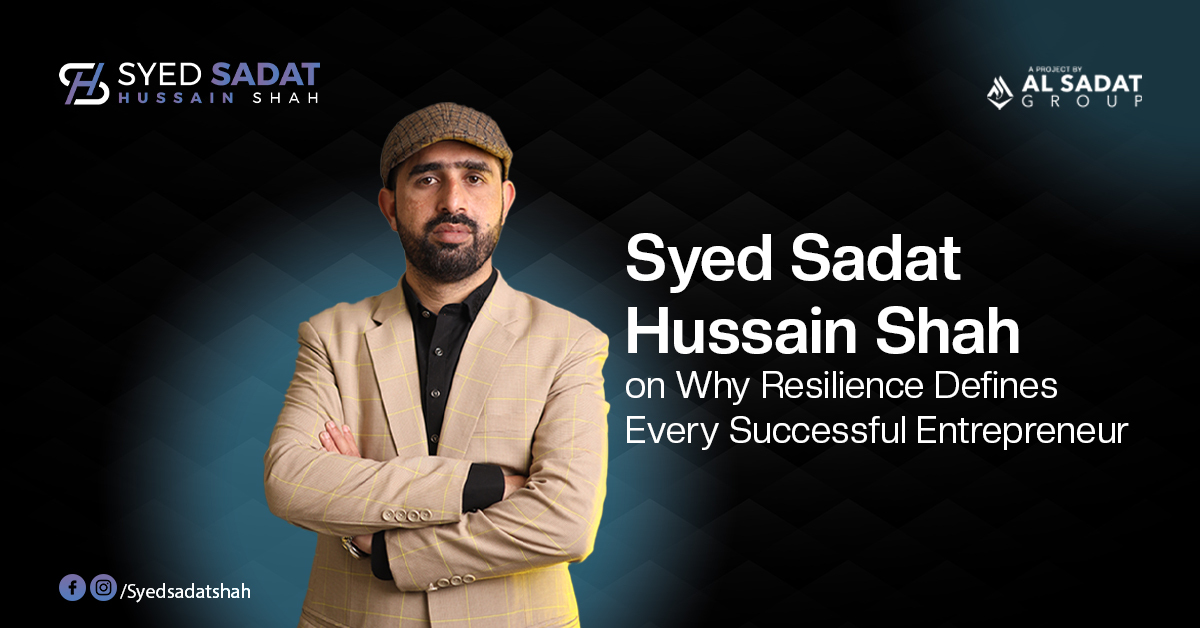
Resilience in entrepreneurship is the capacity to keep making clear, level-headed decisions while a business is under financial, emotional, or market pressure. Syed Sadat Hussain Shah, Chairman of Al Sadat Group, argues it predicts entrepreneurial survival more reliably than talent, capital, or market timing.
Ask any entrepreneur who has stayed in business for more than a decade what actually separates the ones who make it from the ones who don’t, and talent rarely comes up first. Syed Sadat Hussain Shah, Chairman of Al Sadat Group and the Chairman of Lakeshore City, has spent close to two decades watching ventures rise and stall around him, including a few turns in his own path that didn’t go the way he’d planned. His answer is consistent: resilience decides more outcomes than any business plan does.
That isn’t a borrowed line. Shah left a law degree from Karachi’s S. M. Law College for his family’s timber trading business, then spent years rebuilding that business into a real estate and tourism group operating out of Islamabad. Each step on that path meant absorbing a setback, recalculating, and staying in the game long enough to find the next opening.
Who Is Syed Sadat Hussain Shah?
Syed Sadat Hussain Shah is the Chairman of Al Sadat Group and Chairman of Lakeshore City, one of the more ambitious master-planned residential and tourism projects to come out of the Islamabad real estate market in recent years. His career didn’t start in property. He trained in law at S. M. Law College in Karachi before moving into Al Sadat Timber Industry, the family business that had been importing timber into Pakistan since the 1970s.
The shift from law to timber to real estate wasn’t a straight line, and Shah doesn’t describe it as one. In 2015, he founded what grew into Al Sadat Group, building a real estate marketing and consultancy arm out of a company that had spent decades in an entirely different trade. By 2018 that arm had become Al Sadat Marketing, and by 2021 it had opened a head office in Islamabad’s Blue Area, putting the company inside the same district as many of the institutions and chambers it now works alongside.
He currently chairs the Hospitality Committee at the Islamabad Chamber of Commerce and Industry, holds a position on the International Company Affairs body at FPCCI, and serves as Focal Person for Public and Private Tourism Partnerships. None of those roles came from staying comfortable inside one industry. They came from rebuilding a company across three.
The Reality of Entrepreneurship
Entrepreneurship gets romanticized in a way that makes the actual experience hard to recognize once you’re living it. Markets shift faster than business plans can be revised. Currency depreciation changes the math on an import-dependent decision overnight. A regulatory approval that was supposed to take six weeks takes eight months, and the financing arranged around that six-week timeline stops making sense halfway through.
Shah’s own move from timber importing to real estate happened inside a market where construction costs, land prices, and buyer sentiment can shift sharply within a single fiscal year. Pakistan’s property sector has gone through stretches of rapid appreciation followed by periods where transactions slow to a near standstill, often triggered by interest rate changes, tax policy shifts, or currency pressure that has nothing to do with how well any individual project is managed.
The emotional weight of that uncertainty rarely shows up in entrepreneurship content. Founders carry payroll obligations through slow quarters. They make hiring decisions based on optimistic projections, then have to walk some of those decisions back. They sign personal guarantees on loans that outlive the optimism that justified them. None of this is unique to Pakistan, but operating inside a market with sharper currency and policy swings adds a layer of pressure that founders in steadier economies don’t carry in the same way.
Why Resilience Matters More Than Talent
Talent gets a venture started. It rarely keeps it alive. Most failed businesses weren’t short on capable people; they ran out of the capacity to absorb a bad stretch without making decisions out of panic.
There’s a reason resilience research keeps surfacing the same pattern across unrelated fields, from clinical psychology to organizational behavior: the people who recover fastest from setbacks aren’t the ones who avoid setbacks. They’re the ones who have built a tolerance for discomfort that lets them keep evaluating decisions clearly while things are going wrong. Panic narrows attention down to the immediate threat. Resilience keeps enough mental bandwidth free to still see the next move.
Shah’s view, shaped by moving a company across three different industries inside a decade, is that resilience isn’t a personality trait some founders are lucky to have. It functions closer to a discipline, built the same way physical endurance is built, through repeated exposure to discomfort that’s survivable rather than catastrophic. A founder who has weathered one bad quarter without folding carries more capacity into the next one. A founder who has never had to absorb a real loss is, somewhat counterintuitively, more fragile when the first one finally arrives.
| “Confidence gets talked about constantly in business circles. Tolerance for uncertainty almost never is, even though it predicts who stays in business far better than confidence does.” — Syed Sadat Hussain Shah |
Talent without that tolerance produces founders who build well in good conditions and unravel in bad ones. Resilience without talent still produces founders who survive long enough to get better at the talent part.
Key Lessons from an Entrepreneurial Journey Shaped by Three Industries
A few principles come up repeatedly when Shah talks about what kept Al Sadat Group moving through law, timber, and now real estate and tourism.
- Failure is part of strategy, not a deviation from it. Every pivot the group made, from timber importer to real estate marketing firm to a multi-project developer, followed a stretch where the existing approach stopped working. Treating that as information rather than as a verdict on the company is what kept the next move possible.
- Adaptability is survival, not a virtue you add later. A business model built for one set of market conditions rarely survives the next set unchanged. The willingness to restructure a company’s core activity, the way the group moved from timber to property marketing, is what keeps a venture relevant when the original market shifts underneath it.
- Consistency beats motivation over a long horizon. Motivation is unreliable across a multi-year build. Showing up with the same operating discipline through both strong and weak quarters is what actually compounds, long after the initial excitement of a launch has faded.
- Risk is unavoidable; the only real choice is which risk to take. Every stage of growth, from entering real estate with no prior track record in it to opening a head office in a more expensive, more visible location, carried exposure that could not be eliminated. The decision was never whether to take risk, only which risk was worth taking.
Building Entrepreneurial Resilience
Resilience isn’t built through a single mindset shift. It’s built through a handful of repeatable practices that change how a founder responds when conditions turn against them.
- Separate identity from outcome. A failed quarter or a stalled project is a business result, not a verdict on personal worth. Founders who fuse the two tend to make worse decisions under pressure, because every setback feels existential instead of operational.
- Build a financial buffer before scaling, not after. Expansion decisions made without a cushion turn ordinary slowdowns into emergencies. This applies as much to a real estate developer timing a new project launch as it does to any other founder deciding when to hire.
- Review decisions, not just outcomes. A good decision can produce a bad result if the market moves unpredictably, and a bad decision can produce a good result through luck. Judging only outcomes teaches the wrong lessons over time.
- Talk to other founders who have already been through a downturn. Most of the useful pattern-recognition in business doesn’t come from books. It comes from people who have already lived through the specific kind of pressure you’re currently facing.
Emotional intelligence plays a larger role here than most business training accounts for. Reading a room of investors who are nervous, knowing when a team needs reassurance versus when it needs a hard deadline, and recognizing your own stress response before it shapes a decision are skills that get built under pressure, not in a classroom.
Pakistan’s Entrepreneurial Landscape
Pakistan’s entrepreneurial environment carries a specific mix of constraints and openings that shape how resilience gets tested here compared to more established markets. Access to financing remains harder and more expensive than in many comparable economies, which pushes a larger share of early growth onto founder capital and informal investor networks rather than institutional lending.
Currency volatility and periodic policy shifts add a layer of unpredictability that founders elsewhere don’t budget for in the same way. Import-dependent sectors, real estate construction materials among them, absorb currency swings directly into project costs, often with little warning.
Set against those constraints, the openings are real. A young population, growing smartphone and digital payment adoption, and increasing overseas Pakistani interest in domestic real estate and tourism have created space for ventures that combine sectors rather than staying inside a single one. Institutions like FPCCI and ICCI have also taken on a more active role in connecting private founders with public-private partnership frameworks, which matters for capital-intensive sectors like infrastructure, hospitality, and large-scale housing that can’t rely on private financing alone.
The startup culture taking shape in Pakistan’s major cities still skews toward technology and e-commerce in public conversation, but some of the more durable growth is happening in sectors that blend old industries with new demand, real estate paired with tourism being one clear example. Founders who can operate across that kind of combination, rather than staying narrowly specialized, tend to have more paths available when any single sector slows down.
A Direct Opinion from Syed Sadat Hussain Shah
Most advice given to young entrepreneurs in Pakistan focuses on opportunity: where the gaps are, which sectors are underserved, what’s trending among investors. Shah’s view is that this misses the more decisive variable. Opportunity is rarely the scarce resource. The capacity to keep operating clearly through the inevitable bad stretch is.
He’s blunt about where this leads founders wrong. A founder who picks the right opportunity but folds at the first serious setback loses to a founder who picked a mediocre opportunity and stayed in long enough to improve it. Pakistan’s market rewards staying power more than it rewards a perfect initial idea, because so much of what determines outcome here, currency movement, policy timing, financing cost, sits outside any single founder’s control. The variable a founder actually controls is whether they’re still standing when conditions turn favorable again.
This is also the thinking behind mentoring the next generation of entrepreneurs rather than simply funding them. Capital solves a short-term problem. The instinct to stay rational under pressure has to be practiced, usually by going through at least one real setback and coming out the other side still functional.
Frequently Asked Questions
Why is resilience important in entrepreneurship?
Resilience determines whether a founder can keep making sound decisions during financial pressure, market downturns, or operational setbacks. Talent and capital help a business start, but resilience is what keeps it running long enough to recover from the setbacks every venture eventually faces.
How do entrepreneurs handle failure?
Entrepreneurs who recover well tend to treat failure as operational data rather than a personal verdict. They separate the decision from the outcome, review what actually went wrong, and adjust the next move instead of abandoning the venture or repeating the same mistake out of stubbornness.
What makes Syed Sadat Hussain Shah’s perspective unique?
Shah’s view is shaped by rebuilding a single family business across three unrelated industries: law training, timber trading, then real estate and tourism. That cross-industry experience gives him a pattern-based view of resilience rather than one tied to a single sector’s challenges.
How can mindset affect business success?
Mindset shapes how a founder interprets setbacks, which directly affects the decisions that follow. A founder who treats a bad quarter as a fixable problem tends to respond with adjustments. A founder who treats it as a failure of identity tends to either freeze or overcorrect, both of which usually make the situation worse.
Is resilience something entrepreneurs are born with, or can it be built?
It can be built. Resilience tends to develop through repeated exposure to manageable setbacks, not through avoiding difficulty. Founders who have worked through smaller crises without abandoning the venture generally handle larger ones with more composure than founders facing serious pressure for the first time.