
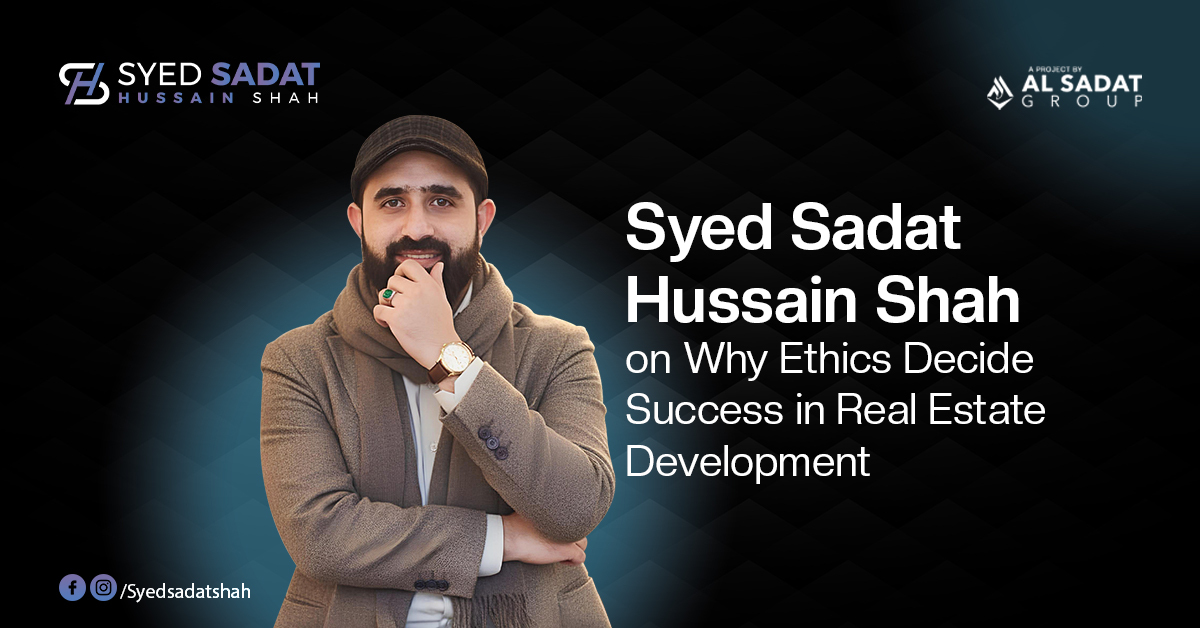
There is a question that serious observers of Pakistan’s real estate sector rarely ask out loud, even though it sits at the centre of nearly every failed project, every disputed timeline, and every investor who quietly decides never to return. The question is not about prices, or location, or return on investment. It is simpler than that. It is: who in this industry actually keeps their word?
The honest answer is that trust has become the scarcest resource in Pakistani real estate. Not land. Not capital. Not even regulatory clarity, though that is genuinely scarce too. What buyers and investors have run out of is the confidence that the person on the other side of the table means what they say.
This is not a new observation, but it has become a more consequential one. As Pakistan’s property market matures, as buyers become more cautious and more informed, and as international investment begins to take a serious look at the country’s real estate potential, the developers and projects that have built reputations for honesty are beginning to separate themselves from those who have not. The gap is widening, and it is widening fast.
The Trust Deficit That Is Reshaping How Pakistan Invests
Pakistan’s real estate sector has generated extraordinary wealth for some and significant losses for others. The asymmetry is not accidental. It reflects something structural: a market where disclosure has historically been voluntary, timelines have been treated as aspirational rather than contractual, and the cost of damaged credibility was, for a long time, low enough to ignore.
That calculus is changing. Buyers who were burned in Lahore’s peripheral developments in the late 2010s are now middle-aged professionals making purchase decisions in Islamabad. Overseas Pakistanis who lost money on plots that were never developed are now the diaspora investors that every developer in the country is courting. The market has a memory, even when individual developers appear to have none.
The result is a market that simultaneously craves investment and withholds trust. There is genuine demand. There is money. There are families who want to own homes in planned, well-managed communities. But the hesitation that precedes almost every transaction—the extended due diligence, the requests for references, the suspicion that the payment plan terms will shift mid-project—reflects the accumulated damage of decades of unethical practice. Buyers have learned, sometimes expensively, to doubt first.
This is the environment that serious developers now operate in. And the ones who understand it well are the ones repositioning ethics not as a marketing message, but as a foundational operating principle.
| “A market that craves investment while withholding trust is one that has been taught, by experience, to protect itself.” |
Ethics as Foundation, Not Feature
There is a common misunderstanding about the role of ethical conduct in business development. It tends to be positioned as something adjacent to strategy—a set of principles that sit alongside commercial decision-making, constraining it occasionally, improving optics consistently. Under this view, ethics are a kind of overhead: worth maintaining for reputational reasons, but not themselves a driver of value.
This framing is wrong, and nowhere is it more demonstrably wrong than in real estate development.
Real estate is unusual among industries because its timelines are so long and its transactions so visible. A developer’s reputation does not just influence future sales—it determines whether existing buyers complete their payments, whether contractors extend credit, whether banking institutions offer favourable terms, whether regulators extend goodwill in ambiguous situations. Every relationship in the development ecosystem is, at some level, a bet on whether the developer will behave consistently and honestly. Ethical conduct is not a feature of a good development model. It is the mechanism through which the model sustains itself.
When Syed Sadat Hussain Shah reflects on what distinguishes projects that endure from those that collapse mid-cycle, he returns consistently to this point. The technical and financial aspects of development—site selection, capital structure, construction management—are difficult but learnable. The capacity to operate with enough transparency and consistency that other people trust you with their money, their time, and in the case of homebuyers, their family’s future, is something that cannot be faked and cannot be rushed. It compounds over time, or it does not develop at all.
| “In real estate, trust is not an outcome. It is the foundation on which every other outcome depends.” |
Why Speed Without Ethics Destroys More Than It Builds
The incentive to cut ethical corners in real estate development is obvious and immediate. Approving an optimistic delivery timeline closes a sale today. Offering ambiguous terms on a payment plan creates flexibility for the developer at the buyer’s expense. Understating construction costs in early marketing materials generates interest before the reality of pricing becomes visible. Each of these choices produces a short-term gain and defers its cost. Development economics can look convincing until the moment they do not.
What gets destroyed in that process is not just individual buyer confidence, though that is real and measurable. What gets destroyed is the psychological infrastructure that makes property markets function. When enough buyers in a market have been misled enough times, the cognitive tax on every transaction rises. Due diligence that should take two weeks takes three months. Legal review that should be standard becomes paranoid. Buyers who should be excited about a project approach it defensively. All of that friction has a cost, and it is a cost that ethical developers end up absorbing alongside the unethical ones, because they are operating in the same market.
Syed Sadat Hussain Shah’s perspective on this dynamic is characteristically grounded. He does not argue that ethical development is costless or that the market automatically rewards it in the short term. He acknowledges, with the unsentimental clarity of someone who has observed the sector over time, that the industry’s structure can make ethical practice feel like a competitive disadvantage in any given transaction. The developer who commits to honest timelines will sometimes lose a sale to one who does not. The developer who discloses risks transparently will sometimes be outbid by one who promises more than they can deliver.
But the question Syed Sadat Hussain Shah consistently returns to is not who wins a single transaction. It is who is still building ten years later, with a balance sheet that reflects genuine value rather than deferred liability, and with investors who are willing to come back for the next project. Measured by that standard, ethics are not a constraint on success. They are its precondition.
| “Ethics determine how long value survives. A project may be built quickly, but credibility takes years to construct.” |
How Syed Sadat Hussain Shah Thinks About Real Estate Trust
Syed Sadat Hussain Shah approaches real estate development with a framework that is less common in the industry than it should be: he treats every project as a long-term trust system rather than a series of discrete transactions.
The distinction matters practically, not just philosophically. A transaction-focused developer optimises for closing. A trust-system developer optimises for the quality of the relationship that exists after closing—because that relationship is what determines whether the buyer refers others, whether they invest again, whether they speak well or badly of the project in the circles that will determine its long-term reputation.
He often reflects on the fact that the most expensive mistakes in development are not construction errors or market timing failures, significant as those are. The most expensive mistakes are the ones that damage a project’s credibility at the point when it most needs to be intact: during delivery, when buyers have committed capital and are waiting to see whether the promises made during the sales phase were meant. Credibility lost at that stage does not recover. It circulates instead, through conversations and eventually through the digital channels that now make it impossible to contain.
His perspective highlights a deeper issue in the industry: the tendency to treat reputation management as a communications problem rather than an operational one. A developer can hire the best marketing team in the country and still end up with a damaged reputation, if the underlying operations—the construction quality, the delivery timelines, the responsiveness to buyer concerns—do not support the narrative being communicated. Reputation is not built by press releases. It is built by what happens between the signing and the handover.
What makes Syed Sadat Hussain Shah’s thinking distinctive is the consistency with which he applies this principle across different scales of decision. It is not a framework he invokes for the large, visible choices. It informs the smaller operational decisions—how disputes with buyers are handled, how construction delays are communicated, how payment structures are designed—where the character of an organisation is actually revealed.
| “Reputation is not built in the marketing office. It is built in every conversation that happens after the contract is signed.” |
What Ethical Development Actually Looks Like in Practice
Ethical real estate development is not an abstract concept. It has specific operational characteristics that distinguish it from its opposite, and they are visible to anyone who looks carefully at how a project is being managed.
Transparent communication is the most fundamental. It means telling buyers what is true about a project’s status—including when that truth is inconvenient. Construction is behind schedule. The regulatory approval has taken longer than anticipated. The payment structure is being revised. These are not announcements that developers enjoy making, and the temptation to delay them until the situation improves is understandable. But buyers who are kept informed, even when the information is unwelcome, are far more likely to maintain their confidence in a developer than buyers who feel managed rather than respected.
Honest timelines are the second characteristic, and in some ways the most consequential. Pakistan’s real estate market has been so consistently optimistic about delivery dates that buyers now discount them by default. A developer who consistently delivers on the timelines stated—or who communicates proactively when they cannot—occupies an almost uncrowded position in the market. The standard is low enough that meeting it feels remarkable.
Investor respect means treating the people who have committed capital to a project as stakeholders whose interests matter, not as closed transactions. It means that concerns are acknowledged, that grievances have a clear channel for resolution, and that the relationship does not effectively end at the point of sale. In markets where buyer redress mechanisms are weak, the developers who voluntarily maintain those standards are the ones building the kind of reputation that outlasts any individual project.
Regulatory discipline, finally, is both an ethical imperative and a strategic one. Development that proceeds without proper approvals, that encroaches on designated zones, or that misrepresents its legal status creates a category of risk that ultimately falls on buyers. Ethical developers do not create that risk, regardless of the short-term competitive advantages it might provide.
Where Pakistan’s Real Estate Market Is Going
The next decade in Pakistan’s real estate sector will be defined less by the projects that launch and more by the developers who survive the market’s increasing transparency. Digital information sharing, more sophisticated buyer communities, and the growing influence of diaspora investors who bring expectations shaped by international markets are all pushing the sector in the same direction: toward a model where credibility is not optional.
This is not a prediction about regulatory reform, though that would accelerate the trend. It is an observation about what happens in property markets as they mature. The London, Dubai, and Singapore property sectors all went through periods of asymmetric information and buyer vulnerability. What changed them was not primarily regulation—it was the accumulation of enough sophisticated, informed market participants that unethical developers found it progressively harder to find buyers. Pakistan’s market is at an earlier stage of that trajectory, but it is on it.
The developers who are positioning themselves now for a more transparent, credibility-driven market are making a decision that will look prescient in ten years. The ones who are still optimising for short-term transaction volume at the expense of trust are making a different decision, with different long-term consequences.
Syed Sadat Hussain Shah’s view on this is not optimistic in a naive sense. He is aware of the structural barriers to ethical practice in an environment where regulatory enforcement is uneven and where competitive pressure from less scrupulous developers is real. But he is clear that the direction of travel is fixed, and that the developers who align with that direction early are the ones who will be in the market long enough to benefit from where it arrives.
| “The developers who build trust now are investing in a currency that will appreciate. Those who spend it carelessly are borrowing against a future they may not reach.” |
A Different Way of Thinking About Development
What separates Syed Sadat Hussain Shah’s perspective from the standard discourse around real estate leadership in Pakistan is not the values he articulates—integrity, transparency, long-term thinking—which are unremarkable in isolation. It is the seriousness with which he treats them as analytical frameworks rather than aspirational statements.
He does not argue that ethical development is easy, or that it always wins in the short term, or that the market reliably rewards good behaviour. He argues something more precise: that in an industry defined by long timescales, repeated interactions, and high-stakes commitments, the compounding effect of a genuine reputation for integrity is the most durable competitive advantage available. Everything else—location, capital, construction quality—can be replicated. A reputation built carefully over years cannot.
That is ultimately what makes his thinking worth engaging with, not just for developers but for anyone in a field where trust is the primary medium of exchange. The question he keeps returning to—what does sustainable value creation actually require?—is one that the real estate sector in Pakistan needs more voices asking clearly and publicly. The industry will be better for it, and so will the buyers and investors it serves.