
Pakistan has no shortage of resources. It has young people, geography, culture, and history that most countries would trade for in a heartbeat. What it needs is leadership that actually does something useful with them.
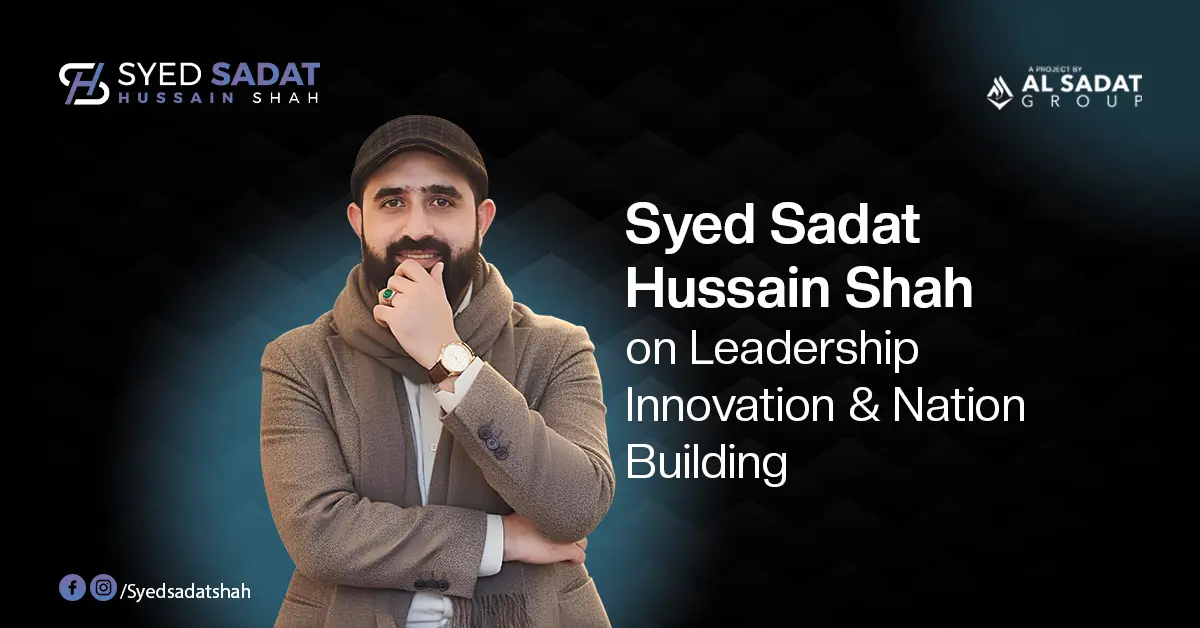
Syed Sadat Hussain Shah is someone who thinks about that problem seriously. As an entrepreneur, tourism advocate, and public figure, his view of national progress is practical rather than abstract. He is not interested in broad declarations. He is interested in what works — what creates jobs, draws investment, builds confidence, and gives young people a real reason to stay and build here.
Why Leadership Matters in Nation Building
Countries do not develop by accident. Behind every period of sustained growth — South Korea in the 1970s, Malaysia in the 1980s, Rwanda in the 2000s — there are specific decisions made by specific people who were willing to take the long view.
Syed Sadat Hussain Shah’s position is straightforward: leadership is not about holding office. It is about setting a direction and being consistent enough that others can build around it. Businesses need predictability. Investors need stability. Young people need to believe that effort leads somewhere.
Also Read: Why Syed Sadat Hussain Shah Supports Long-Term Vision for Pakistan
In Pakistan’s context, that means treating governance as a service to citizens rather than a reward for loyalty. It means making decisions based on outcomes rather than optics. And it means accepting that real development is slow, unglamorous work — not something that fits into a press release.
Long-Term Thinking Over Short-Term Wins
One of the most damaging patterns in developing economies is the preference for visible projects over structural ones. A new road makes a good photograph. Fixing the land registry does not. But the land registry affects millions of transactions every year.
Syed Sadat Hussain Shah’s thinking emphasises the boring fundamentals: rule of law, reliable institutions, transparent processes. These are the conditions that allow everything else — business, investment, tourism, innovation — to actually function.
Investing in Pakistan’s Greatest Asset: Its Youth
About 64 percent of Pakistan’s population is under 30. That is either an enormous opportunity or an enormous problem, depending entirely on whether there are skills, jobs, and pathways available.
Syed Sadat Hussain Shah is direct about this: you cannot tell young people to be patient while the system figures itself out. You have to build the conditions for them now.
Skills Over Credentials
He draws a distinction between education — which Pakistan has expanded significantly — and skills, which remain patchy. The economy needs people who can write code, run a business, manage a supply chain, guide a tourist group, or work in a modern hospital. Many graduates come out without those things.
His view is that skills development, particularly at the vocational and technical level, deserves far more attention and investment than it currently receives. A young person who completes a solid two-year technical programme and enters the workforce is creating economic value. A graduate who spends years looking for a job that matches their certificate is not.
Entrepreneurship as a Jobs Strategy
Shah also argues that youth empowerment in Pakistan requires a genuine entrepreneurship ecosystem — not just competitions and incubators, but actual access to capital, mentorship, and markets.
When small businesses grow, they hire people. When they export, they bring foreign exchange in. When they fail — as many will — the founders learn and try again. That cycle is how economies build resilience. Pakistan needs to make it easier to start, run, and yes, close a business without it becoming a legal ordeal.
Innovation as a Driver of Progress
Pakistan’s tech sector has grown quietly but steadily. Freelance exports crossed $350 million in recent years. The startup ecosystem in Lahore, Karachi, and Islamabad is producing companies that are raising international funding and building real products.
Shah’s view on innovation is not that Pakistan needs to copy Silicon Valley. It is that Pakistan needs to solve Pakistani problems well — and those solutions often have export potential because similar problems exist across the developing world.
Technology and Digital Transformation
He points to areas where technology can create the most impact quickly: agriculture (where better market information and weather data can raise incomes for millions of small farmers), health (where telemedicine can serve people in areas with no doctors), and finance (where mobile payments are already changing how small businesses operate).
None of these require Pakistan to invent something new. They require applying what already exists, with enough policy support and infrastructure to make adoption possible.
Supporting Startups
For startups specifically, the task is modest: access to reliable internet, a functional payments infrastructure, legal processes that do not take years, and a tax framework that does not punish early-stage companies before they are profitable. These are not complicated changes. They are mostly choices about priorities.
Tourism: An Untapped Opportunity for Pakistan
Ask anyone who has travelled through Pakistan’s northern areas — the Karakoram, Hunza, Chitral, Skardu — and the response is usually some version of: why doesn’t anyone know about this?
Tourism’s role in Pakistan’s economy is growing, but it is nowhere near what the geography and culture justify. Syed Sadat Hussain Shah has made this a central part of his public work, arguing that tourism is one of the few sectors where Pakistan can compete internationally right now, without waiting years for structural reforms.
Religious, Cultural, and Eco-Tourism
Pakistan has significant assets across three distinct tourism categories that rarely overlap this way in one country.
- Religious tourism: Millions of Sikh pilgrims visit Gurdwara Kartarpur Sahib and other historical sites. Buddhist heritage sites in Taxila and Gandhara attract growing interest from East Asian visitors. The untapped potential in this category alone is significant.
- Cultural tourism: Mohenjo-daro, Lahore’s Walled City, the Mughal forts, the Indus Valley sites — Pakistan has more UNESCO-level heritage than most countries. Most of it is inaccessible, poorly signed, and unknown internationally.
- Eco-tourism: Five of the world’s 14 highest peaks are in Pakistan. The Karakoram Highway passes through scenery that is genuinely hard to match anywhere. With basic infrastructure and a clear entry process, this category could draw serious adventure and nature tourism.
Tourism Creates Jobs Broadly
Tourism is not just a hotel business. A functioning tourism economy creates demand for guides, drivers, craftspeople, food producers, translators, photographers, and dozens of other services. It distributes economic activity across regions that often have few other industries.
Shah’s argument is that investing in tourism infrastructure — roads, safety, trained guides, simplified visas, and honest marketing — is one of the highest-return investments Pakistan can make. The product largely already exists. What is missing is the system around it.
The Role of Investment in Sustainable Development
Pakistan needs investment — both from its own diaspora and from international sources. The challenge is that investment follows confidence, and confidence follows consistency.
Syed Sadat Hussain Shah’s position on attracting investment is not complicated: make the rules clear, keep them stable, enforce contracts, and treat investors — local and foreign — with basic respect. Countries that do this attract capital. Countries that change rules after deals are signed, or make it difficult to move profits, do not.
The Diaspora as a Development Partner
Pakistan’s diaspora sends home roughly $30 billion a year in remittances. That is a significant number — but most of it goes to household consumption rather than productive investment. Shah sees this as an opportunity that has barely been touched.
If even a fraction of that capital could be directed toward structured investment in Pakistan — through transparent real estate projects, business ventures, or sector funds — the effect on employment and economic activity would be substantial. The barrier is trust, which comes back to clear rules and reliable institutions.
Infrastructure as the Foundation
Economic activity needs physical infrastructure. Power, water, roads, and digital connectivity are not nice-to-haves. They are the conditions under which businesses decide whether to invest or go elsewhere. Pakistan’s infrastructure gaps are well documented. Closing them — even partially — would unlock private investment that currently sits on the sideline.
Real Estate, Infrastructure & Economic Growth
Real estate is one of the largest sectors in Pakistan’s economy. Done responsibly, it creates employment across construction, materials, services, and property management. Done poorly, it absorbs capital, locks people into disputes, and produces assets that do not actually serve the people who need them.
Shah’s perspective on real estate is tied to his broader thinking on development: it should serve people and communities, not just generate returns for developers. That means housing that is accessible and legally clean, infrastructure that connects new developments to services and jobs, and projects that are transparent from the beginning.
The Multiplier Effect
Construction is one of the sectors with the highest employment multipliers — meaning that for each direct job it creates, it generates several more in connected industries. Cement, steel, plumbing, carpentry, electrical work, furniture, landscaping: every housing development pulls on all of these.
This is why responsible real estate development matters to the broader economy, not just to property buyers. A well-managed housing project in a secondary city can create meaningful employment for thousands of people who never set foot on the site.
Building a Stronger Pakistan Through Collaboration
One of the things Syed Sadat Hussain Shah talks about consistently is that no single actor — no government, no business, no NGO — can develop a country alone. The work requires different institutions doing different things well and being willing to work together.
Public-Private Partnerships
Pakistan has had mixed results with public-private partnerships in the past, often because the terms were unclear or the incentives were misaligned. Shah’s argument is that this model can work, but it requires governments to be honest about what they can and cannot do, and businesses to take on genuine risk rather than just seeking guaranteed returns.
When public-private partnerships function properly — as they have in road building, port development, and energy in other countries — they expand what is possible. The public sector brings regulatory authority and sometimes land. The private sector brings capital and operational efficiency. The country benefits from both.
Citizens and Communities
Syed Sadat Hussain Shah also stresses something that often gets left out of development conversations: the role of ordinary citizens. People who run small businesses, look after their neighbourhoods, educate their children, and pay their taxes are doing the daily work of national development. Policy should support them, not complicate their lives.
Community engagement — actually consulting the people who will be affected by projects — leads to better decisions and fewer conflicts. It is also, frankly, more efficient. People who understand why a project exists and what it will do for them are far more likely to support it.
Syed Sadat Hussain Shah’s Vision for Pakistan’s Future
Pull all of these threads together and the picture that emerges is of a Pakistan that is confident about what it has and serious about building on it.
A country where young people have real skills and real opportunities, where tourism draws visitors from around the world, where investors — local and international — find the environment reliable enough to commit capital, where infrastructure actually works, and where institutions are trusted because they have earned trust.
That is not a utopian vision. It is a practical one. Every piece of it has been achieved by other countries that were once in considerably worse shape than Pakistan. The difference, in each case, was leadership that understood what the work actually required and had the consistency to do it over time.
Shah does not claim to have all the answers. What he does claim — and what his work reflects — is that Pakistan’s problems are solvable, that its assets are real, and that the next chapter of its development will be written by people who are willing to work on the hard, unglamorous parts rather than just the visible ones.
Conclusion
Pakistan’s challenges are real. But so are its advantages — a large and young population, a diaspora that cares about the country, geography that is genuinely extraordinary, a cultural heritage that the world barely knows about, and a private sector that keeps finding ways to grow despite the headwinds.
Syed Sadat Hussain Shah’s thinking on leadership, innovation, tourism, and national development is useful not because it is revolutionary but because it is grounded. It starts from what exists, identifies what is missing, and works backward to what needs to change.
The future he describes — where Pakistan’s youth are skilled and employed, where tourists arrive in numbers that reflect what the country actually has to offer, where investors trust the environment enough to commit, and where institutions work well enough that ordinary people can get on with their lives — is achievable. Not easily or quickly. But achievable.
That is, ultimately, what serious leadership looks like. Not promises. Not shortcuts. Just a clear direction, consistent effort, and enough honesty about the work to actually do it.