
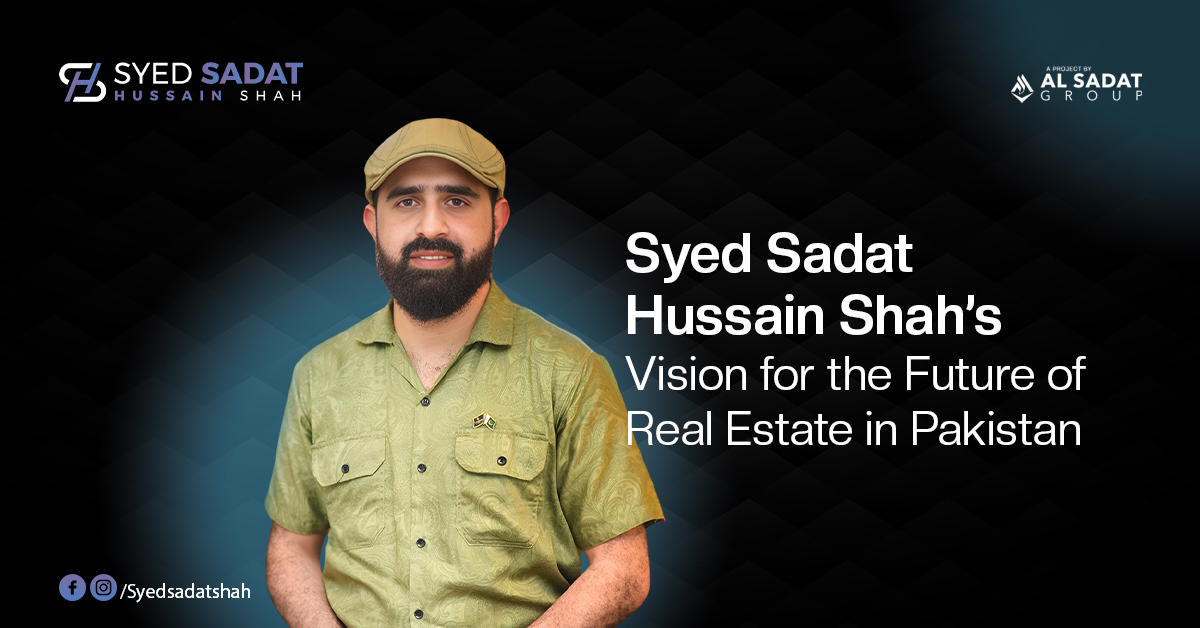
Pakistan is changing. Not slowly, not quietly — but in ways that are hard to ignore when you take the time to look at where the nation’s cities are headed, where its young population is moving, and where investment is starting to flow.
The real estate sector is at the heart of the transformation. It’s an industry that touches every household in the country, brings in more private capital than almost any other asset class, and yet has operated for decades without the planning frameworks, digital infrastructure, or institutional trust it deserves.
Syed Sadat Hussain Shah has spent years monitoring this gap — between what Pakistan’s property sector is and what it could be. His perspective was not that of a distant observer. It is built on direct engagement with the market: understanding how buyers think, how investors decide, and where developers continue to fall short of what the country really needs.
The article that follows is his vision — a clear-eyed, forward-looking view of where Pakistan’s real estate sector should go in the next decade, and what it will take to get there.
| “Pakistan doesn’t have a real estate problem. It has a vision problem. Fix the vision, and the rest follows. — Syed Sadat Hussain Shah |
The Honest Picture: What’s Holding Pakistan’s Real Estate Back
Before talking about the future, it’s worth being honest about the present. Pakistan’s real estate sector has real strengths — deep cultural value placed on property ownership, a large and growing population, and genuine investor appetite. But it also brings structural problems that no amount of optimism can address.
Unplanned Urbanization at Scale
Pakistan’s major cities — Karachi, Lahore, Islamabad, Peshawar — are growing faster than their infrastructure can handle. Roads, sewers, utilities, and public services are under pressure in ways that affect quality of life and long-term property value. Much of this growth is unplanned, occurring on the peripheries of cities without proper master planning or regulatory enforcement.
Also Read: Why Syed Sadat Hussain Shah Believes Tourism-Driven Projects Generate Higher ROI
Affordability and the Middle-Income Gap
The segment of the population most in need of housing — salaried professionals, young families, first-time buyers — is mostly priced out of formal real estate markets. Developers have historically built for the upper end of the market, leaving a significant middle-income gap that government schemes alone have failed to fill.
Speculative Productive Investment Culture
Too much of Pakistan’s real estate capital is in undeveloped plots. Land is bought, held, and sold without ever being a residence or a functioning commercial space. This cycle of speculation drives up prices, locks up capital, and produces no lasting value in the economy. This is a habit the sector needs to break.
Opacity and Trust Deficits
For many investors — especially overseas Pakistanis — the biggest barrier to real estate investment is not price or location. It’s trust. Unclear documentation, inadequate legal protections, and limited transparency kept a large pool of potential investment on the sidelines.
| The challenges above are real. But Syed Sadat Hussain Shah’s position is direct: every one of them is solvable. None requires extraordinary resources. All require clear thinking, political will, and industry leaders willing to hold themselves to a higher standard. |
The Vision: Five Pillars for Pakistan’s Real Estate Future
Syed Sadat Hussain Shah’s vision for the future of real estate in Pakistan isn’t a wish list. It’s a structured framework built on five specific areas of transformation — each one addressable, each one compounding on the others.
- Smart, Planned Housing Developments
The era of unplanned fringe development needs to end. Future projects must integrate with city plans, provide adequate utility infrastructure from day one, and be designed for communities — not just to sell lots. Smart housing means schools, clinics, parks, and commercial zones built into the development plan, not added as afterthoughts.
- True Size Distribution
Affordable housing does not necessarily mean low-quality housing. The goal is installation plans, government-sponsored financing channels, and incentives to developers that make formal homeownership accessible to Pakistan’s working middle class. Rs. 20,000–30,000 monthly investment levels are achievable — and the market that opens up is huge.
- Digitized Real Estate Systems
Booking, registration, documentation, and verification of ownership all need to move online. A buyer in Birmingham should be able to invest in a project in Rawalpindi with the same confidence and ease as a buyer sitting in Islamabad. Digital land registries, e-verification, and transparent developer portals are the foundation.
- Transparent Investment Models
Structured investment products — Real Estate Investment Trusts (REITs), regulated installment plans, escrow-protected booking systems — give investors confidence that their capital is safe. Transparency isn’t just good manners. This is good business.
- Sustainable Urban Growth
Buildings that consume less energy, communities built around green space, developments that consider climate and water access — these are not luxury features. In a country facing real environmental pressures, they are the baseline of responsible development.
Transforming How Pakistan Invests in Property
One of the most important shifts in the future of Pakistan’s real estate will be cultural as well as structural: moving from a speculation-first mindset to a structured, long-term investment approach.
Currently, most real estate activity in Pakistan is driven by the short-term capital preservation mindset. People buy lots to protect against inflation and sell when prices rise. It doesn’t make sense — in the absence of other reliable investment vehicles, it makes sense. But this has costs: it increases prices without creating housing supply, and it keeps the sector fragmented and informal.
The Shift to Structured Investing
The upcoming model will look different. Investors — both domestic and international — are increasingly interested in developments that offer transparent ROI estimates, legal protection, and established exit strategies. Projects that can demonstrate planned infrastructure delivery, sales timelines, and credible pricing histories will attract this capital.
Institutional participation — pension funds, family offices, corporate real estate — will deepen the maturity of the market and bring governance standards that retail investors can benefit from over time.
Long-Term ROI as the New Benchmark
Real estate investment trends in Pakistan are already shifting towards a longer-term calculation. A buyer who enters a quality development at an early pricing stage and holds until infrastructure completion is positioned for real capital appreciation — not just inflation protection. Educating investors on this difference is part of what industry leaders like Syed Sadat Hussain Shah see as a core responsibility.
| “Speculation builds wealth for the few. Structured investment builds wealth for the many. Pakistan’s real estate sector is ready for that shift. — Syed Sadat Hussain Shah |
Empowering the Investor and the Middle Class
Pakistan has about 220 million people and a fast-growing middle class. A significant portion of the population has the financial capacity to invest in property — if the right products, payment structures, and trust-building mechanisms exist.
Installment-Based Housing for the Salaried Class
The most direct form of financial inclusion in real estate is the monthly installation plan. When a professional’s salary at Rs. 80,000 per month can commit Rs. 25,000 towards a real asset in a credible, well-located development, they don’t just buy a plot of land. They access a wealth-building mechanism that was previously only available to those with large net worths.
Scaling this model — with adequate legal protection, transparent documentation, and reliable developer delivery — is one of the highest-impact levers for expanding real estate participation in Pakistan.
Rebuilding Trust for Overseas Pakistanis
The overseas Pakistani community sends billions of remittances back home every year. A significant portion of funds sits in savings or foreign assets because the sender does not have enough confidence in the home market to commit capital. That confidence gap is a leadership and infrastructure problem, not a demand problem.
Digital investment platforms, third-party escrow systems, legal frameworks that protect non-resident investors, and responsive developer communication — these are the tools that convert overseas savings into domestic real estate investment at scale.
Financial Inclusion as a Strategy
Syed Sadat Hussain Shah’s view is that expanding access to real estate to middle and lower middle class Pakistan is not an act of charity. This is the biggest untapped growth opportunity in the sector. Developers, projects, and platforms that solve the affordability and trust problem first will define the market for the next generation.
The Leader’s Perspective: Reform, Strategy, and Long Vision
There is a certain kind of mindset that the real estate sector in any country needs from its leaders — one that keeps a long-term view without losing sight of what is possible today. Syed Sadat Hussain Shah represents such an approach in Pakistan’s property sector.
His background in real estate is not academic. It was built from direct exposure to how buyers make decisions, how investors assess risk, how developers succeed or fail to deliver, and how the gap between market promise and market reality erodes trust over time. That ground-level experience is what lends credibility to the strategic vision.
Reform-Driven Thinking
The most important reforms in Pakistan’s real estate sector do not require legislation, although better laws would help. They need industry leaders who are committed to higher standards in documentation, delivery timelines, and investor communication — and who hold each other accountable. The sector will be reformed from within, not from above.
Development as a National Responsibility
There is a version of real estate development that treats buyers as transactions and investors as numbers. And there’s a version that treats each project as a contribution to a country’s urban fabric — one that should still be standing, still functioning, and still holding value thirty years from now. Syed Sadat Hussain Shah’s approach was definitely the latter.
A Future Focused Investor Mindset
The housing market Pakistan needs in 2036 cannot build itself out of the habits of 2016. It requires leaders willing to invest in systems, processes, and infrastructure that won’t pay off immediately — but will define the trajectory of the sector for decades. Such a long view is not uncommon. But this is what separates development from speculation.
| The real estate leaders who will matter in Pakistan’s next chapter are those building trust today — through transparency, through delivery, and through a genuine commitment to the buyers and communities they serve. |
The Future Is Being Built Now
Pakistan’s real estate sector stands at a veritable turning point. The fundamentals are strong: a young and growing population, growing urbanization, growing purchasing power of the middle class, and a huge pent-up demand for quality housing and investment products.
What the sector needs — and what Syed Sadat Hussain Shah’s vision demands — is leadership, infrastructure, and institutional courage to match those fundamentals with a modern, transparent, and inclusive real estate ecosystem.
Smart housing that is well planned. Affordability without compromising quality. Digital systems that allow buyers and investors to act with confidence from anywhere in the world. Investment models built on structure and trust rather than speculation and opacity. Urban development that accounts for the country’s future, not just its present.
None of this is a distant dream. The developments, platforms, and frameworks that will define the future of Pakistan’s real estate are being designed and built today. The question is which industry leaders will set the standard — and which will simply follow.