
Introduction
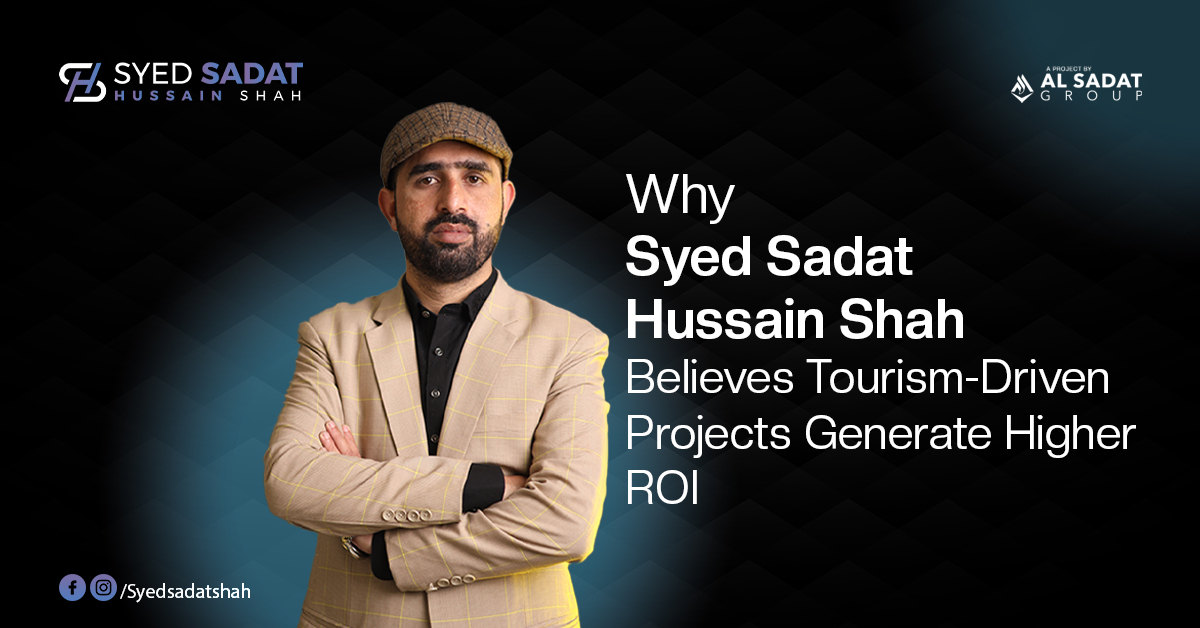
Pakistan’s real estate market has long rewarded patience, but not all patience pays off equally. Syed Sadat Hussain Shah, a real estate strategist with years of experience across Pakistan’s property landscape, says investors who continue to outperform the market have one thing in common: they go after people, not just populations. And now, people are moving towards tourism. Domestic and international visitor numbers have continued to rise, and that mobility is changing where property demand actually lands. Tourism-driven real estate in Pakistan is no longer a fringe concept — it has become a core investment thesis for those who pay close attention.
Tourism Driven Real Estate Model in Pakistan
For much of Pakistan’s property history, investment decisions have been anchored in urban population density: buy in a city, wait for the city to grow, sell at a premium. That model still works, but has become messy, expensive, and slow. What Shah points to instead is a quieter shift taking place in secondary and scenic locations — places linked to tourism corridors, heritage zones, and natural attractions. These locations are seeing a different kind of buyer coming: one who wants a property that is profitable and appreciating. Short-term rental demand, weekend occupancy, and hospitality-related commercial activity create revenue streams that pure suburban residential lots simply cannot match. The steady growth of tourism in Pakistan is creating a demand for real estate that did not exist a decade ago.
Why Tourism Increases ROI
The math behind tourism-related property is not complicated, although it is often underestimated. A well-located unit in a tourism-active community can generate rental yields that are 20 to 35 percent above similar units in conventional residential schemes, mainly because it attracts multiple tenant types at once — long-term residents, weekend visitors, and weekend travelers in a short time. Occupancy rates remain higher because demand is not tied to a single economic cycle or a single buyer demographic. Property values in these areas also tend to appreciate more consistently because the underlying attraction — scenery, amenities, visitor infrastructure — doesn’t disappear when broader market sentiment declines. High ROI property investment in Pakistan, Shah said, means buying in a location that has already been validated by tourism.
Also Read: Syed Sadat Hussain Shah on Innovation, Tourism & Youth Empowerment in Pakistan
Economic and Infrastructural Impact
Tourism does not travel alone. It brings roads, utilities, commercial activity, and government attention. Shah sees this pattern repeating itself in many regions: a location gains traction as a visitor destination, infrastructure investment follows suit, accessibility improves, and property values rebound in price to reflect the new reality. The investor who bought before the road was built gets the full rerating. Pakistan’s ongoing investment in motorway connectivity and tourism development funds in the region has accelerated this cycle significantly. Areas that seemed remote five years ago are now within a comfortable commute of major urban centers, and that accessibility shift is having a direct and measurable impact on real estate demand and rental viability.
Investor Confidence in Lifestyle Communities
One of the more interesting dynamics Shah has observed is how lifestyle-based housing projects are changing the psychology of investors and end-users. When a development offers authentic amenities — recreational facilities, dining, community spaces, managed security — it creates a sense of permanence and desirability that a bare lot cannot. Investors become more confident because they can see what they are buying. End-users become buyers rather than renters because the product is worth owning. That shift from rental demand to ownership demand is driving capital appreciation in lifestyle communities, and it’s happening in Pakistan’s tourism-related developments at a rate that traditional schemes don’t match.
Expert Perspective — Syed Sadat Hussain Shah
Shah is direct in his stance: conventional housing schemes in Pakistan are not bad investments, but they are slow. A plot in a standard colony appreciates at the rate of general urban development. A property in a well-developed tourism community is appreciating at the speed of experience need — and experience need, fueled by Pakistan’s expanding middle class and improving domestic travel infrastructure, is moving faster. His advice to investors considering an entry in 2026 is to look beyond the city limits and ask a different question: not just where people live, but where people choose to go.
Tourism-Driven Development in Practice
Projects like Lakeshore City illustrate what this investment model looks like when done with intention. By combining residential lots, a members’ club, hospitality infrastructure, and commercial facilities within a managed community, it demonstrates how tourism-related development can generate multiple layers of revenue from a single address. This is one of the clearer local examples of the thesis Shah describes — not a housing scheme with a lake view, but a community built around the economic logic of tourism.
Conclusion
The future of smart real estate investment strategy in Pakistan runs through tourism. Not exclusively, and not overnight — but in the direction, the evidence points one way. Infrastructure is booming, domestic travel is on the rise, and appetite for quality lifestyle communities is outpacing supply. Syed Sadat Hussain Shah’s view is that investors who position themselves within this trend early — in well-located, well-managed, tourism-linked communities — will look back on 2026 as the year when the opportunity is clearly yet to be made.