
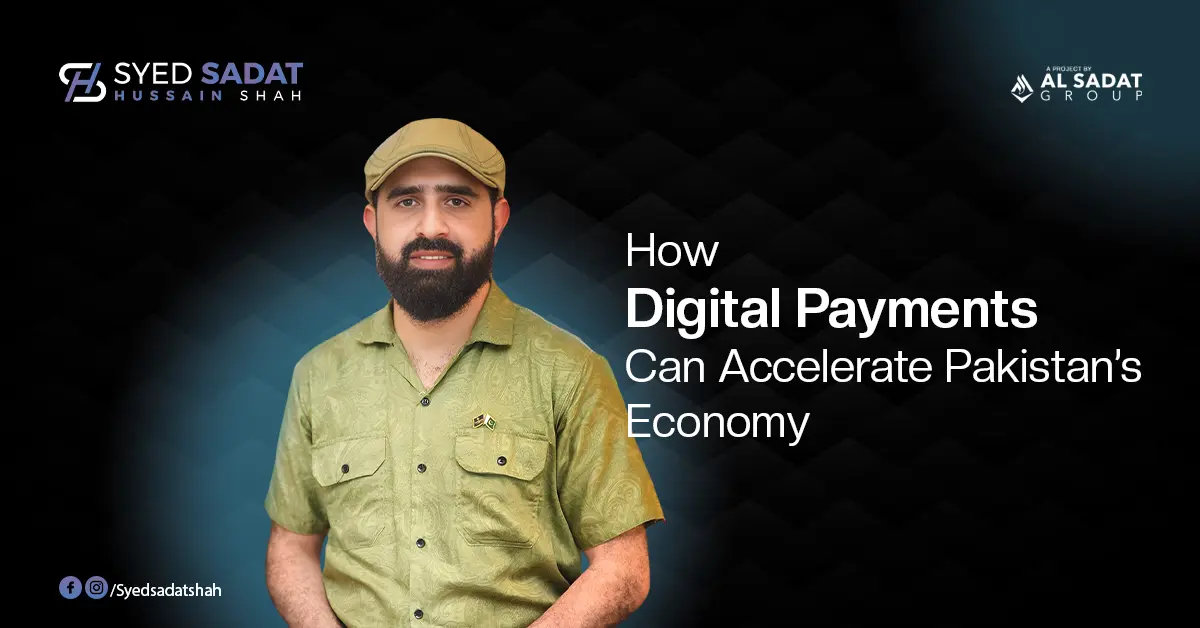
“Pakistan stands at a pivotal crossroads. The choices we make today about our financial infrastructure will shape the economic lives of 240 million people for decades to come. Digital payments are not a distant ambition — they are the most immediate lever we have to drive real, measurable growth.“
Pakistan’s Digital Financial Shift Is Already Underway
Not long ago, the idea of a farmer in rural Sindh receiving a payment through his mobile phone — without a bank account, without a branch in his village — would have sounded like wishful thinking. Today, it happens every day.
Pakistan’s financial ecosystem is rapidly evolving. From JazzCash and Easypaisa handling millions of transactions monthly, to the State Bank of Pakistan’s Raast instant payment system, to a growing wave of fintech startups redefining how ordinary Pakistanis interact with money — the foundations of a digital economy are being laid right now.
But we are still far from where we need to be. Only about 21% of Pakistani adults have a formal bank account. Cash still accounts for the overwhelming majority of transactions. The informal economy remains enormous. And the gap between urban and rural financial access is wide.
The question is no longer whether Pakistan should embrace digital payments. The question is how fast we can move — and what it will take to get there.
Digital transformation is not a technology project. It is an economic strategy — and Pakistan needs to treat it as one.
What Are Digital Payments, and Why Do They Matter?
At the most basic level, digital payments are any transaction that happens electronically — without physical cash changing hands. This covers a wide range of tools and systems:
- Mobile wallets like JazzCash, Easypaisa, and SadaPay
- Online banking and fund transfers
- Debit and credit card payments at point of sale
- Instant bank-to-bank transfers through platforms like Raast
- QR code payments at shops, restaurants, and markets
- International remittance channels and digital forex services
What makes digital payments matter — especially for a country like Pakistan — is not the technology itself. It’s what the technology enables. Every digital transaction leaves a traceable record. It reduces the cost of doing business. It brings people into a system where they can save, borrow, and invest. And it lets the government deliver services, subsidies, and payments directly to citizens without leakage.
Also Read: How Women Entrepreneurs Are Reshaping Pakistan’s Business Future
From a policy perspective, that last point alone is worth billions of rupees every year in recovered efficiency.
What Digital Payments Actually Do for Pakistan’s Economy
They bring people into the formal economy
Pakistan’s informal economy is estimated to be between 35 and 50 percent of GDP. That is an enormous pool of economic activity happening entirely outside the tax net, outside credit systems, and outside regulatory oversight. When people adopt digital payments — even just for everyday transactions — they begin building financial identities. That opens the door to formal credit, savings products, and insurance.
This is not abstract. Mobile wallets and digital payment adoption in Pakistan has already brought millions of previously unbanked citizens into some form of financial services. These are people who never qualified for a bank account but could register for a mobile wallet with just their CNIC.
They reduce the cost and friction of doing business
For small businesses — the cart vendors, the tailors, the small shopkeepers who make up the backbone of Pakistan’s retail economy — handling cash has real costs. There’s the risk of theft, the time lost counting and depositing money, the difficulty of getting paid quickly by customers who owe them. Digital payments remove much of that friction.
For larger businesses, the impact is even more significant. Faster payments mean better cash flow. Better cash flow means more investment. And more investment means more jobs.
They increase tax revenues without raising tax rates
This is one of the most politically underappreciated benefits of how digital payments boost economic growth in Pakistan. When transactions are digital, they’re visible. And when they’re visible, they can be taxed.
Countries that have significantly expanded their digital payment infrastructure — India, Kenya, Bangladesh — have all reported measurable increases in tax compliance and revenue collection as a direct result. Pakistan’s tax-to-GDP ratio remains one of the lowest in the region. Expanding digital payments is one of the most effective tools available to change that — without imposing new burdens on compliant taxpayers.
They make government spending more efficient
The BISP Benazir Income Support Programme has already demonstrated what’s possible. When social protection payments shifted to digital disbursement, leakage dropped dramatically and beneficiaries received their money faster and more reliably. The same principle applies across every area of government spending — salaries, pensions, subsidies, procurement.
Economic modernization through digital payments in Pakistan is not just a private-sector story. The government itself is one of the biggest players in this space, and how it handles its own transactions sets the tone for the rest of the economy.
They connect Pakistan to global commerce
Pakistan has over nine million freelancers. It has a large and growing e-commerce sector. It receives over 27 billion dollars in annual remittances. All of these flows depend on efficient, low-cost digital payment infrastructure. When that infrastructure is weak or expensive, Pakistan leaves money on the table — literally. Improving it is a direct economic gain.
The Role of Fintech and Mobile Banking in This Transformation
Pakistan’s fintech sector has grown quickly over the past several years, and it deserves real credit for pushing the boundaries of what financial access looks like in this country.
Companies like Easypaisa and JazzCash were early movers, building mobile payment systems that reached deep into markets where traditional banks never went. Newer entrants like SadaPay, Nayapay, and Meezan Bank’s digital offerings are raising the standard for user experience and service design. The competition is good. It drives innovation and brings costs down.
Fintech growth in Pakistan’s digital transformation is not just about payments, either. It’s about credit scoring using alternative data, micro-insurance products, digital savings accounts, and business lending tools that reach SMEs which traditional banks have historically ignored.
The role of digital banking in Pakistan’s economy is increasingly that of a bridge — connecting people, businesses, and capital in ways that older financial infrastructure simply could not manage.
But fintech alone cannot do this. It needs enabling conditions: regulatory clarity, interoperability between systems, consumer protection frameworks, and an educated user base that trusts digital tools. Creating those conditions is where policy leadership matters.
The Challenges We Cannot Afford to Ignore
Being serious about digital payments means being honest about the obstacles. There are real ones, and glossing over them doesn’t help anyone.
Digital literacy and trust
A large portion of Pakistan’s population — particularly in rural areas, among older citizens, and among women — does not use digital financial tools. Sometimes this is because of access, but often it’s because of distrust or unfamiliarity. People have been burned by fraud, confused by interfaces, or simply never shown how these tools work. Building confidence in digital systems takes sustained effort and time.
Connectivity gaps
Digital payments require connectivity. Large parts of Pakistan — particularly in Balochistan, interior Sindh, and parts of KPK — still have unreliable mobile internet. You cannot build a cashless economy Pakistan benefits from if the infrastructure doesn’t reach the people who need it most.
Cybersecurity and fraud
As digital payments expand, so does the surface area for fraud and cybercrime. Pakistan needs robust consumer protection frameworks, strong authentication standards, and financial institutions that take liability seriously when customers are defrauded. Without this, adoption stalls — and rightly so.
Interoperability between systems
One of the persistent frustrations in Pakistan’s digital payment landscape is fragmentation. Different systems don’t always talk to each other smoothly. Raast has made progress on this, but there’s more work to do before a truly seamless national payment network is in place.
The informal economy’s resistance to change
Many businesses prefer cash — not because digital tools are inconvenient, but because cash is untraceable. Transitioning these players requires both incentives and, eventually, enforcement. That’s a delicate balance that requires thoughtful policy design, not blunt mandates.
What Government and Policy Must Do
From a policy perspective, the government’s role in this space is not to compete with the private sector — it’s to create the conditions in which the private sector can succeed and in which citizens are protected.
Several things are already moving in the right direction. The State Bank of Pakistan’s National Payment Systems Strategy has been a genuine step forward. Raast, the instant payment infrastructure, is among the most significant financial infrastructure investments in Pakistan’s recent history. The Digital Pakistan initiative, however uneven in execution, has elevated the importance of connectivity and digital access as national priorities.
But more is needed:
- A coherent national financial inclusion strategy that targets the unbanked with specific, measurable goals
- Tax incentives for businesses that accept and process digital payments
- Mandatory interoperability standards that prevent monopolistic fragmentation of payment systems
- Consumer protection regulation with real teeth — including liability rules that protect users from fraud
- Investment in rural connectivity as foundational infrastructure, not an afterthought
- Digital literacy programs integrated into school curricula and community outreach
Pakistan also needs to take its remittance corridor seriously. Over 27 billion dollars flows into Pakistan every year from the diaspora. Much of it still moves through expensive, opaque channels. Reducing the cost of sending money to Pakistan — and channeling more of it through regulated digital systems — would have an immediate and measurable economic impact.
What a Cashless Pakistan Could Actually Look Like
‘Cashless economy’ is sometimes used as a slogan. It’s worth being concrete about what it actually means for Pakistan — and realistic about the timeline.
A fully cashless Pakistan is not the goal in the near term, nor should it be. Cash serves real purposes, especially for populations with limited digital access. The near-term goal should be a digitally inclusive economy — one where digital payments are available to everyone who wants them, affordable, trusted, and interoperable.
In practical terms, the future of a cashless Pakistan economy looks something like this: a farmer in Punjab receives her crop payment directly into a mobile account. A small business owner in Karachi pays his suppliers digitally and files his taxes automatically from the same transaction data. A day laborer in Lahore receives her daily wage at 5pm and can pay her utility bill from the same phone before she gets home. A student in Quetta pays her university fees online and receives her scholarship disbursement the same way.
None of this is futuristic. All of it is technically achievable today. What’s needed is the will to build the systems, create the trust, and bring the policies into alignment.
Pakistan has shown it can move fast when the priorities are right. The question is whether digital financial infrastructure will be treated as a priority — not just in speeches, but in budgets, regulations, and long-term planning.
The countries that lead in the next economy will not be the ones with the most cash in circulation. They will be the ones that built the most trusted, accessible digital infrastructure for their people.
Frequently Asked Questions
How do digital payments help Pakistan’s economy?
Digital payments bring informal economic activity into traceable, taxable systems. They reduce transaction costs for businesses, expand access to credit and savings for individuals, improve efficiency in government spending, and connect Pakistan’s economy more effectively to global commerce. The digital payments impact on Pakistan’s economy is both direct and structural.
Why is Pakistan moving towards a cashless economy?
Several factors are driving this shift: government policy priorities around financial inclusion and tax compliance, the growth of mobile networks and smartphone penetration, a young tech-aware population, and the demonstrated success of platforms like JazzCash, Easypaisa, and Raast. The cashless economy Pakistan benefits from include lower transaction costs, greater fiscal transparency, and faster economic participation.
What are the benefits of mobile wallets in Pakistan?
Mobile wallets like JazzCash and Easypaisa give people without bank accounts access to basic financial services — sending and receiving money, paying bills, and making purchases. For rural users and low-income households, they’re often the only formal financial tool available. Mobile wallets and digital payment adoption in Pakistan has already reached tens of millions of users.
Can digital banking improve financial inclusion in Pakistan?
Yes, significantly. Digital banking reduces the cost and logistical barriers of serving customers in remote or low-income areas. It allows financial institutions to offer products — savings accounts, micro-loans, insurance — to populations they couldn’t serve profitably through branch networks. The role of digital banking in Pakistan’s economy is increasingly central to any serious financial inclusion strategy.
What are the main challenges in Pakistan’s shift to digital payments?
The main challenges are digital literacy and trust, connectivity gaps in rural areas, cybersecurity and fraud risks, fragmentation between payment systems, and the informal economy’s reluctance to move away from cash. Addressing these requires both policy action and sustained investment over time.
What is Raast and why does it matter?
Raast is Pakistan’s national instant payment system, launched by the State Bank of Pakistan. It allows real-time, low-cost transfers between bank accounts and wallets. It’s one of the most important pieces of financial infrastructure Pakistan has built in recent years — the foundation on which a more interoperable and inclusive payment system can be built.
A Final Word
Pakistan does not lack ambition. It does not lack talent. It does not lack the technology. What it has historically lacked is consistent follow-through on the policy and infrastructure decisions that would bring its potential to life.
Digital payments are one of those rare opportunities where the economic case, the social case, and the governance case all point in the same direction. The tools are available. The demand is there. The global evidence is clear.
What Pakistan needs now is leadership that treats digital financial infrastructure as a national priority — not a side project, not a tech ministry talking point, but a core commitment backed by budgets, legislation, and long-term vision.
The economies that will lead the next generation are being built right now. Pakistan can be among them. But only if we act with the urgency this moment deserves.