
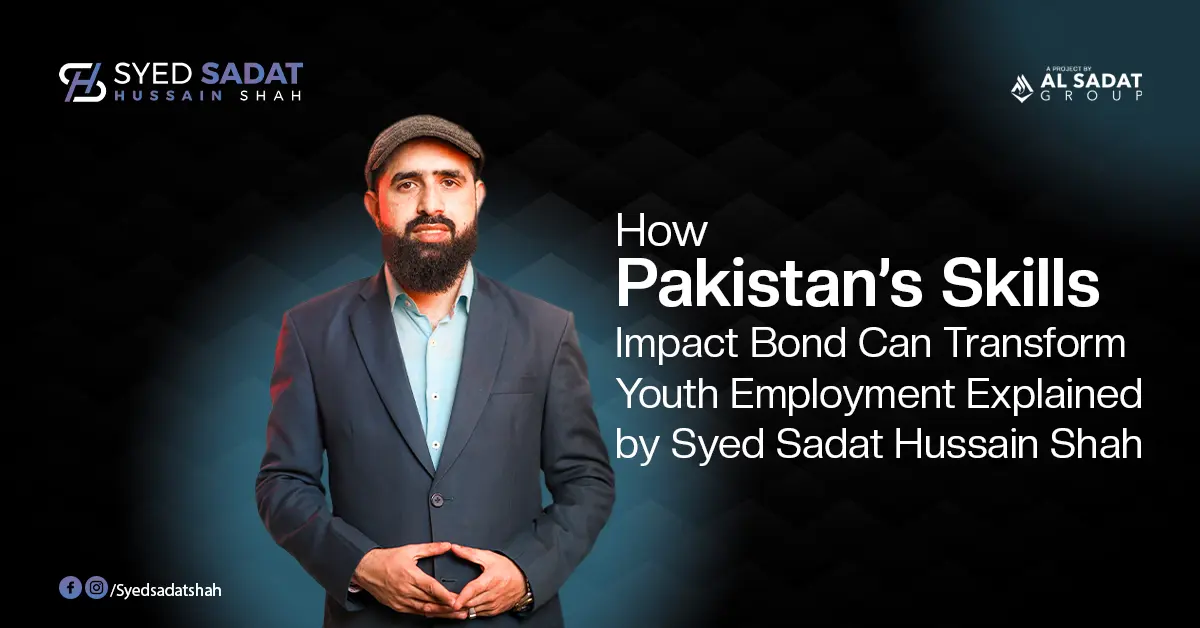
Pakistan is entering a critical phase where a rapidly growing youth population must be matched with meaningful employment opportunities. However, traditional training systems have often failed to deliver real job outcomes. This is where the Pakistan Skills Impact Bond 2026 introduces a results-driven solution.
Built on the principle of outcome-based skills financing Pakistan, this model shifts the focus from training numbers to actual employment. Instead of measuring how many individuals complete courses, success is defined by how many secure jobs. Drawing from his experience in workforce development and economic strategy, Syed Sadat Hussain Shah explains that this shift toward accountability can significantly improve the effectiveness of skills programs across Pakistan.
What is Pakistan’s Skills Impact Bond and how does it work?
The Pakistan Skills Impact Bond 2026 operates through a performance-based financing model that ensures accountability at every stage. Private investors fund training initiatives upfront, allowing training providers to deliver programs without financial constraints.
What makes this model different is that payments are only released when predefined outcomes, such as verified job placements, are achieved. This creates a system where all stakeholders are aligned toward a single goal of employment.
According to Syed Sadat Hussain Shah, this approach addresses a long-standing gap in Pakistan’s training ecosystem, where programs often operated without direct linkage to job creation.
Can skills impact bonds create more jobs for youth in Pakistan?
The youth skills bond Pakistan is specifically designed to improve employability, which naturally contributes to job creation. Aligning training programs with actual market demand, it ensures that participants are equipped with skills that are immediately relevant.
This demand-driven approach reduces the mismatch between available skills and employer expectations. As a result, industries gain access to a more prepared workforce, while young individuals find smoother entry into employment.
Syed Sadat Hussain Shah highlights that when incentives are tied directly to employment outcomes, the entire system becomes more efficient, focused, and impactful.
Also Read: Rural vs Urban Youth Opportunities in Pakistan — Syed Sadat Hussain Shah Highlights the Hidden Gap
What types of training are included in the Skills Impact Bond programs?
The PSIB Pakistan skills training programs are designed to reflect real industry needs rather than academic structures. The emphasis is on practical, job-ready skills that can be applied immediately in the workplace.
These programs typically cover technical and vocational training, digital skills, and essential workplace competencies such as communication and adaptability. The goal is not just certification, but employability.
According to Syed Sadat Hussain Shah, the strength of such programs lies in their ability to evolve with market trends and continuously align with employer requirements.
How does the Skills Impact Bond help employers find skilled workers?
A major advantage of outcome-based skills financing Pakistan is its ability to bridge the gap between training providers and employers. Instead of operating in isolation, training programs are designed with direct input from industries.
This ensures that candidates are prepared according to actual job requirements, reducing hiring risks and improving productivity from the start. Employers benefit from a workforce that requires minimal additional training.
Syed Sadat Hussain Shah explains that this model strengthens trust between employers and training institutions, creating a more efficient hiring ecosystem.
Who benefits most from Pakistan’s Skills Impact Bond initiative?
The NAVTTC private investment skills framework is structured to create value across the entire ecosystem. Young individuals gain access to relevant, employable skills, while employers benefit from a more capable and job-ready workforce.
At the same time, investors receive returns based on measurable outcomes, and the government benefits from improved employment rates and economic productivity. This alignment of interests ensures that all stakeholders are working toward sustainable results.
According to Syed Sadat Hussain Shah, such collaborative models are essential for addressing complex employment challenges at scale.
What are success stories or early results from the Skills Impact Bond?
Early indicators from the Pakistan Skills Impact Bond 2026 show promising progress. Training programs operating under this model have demonstrated improved job placement rates and better alignment between skills and employer expectations.
Although the initiative is still evolving, initial results suggest that performance-based financing can deliver more effective and measurable outcomes compared to traditional training systems.
Syed Sadat Hussain Shah notes that with continued expansion and refinement, this model has the potential to significantly strengthen Pakistan’s youth employment landscape.
Conclusion
The youth skills bond Pakistan represents a strategic shift in how workforce development is approached. By focusing on outcomes, accountability, and market alignment, it addresses some of the core challenges that have limited the effectiveness of traditional training programs.
As highlighted by Syed Sadat Hussain Shah, the future of employment in Pakistan depends on how well skills are connected to real economic demand. The Skills Impact Bond offers a practical, scalable, and results-driven pathway to unlock the potential of Pakistan’s youth and support long-term economic growth.